Artwork
狗児図|A Pair of Puppies
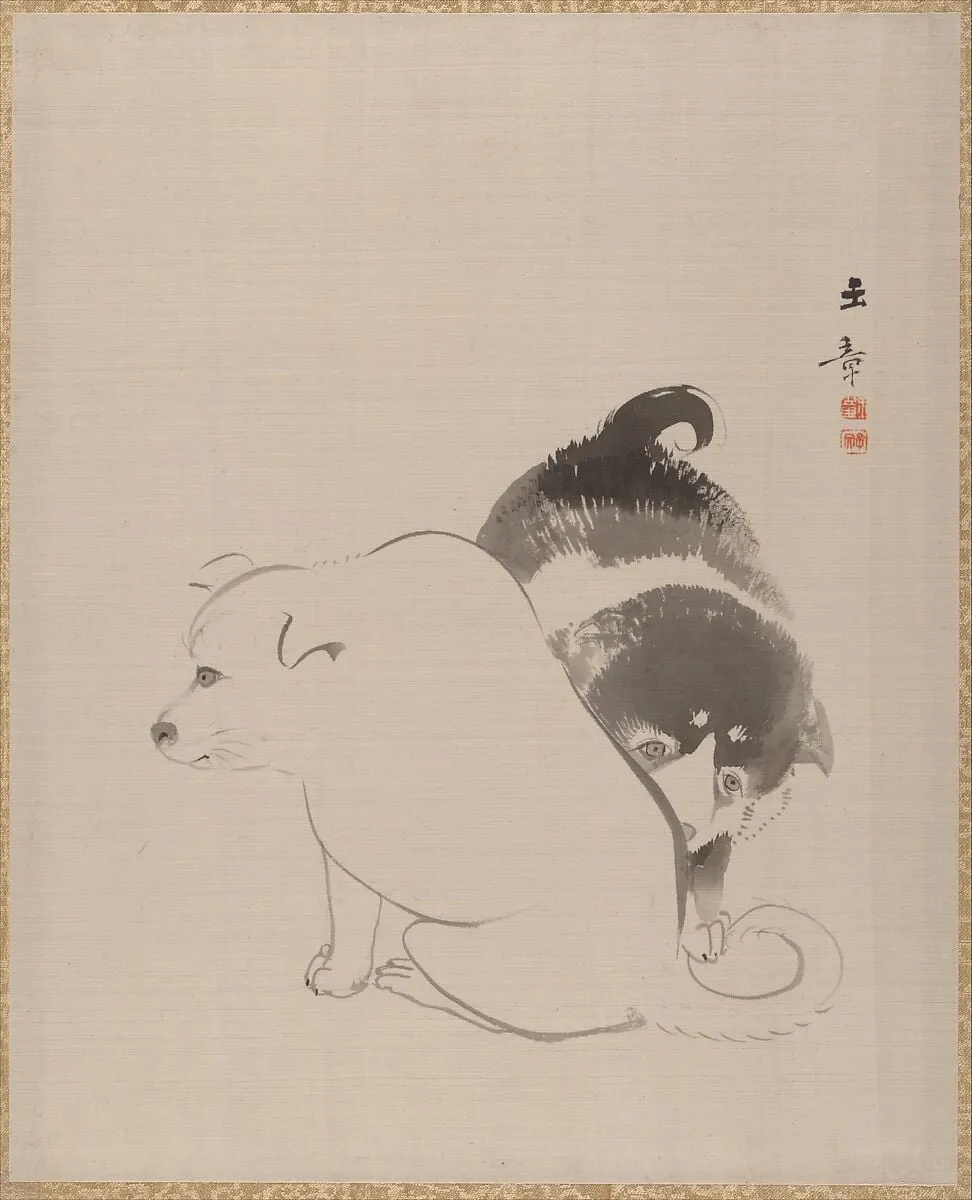
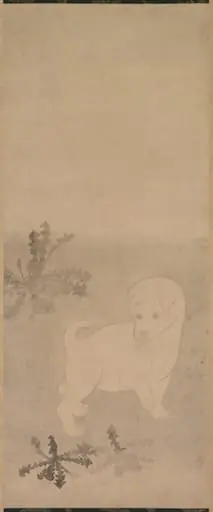
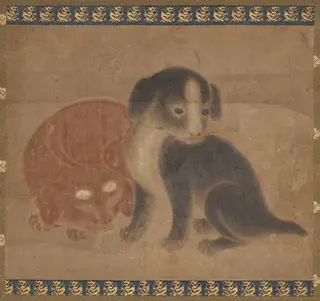
狗児図|A Pair of Puppies is an ink painting by the Impressionist artist Kawabata Gyokushō. It dates from 1890 and is held in the collection of the Metropolitan Museum of Art.
About this work
Subject & Meaning
Puppies in East Asian art often carry associations with domesticity, fertility, and playful innocence, though no explicit symbolism is recorded for this work.
The painting depicts a pair of puppies resting on a patterned textile, rendered in ink on silk with delicate, naturalistic detail. The subject belongs to the still-life genre within Japanese painting, focusing on animal life rather than narrative or landscape. Puppies in East Asian art often carry associations with domesticity, fertility, and playful innocence, though no explicit symbolism is recorded for this work.
The choice of dogs as a subject reflects a broader tradition in Japanese art of observing and elevating everyday creatures to the status of refined artistic motifs.
Technique & Style
The work is executed as an album leaf using ink on silk, a pairing typical of Japanese painting formats that allows intimate presentation of small subjects. The handling is refined, with delicate ink washes modulating from deep blacks to subtle gradations to convey the puppies’ fur and forms. Stylistically, the composition favors naturalism within a minimal setting, focusing attention on the animals through uncluttered space and economical contour lines that define posture and movement.
The medium’s luminous silk support heightens the contrast between the dark ink and the pale ground, enhancing the tactile suggestion of fur and the soft fall of light across the figures.
History & Provenance
The album leaf titled A Pair of Puppies was created in 1868 by Kawabata Gyokushō, as indicated by the work’s date of inception and the artist’s signature on the piece. The painting is rendered in ink on silk and depicts two puppies, aligning with the still-life genre and the artist’s known focus on animal subjects.
By the time of its cataloguing, the work entered the collection of the Metropolitan Museum of Art, where it is currently held. The museum’s records confirm the painting’s dimensions as 34.3 cm in height and 27.6 cm in width, and its Japanese origin is noted.
The artwork titled A Pair of Puppies (狗児図) is held in the collection of the Metropolitan Museum of Art. Created by Kawabata Gyokushō in 1868, the piece is an album leaf executed in ink on silk. While the source identifies the holding institution and the work's physical dimensions, it does not provide a specific inventory or accession number for the painting. Additionally, the available records do not document any exhibition history for this specific work.
Legacy
The painting A Pair of Puppies (1868) by Kawabata Gyokushō entered the collection of the Metropolitan Museum of Art, where its depiction of domestic dogs has been cited in studies of Meiji‑era animal imagery. As one of the few surviving album‑leaf works that combine ink technique with silk support, it illustrates the period’s fascination with everyday subjects and has influenced later Japanese artists who explored similar themes of domestic life. The work’s inclusion in a major Western museum has contributed to renewed scholarly attention to Kawabata’s role in bridging traditional Japanese painting and modern visual culture.
Overview
Created around 1890, this album leaf by Kawabata Gyokushō presents a pair of small dogs rendered in ink on silk. The composition is confined to a single sheet, the background left blank, allowing the two figures to dominate the visual field. The work belongs to the genre of Japanese ink paintings that were often compiled in portable albums for private viewing.
Context
The painting dates to a period when Japan was increasingly exposed to Western artistic ideas following the Meiji Restoration. Though executed in a traditional medium, the work reflects a broader interest in realistic animal depiction and the incorporation of new visual sensibilities that were circulating among Japanese artists of the era.
Artist & collection