Artwork
Cycle Race
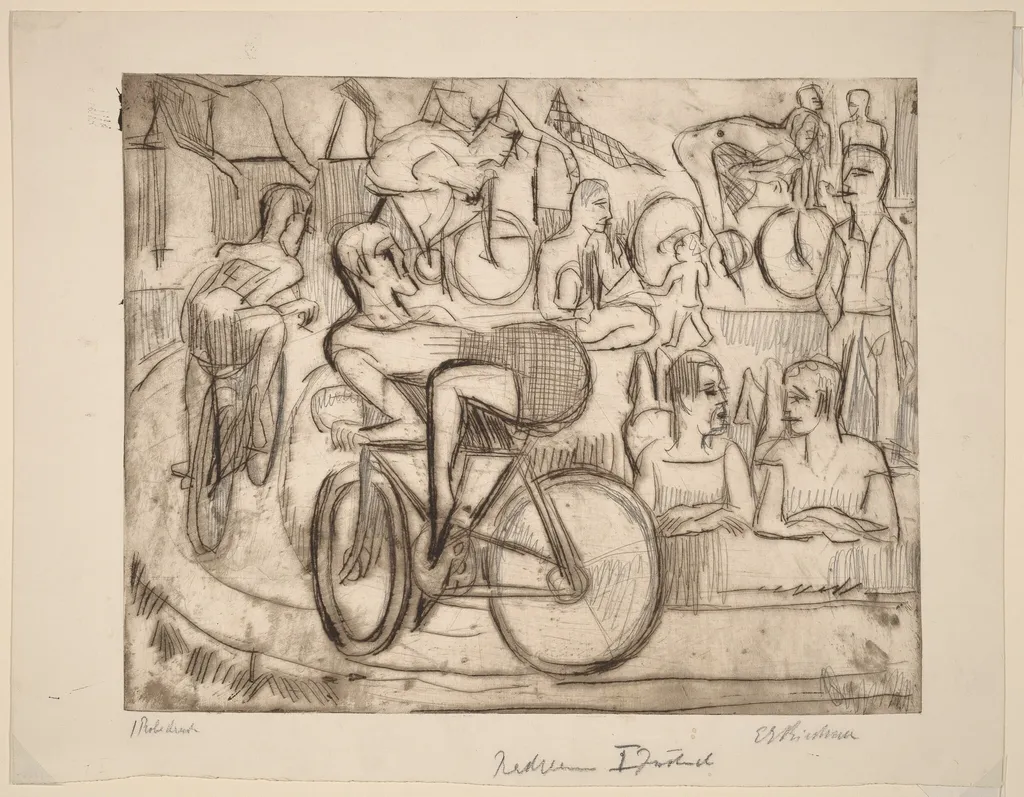
Cycle Race is a graphite print by Ernst Ludwig Kirchner. It dates from 1926 and is held in the collection of the National Gallery of Art.
- Inscription
- Inscribed:lower left in graphite: Probedruck; lower right in graphite: EL Kirchner; bottom center in graphite: Radieren I Zustand; lower left verso by later hand in graphite: I = Sch 517 I K9075; lower right verso by later hand in black pencil: 8y32
About this work
Overview
Created in 1926, Cycle Race is a drypoint print by Ernst Ludwig Kirchner, rendered in brown-black ink with added graphite.
Created in 1926, Cycle Race is a drypoint print by Ernst Ludwig Kirchner, rendered in brown-black ink with added graphite. The work belongs to Kirchner’s post-war period, following his discharge after a mental health crisis during World War I. Unlike traditional prints, it retains the raw energy of a sketch, emphasizing movement and disarray over precision. Its unfinished appearance reflects Kirchner’s interest in capturing transient moments rather than idealized forms.
Subject & Meaning
The print depicts a chaotic bicycle race, with figures overlapping and dissolving into one another. Riders are fragmented, their limbs elongated or truncated by the frame’s edge, suggesting motion too rapid to be fully captured. The lack of clear boundaries between bodies conveys the frenetic pace of modern urban life, a recurring theme in Kirchner’s work. The scene resists narrative clarity, instead evoking the sensory overload of contemporary experience.
Technique & Style
Kirchner employed drypoint to scratch directly into the plate, creating dense, irregular lines that build shadow and texture. Graphite was added by hand to deepen tones and enhance contrast. The surface is deliberately rough, with overlapping strokes and uneven ink distribution.
This method rejects smooth finishes, favoring a tactile, almost violent mark-making that mirrors the agitation of the subject.
History & Provenance
Produced in 1926, during Kirchner’s time in Davos, Switzerland, the print emerged after years of isolation and recovery from wartime trauma. It reflects his continued engagement with urban themes despite his physical removal from city life. As part of his later graphic output, Cycle Race demonstrates his sustained commitment to printmaking, even as his style evolved toward more introspective forms.
Context
Kirchner was a founding member of Die Brücke, a group that sought to break from academic traditions and express emotional truth through bold forms. While earlier works focused on Berlin’s nightlife, this print captures a different kind of modernity, sport as spectacle, movement as chaos. The work aligns with broader interwar European interests in speed, mechanization, and the fragmentation of perception.
Legacy
Cycle Race exemplifies Kirchner’s late graphic style: unpolished, emotionally charged, and formally experimental. It influenced later artists interested in the expressive potential of printmaking beyond reproduction. The work’s emphasis on process over polish contributed to post-war reevaluations of print as a medium for personal, rather than commercial, expression.
Own this work as a print
Artist & collection
Artist
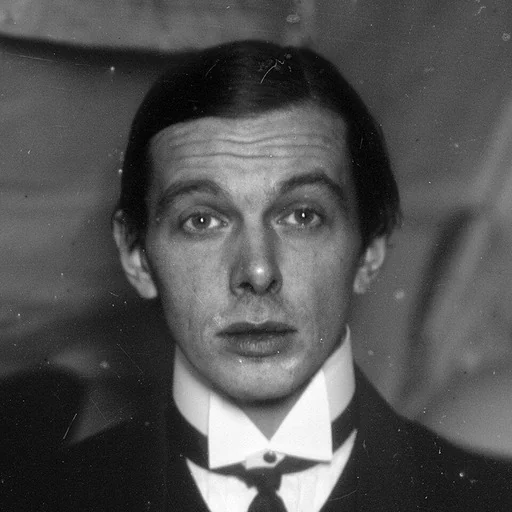
Ernst Ludwig Kirchner (6 May 1880 – 15 June 1938) was a German expressionist painter and printmaker.

![Dance Hall Bellevue [obverse], by Ernst Ludwig Kirchner](https://artifactworldgallery.com/img/ernst-ludwig-kirchner--dance-hall-bellevue-obverse--d1e14aac4297c69e-w320.webp)
![Nude Figure [reverse], by Ernst Ludwig Kirchner](https://artifactworldgallery.com/img/ernst-ludwig-kirchner--nude-figure-reverse--4b135f0364753e98-w320.webp)
![Two Nudes [obverse], by Ernst Ludwig Kirchner](https://artifactworldgallery.com/img/ernst-ludwig-kirchner--two-nudes-obverse--eb3914183f0bc96d-w320.webp)
![Dancing Couple in the Snow [reverse], by Ernst Ludwig Kirchner](https://artifactworldgallery.com/img/ernst-ludwig-kirchner--dancing-couple-in-the-snow-reverse--87ca007d7c05b553-w320.webp)