Artwork
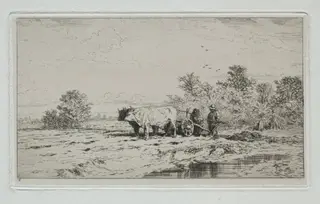
Team of Oxen in Harness
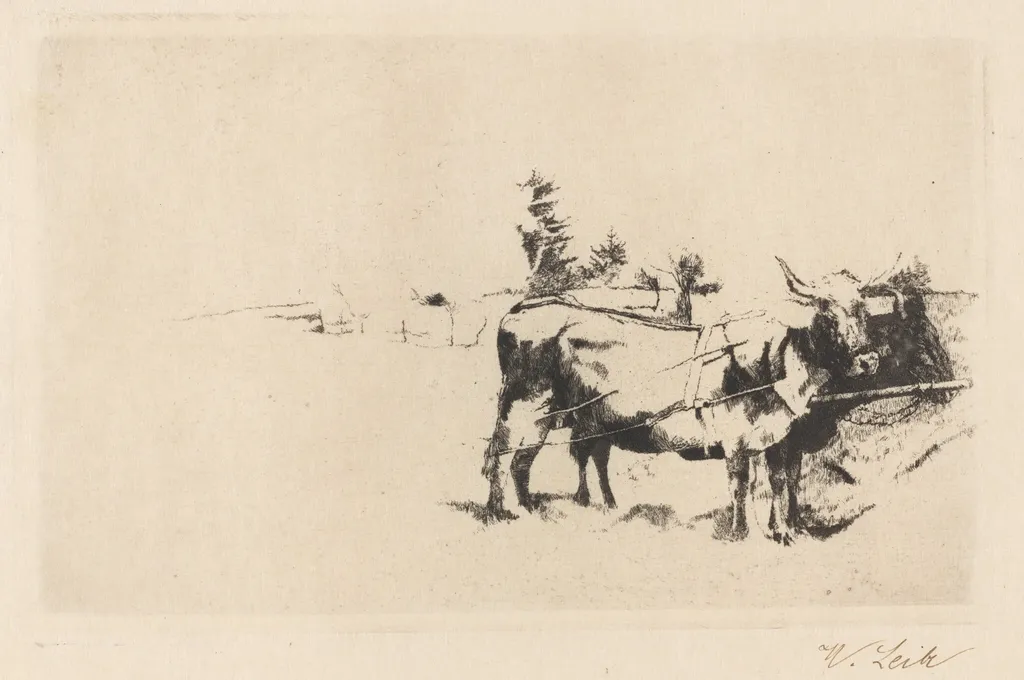
Team of Oxen in Harness is an ink print by the Impressionist artist Wilhelm Leibl. It dates from 1876 and is held in the collection of the National Gallery of Art.
- Inscription
- Inscribed:lower right in ink: W. Leibl; lower left verso in graphite: D404; lower left corner verso in graphite: 7150
About this work
Overview
Created between 1874 and 1880, with this specific etching dated to 1876, Wilhelm Leibl's 'Team of Oxen in Harness' captures a rural scene of agricultural labor.
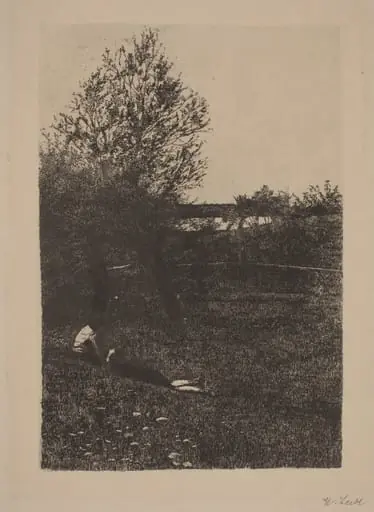
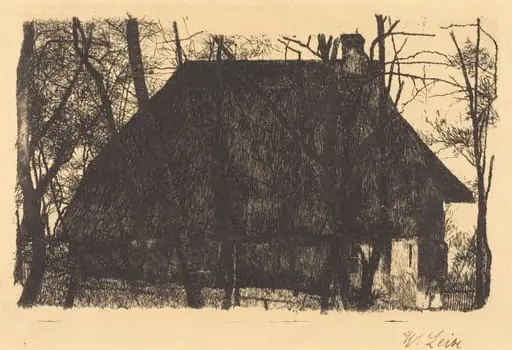
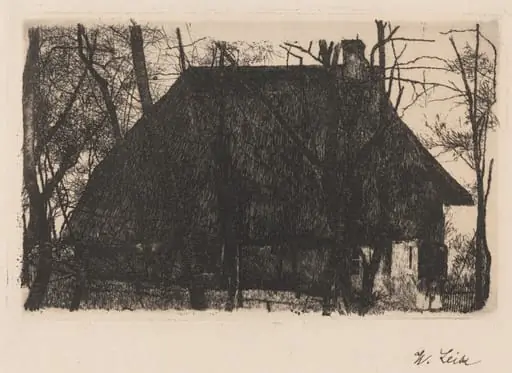
Created between 1874 and 1880, with this specific etching dated to 1876, Wilhelm Leibl's 'Team of Oxen in Harness' captures a rural scene of agricultural labor. The composition centers on two dark, solid oxen straining against their harnesses as they pull a rough wooden cart across a grassy, uneven field. Leibl employs quick, sketchy lines to render the texture of the animals' hides and the movement of the team, contrasting their heavy forms with the lighter, more atmospheric background where a few trees and a low fence define the horizon.
Executed in etching on wove paper, the work reflects Leibl's commitment to Realism and his focus on the dignity of peasant life, a theme central to his career during his time in the Bavarian countryside. Unlike his highly finished oil paintings, this print demonstrates his ability to convey volume and vitality through economical, direct mark-making, emphasizing the physical exertion of the animals within a sparse, natural setting.
Subject & Meaning
The image depicts a pair of oxen yoked to a simple wooden cart as they traverse a uneven, grassy field. The animals appear solid and muscular, their harnesses drawn tightly against their backs. A low fence and a few distant trees frame the horizon, suggesting a quiet, working landscape.
Technique & Style
Leibl employed the etching process, using quick, sketch‑like lines to convey the texture of the oxen’s fur and the irregular ground. The medium of wove paper provides a smooth surface that accentuates the fine, tonal variations achieved through varied line density and hatching.
History & Provenance
Created circa 1876, the print entered the National Gallery of Art’s holdings at an unspecified date, where it remains on view. Its acquisition reflects the museum’s interest in 19th‑century European printmaking and Leibl’s contribution to realist depictions of everyday labor.
Own this work as a print
Artist & collection