Artwork
Vase of flowers
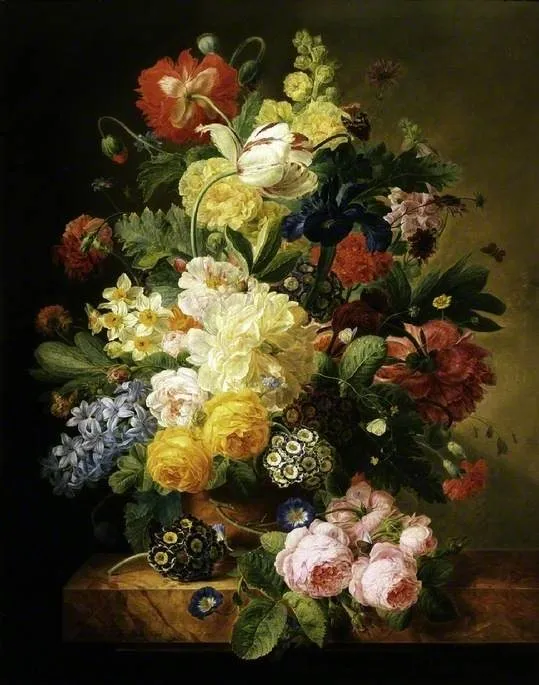
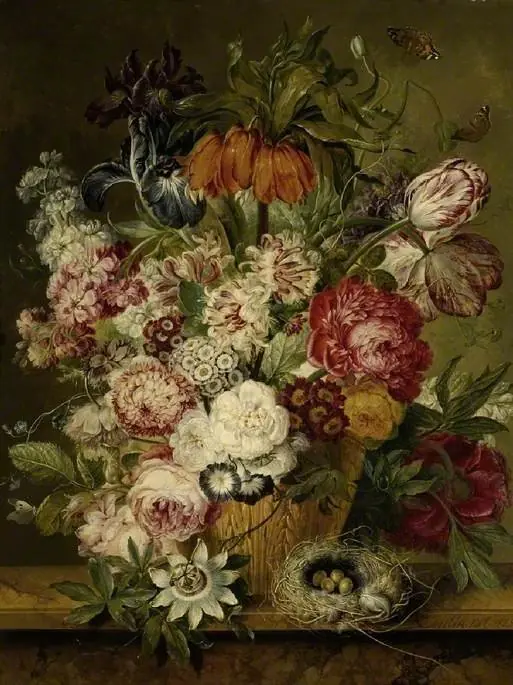
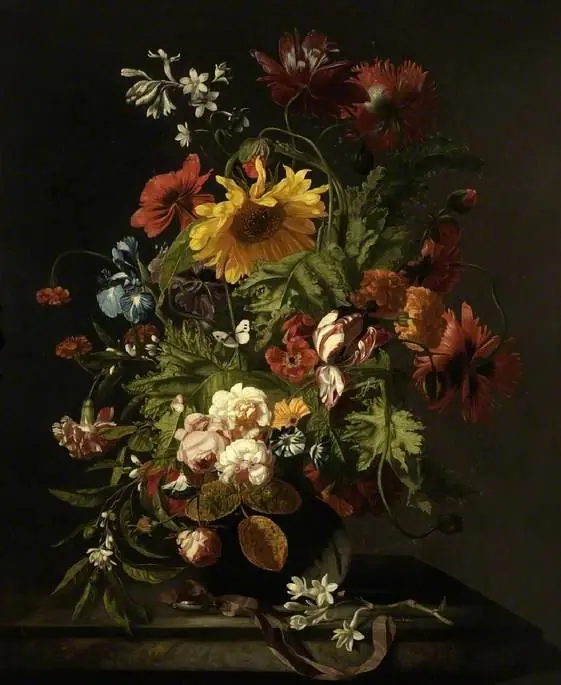
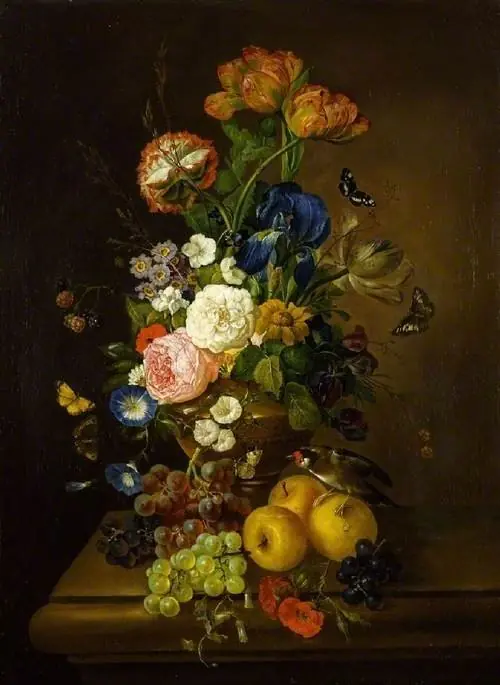
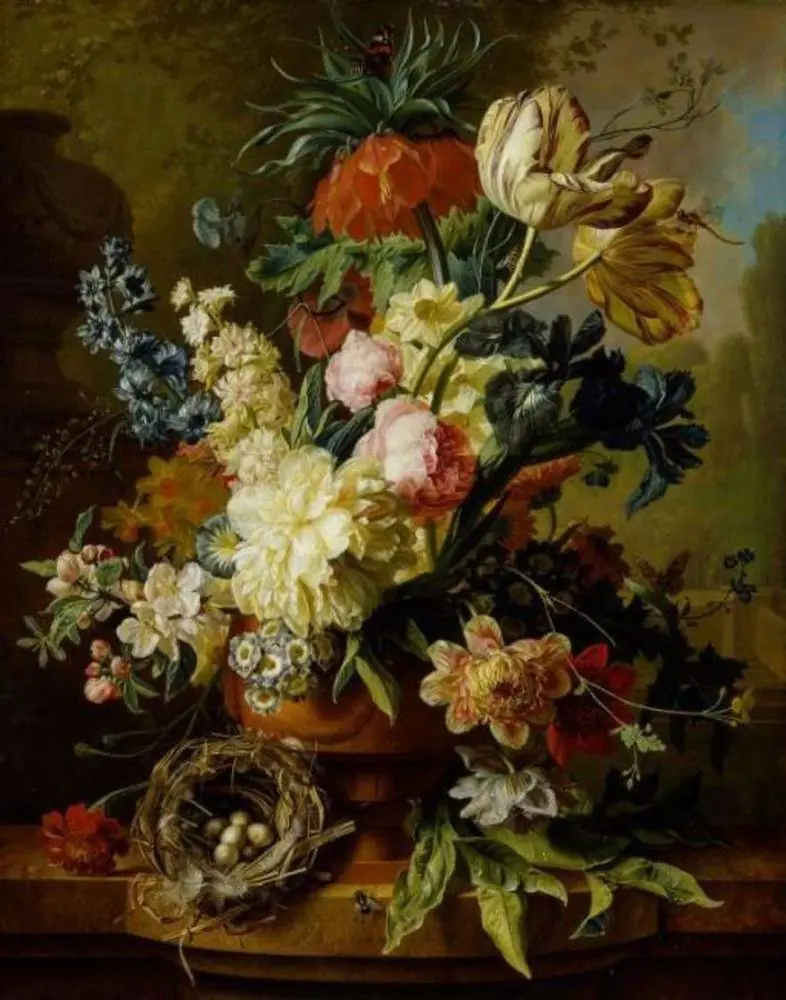
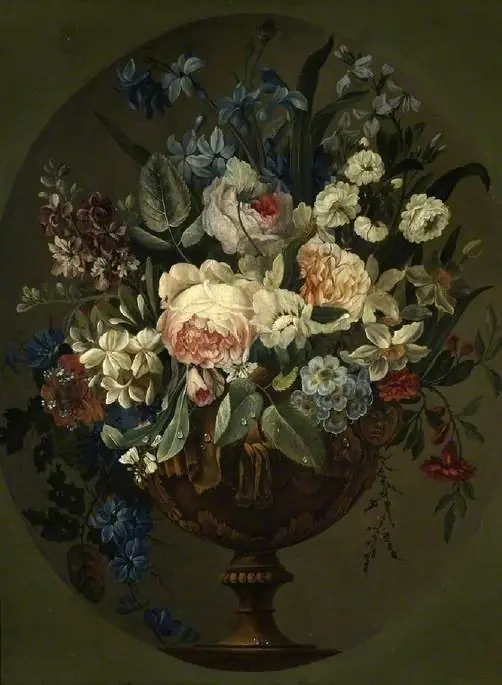
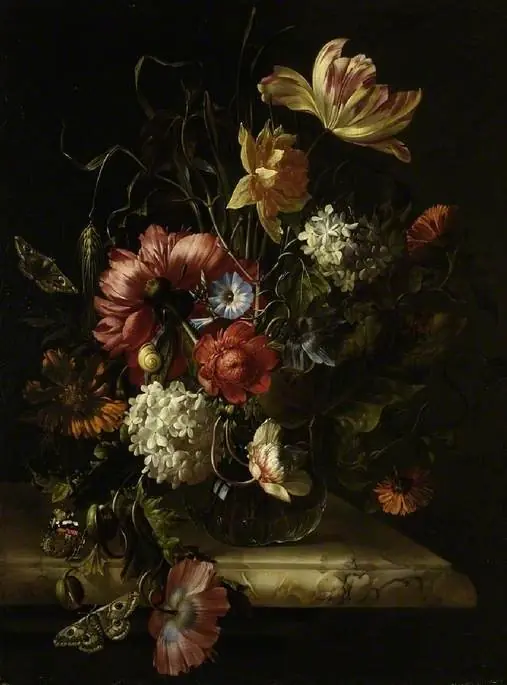
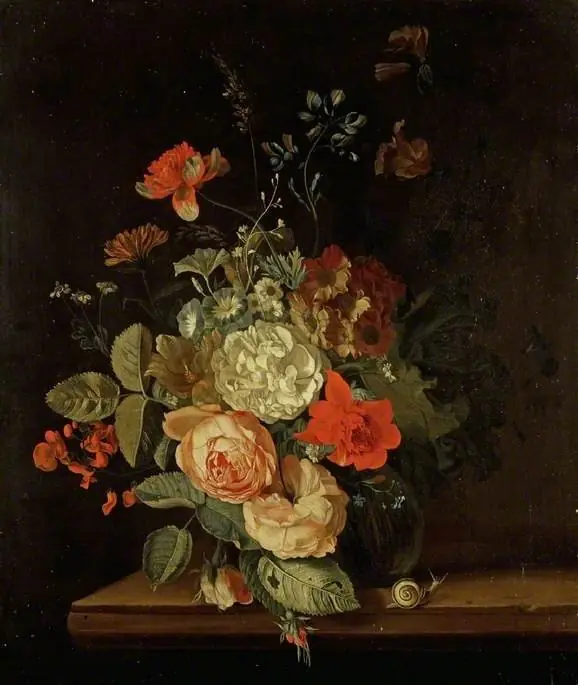
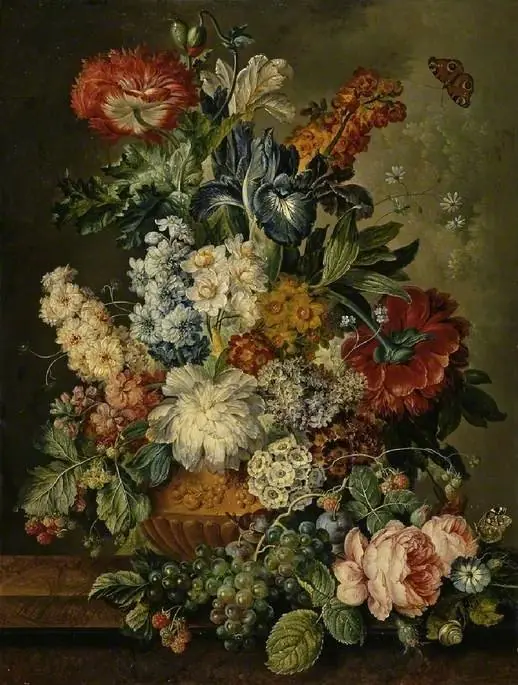
Vase of flowers is an oil painting by Mélanie de Comoléra. It dates from 1830 and is held in the collection of the Fitzwilliam Museum. Created in 1830, this oil painting presents a tall, transparent vase brimming with an assortment of blossoms.
About this work
Overview
The work exemplifies the intersection of botanical precision and aesthetic refinement that defined de Comoléra's career across France and England.
Vase of Flowers is an oil on canvas painting by the French floral specialist Mélanie de Comoléra, dated 1830. Measuring 89.5 by 71 cm, the work depicts a densely packed bouquet in a terracotta vase set upon a marble ledge, rendered with the smooth, highly finished brushwork characteristic of the artist's training. The painting is held in the collection of the Fitzwilliam Museum, Cambridge, where it entered in 1966 as a gift from Major the Hon. Henry Rogers Broughton. An inscription on the canvas identifies the artist as "Melanie de Colomer / Peintre de S.M. Britannique," marking her status as painter to the British royal household. The work exemplifies the intersection of botanical precision and aesthetic refinement that defined de Comoléra's career across France and England.
Subject & Meaning
The painting presents a sumptuous floral still life arranged in a terracotta vase resting on a marble ledge. The bouquet comprises roses in pink, yellow, and white, a red poppy, white and yellow tulips, blue hyacinths, a dark iris, and numerous smaller blooms in purple, white, and orange, with green leaves and stems weaving throughout the composition. Several blossoms droop over the vase's edge, while a few petals and a small blue flower rest on the ledge below, introducing a subtle note of transience. The dark, muted background shifts from deep brown on the left to olive green on the right, creating a dramatic contrast that throws the saturated colors of the flowers into relief. Light enters from above, illuminating the central blooms and casting soft shadows beneath the leaves. This combination of meticulous botanical observation with symbolic undertones of vanitas, suggested by the fallen petals, aligns the work with the long tradition of Dutch and Flemish flower painting that de Comoléra's teacher Cornelis van Spaendonck perpetuated in France.
Technique & Style
The painting is executed in oil on canvas, a medium that allowed de Comoléra to achieve the smooth, highly finished surface for which she was renowned. The brushwork demonstrates careful attention to petal textures and dewy surfaces, with each flower rendered in precise detail while maintaining overall compositional harmony. The artist's handling of light reveals her technical sophistication: illumination from above models the three-dimensional forms of the bouquet and creates subtle shadows beneath the leaves, enhancing the sense of naturalistic depth. The rich, saturated palette, set against the dark ground, reflects the influence of her master Cornelis van Spaendonck, from whom she inherited both precision and pigment vivacity. The marble ledge, with its nuanced veining, and the terracotta vase demonstrate her skill in rendering varied textures, from porous earthenware to polished stone. This refined technique, combining scientific botanical accuracy with painterly elegance, positioned de Comoléra within the highest ranks of European flower painters of her generation.
History & Provenance
The painting is dated 1830, a pivotal year in de Comoléra's biography that coincided with the July Revolution in France and her subsequent establishment in England as flower painter to Adelaide, Duchess of Clarence, who became queen consort upon her husband's accession as William IV. The work bears the accession number PD.20-1966 at the Fitzwilliam Museum, having entered the collection through the gift of Major the Hon. Henry Rogers Broughton in 1966. The inscription identifying de Comoléra as "Peintre de S.M. Britannique" confirms its creation during or after her appointment to the British royal household. While specific exhibition history for this canvas is not recorded in the available sources, de Comoléra exhibited regularly at the Salon in Paris and with the Royal Society of British Artists in London during this period. The painting's provenance before the 1966 gift remains to be fully documented, though its preservation in museum collections suggests recognition of its artistic merit.
Context
Mélanie de Comoléra (1789-1854) emerged from a significant moment in European art history when women increasingly pursued professional careers as painters. Born Marie Guillaume Comolera in Paris, she trained with both Gérard and Cornelis van Spaendonck, the latter a former director of the Manufacture nationale de Sèvres who recruited her to paint flowers on porcelain from 1816 to 1818. The creation of the statut d'artiste libre in 1777 had opened professional opportunities for women, and de Comoléra exemplified this trend, transforming the floral painting that had served as genteel education for marriageable girls into a serious vocation. Her 1827 move to London, where she copied a Jan van Huysum painting at the home of Thomas Hope in Cavendish Square, initiated her English career. The 1830 date of Vase of Flowers places it at the threshold of her royal appointment, when she succeeded in securing patronage from the highest level of British society. Critical reception of her work was consistently positive in both Paris and London, with her art gaining recognition in botanical and horticultural circles. Her participation in the 1838 Exposition publique des produits de l'horticulture at the Orangerie du Louvre, where she showed oil paintings alongside painted ostrich eggs, demonstrated the interdisciplinary esteem in which her work was held.
Legacy
Vase of Flowers stands as a significant testament to de Comoléra's achievement in a genre and profession where women gained hard gendered access. The painting's preservation in the Fitzwilliam Museum ensures its continued availability for scholarly study and public appreciation, contributing to the ongoing recovery of women artists whose careers were obscured by historical neglect. De Comoléra's later life, marked by poverty and residence in charitable institutions despite her royal connections, illustrates the precariousness of artistic careers for women even after professional success. Her death in 1854 at the Society of Friends of Foreigners In Distress, and the posthumous account by Thomas Archer in The Quiver (1874), which found her living in reduced circumstances surrounded by unsold canvases, has shaped subsequent understanding of her biography. The painting's afterlife in museum collections, however, testifies to enduring artistic value independent of the artist's personal fortune. As scholarship on women artists and on the tradition of floral painting continues to expand, Vase of Flowers offers concrete evidence of the technical accomplishment and professional standing that de Comoléra attained at the height of her career in 1830.
Artist & collection
Artist
Mélanie de Comoléra (1789 – 1854) was a French flower painter. She learned to paint from Cornelis van Spaendonck and is best known for her works on porcelain, painted for her employer, the Manufacture nationale de…