Artwork
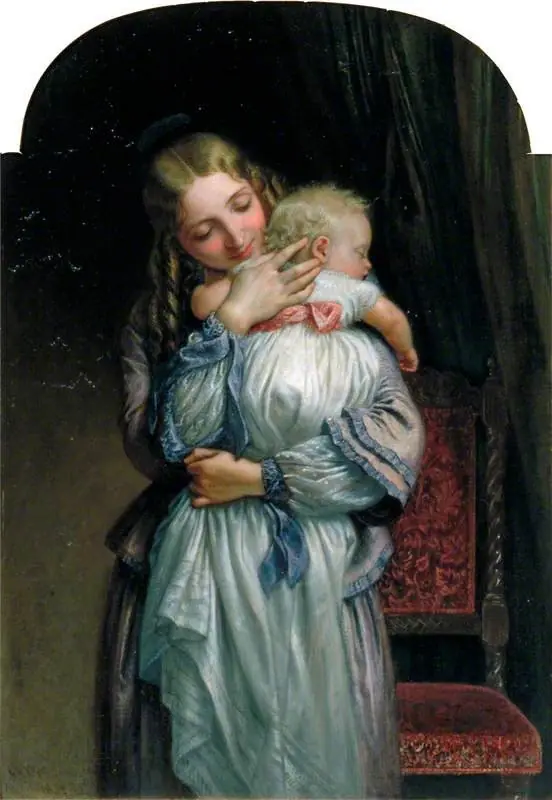
Mother and Child 1894
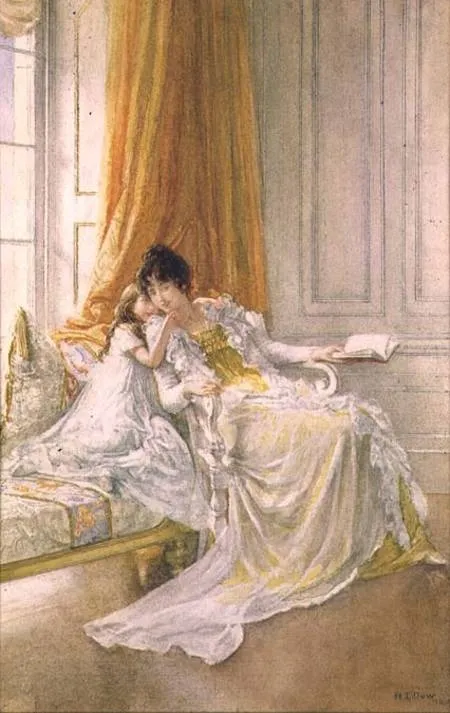
Mother and Child 1894 is an oil painting by the Impressionist artist Mary L. Gow. It dates from 1898 and is held in the collection of the Victoria and Albert Museum. Mother and Child is an oil painting created in 1898 by Mary L.
About this work
Overview
Mother and Child is an oil painting by the British artist Mary L.
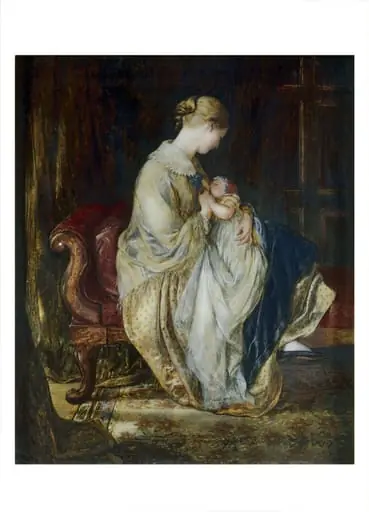
Mother and Child is an oil painting by the British artist Mary L. Gow, created in 1894. The work is a portrait depicting a reclining woman with a small child, executed in a delicate, light-filled manner characteristic of Gow's approach to figure painting. Now held in the collection of the Victoria and Albert Museum in London, the painting represents a significant example of late nineteenth-century British portraiture by a woman artist who achieved professional recognition during a period when female painters faced considerable barriers to exhibition and institutional acceptance.
Subject & Meaning
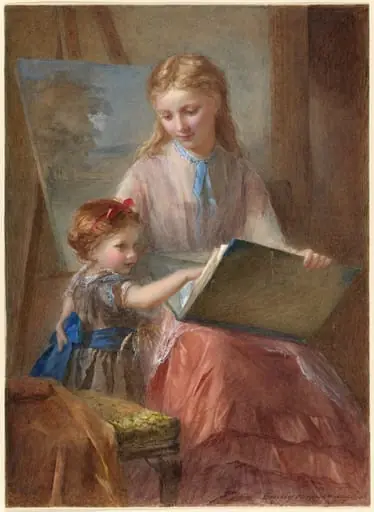
The painting presents an intimate domestic scene: a woman reclines on an ornate chaise longue while a small child leans against her, one hand touching the woman's face in a gesture of affectionate connection. The woman holds an open book in her left hand, suggesting literacy, leisure, and maternal education. She wears a flowing white gown with yellow accents; the child wears a white dress. Behind them, golden drapery falls beside a tall window with visible panes, and the wall shows paneled molding. The iconography of mother and child carries long art-historical resonance, yet here it is rendered without overt religious symbolism, instead emphasizing the psychological bond and everyday tenderness of family life. The open book may signal the intellectual and nurturing role of the mother, a theme that aligned with Victorian and Edwardian ideals of educated motherhood.
History & Provenance
The painting is dated 1894, a year that falls within Gow's mature period, after she had already established her exhibition record at the Royal Academy, the Royal Society of British Artists, and the New Gallery in London. The work is now in the collection of the Victoria and Albert Museum, though the precise circumstances of its acquisition and earlier ownership chain are not specified in the available sources. The painting was reproduced in Women Painters of the World, a publication that helped disseminate images of women's artistic achievement to a broader audience. No exhibition history beyond this publication is recorded in the sources.
Context
Mary L. Gow (1851-1929) was the daughter of James Gow, a painter of genre and historical subjects, and the sister of Andrew Carrick Gow (1848-1920), a respected historical and portrait painter. She studied at Heatherley's School and became a member of the Royal Institute of Painters in Water Colours in 1875, though she worked in oils as well. She exhibited widely, sending works to the Royal Academy from 1873 and showing eighteen works at the Royal Society of British Artists between 1869 and 1880. In 1893, she exhibited at the Palace of Fine Arts at the World's Columbian Exposition in Chicago, a significant platform for international exposure. Her painting Marie-Antoinette was purchased under the Chantrey Bequest in 1908, a notable institutional recognition. In 1907 she married the genre painter Sydney Prior Hall (1842-1922). Mother and Child exemplifies her focus on figures and genre subjects, particularly young girls and domestic scenes, within which she achieved critical and commercial success.
Legacy
Gow's reputation has been partially sustained by her inclusion in publications such as Women Painters of the World, which positioned her within an international community of female artists. The Victoria and Albert Museum's acquisition of Mother and Child ensures its preservation and public accessibility, though scholarly attention to her work remains limited compared to that devoted to her male contemporaries. Her career illustrates both the possibilities and constraints for women artists in late Victorian Britain: she achieved professional membership, international exhibition, and institutional purchase, yet her subject matter remained largely confined to the domestic and feminine spheres deemed appropriate for women painters. The painting continues to serve as a document of women's artistic practice and of the aesthetic values, particularly the emphasis on refinement, delicacy, and atmospheric effect, that characterized much British figure painting of the 1890s.
Artist & collection