Artwork
Artixan (Artisan)
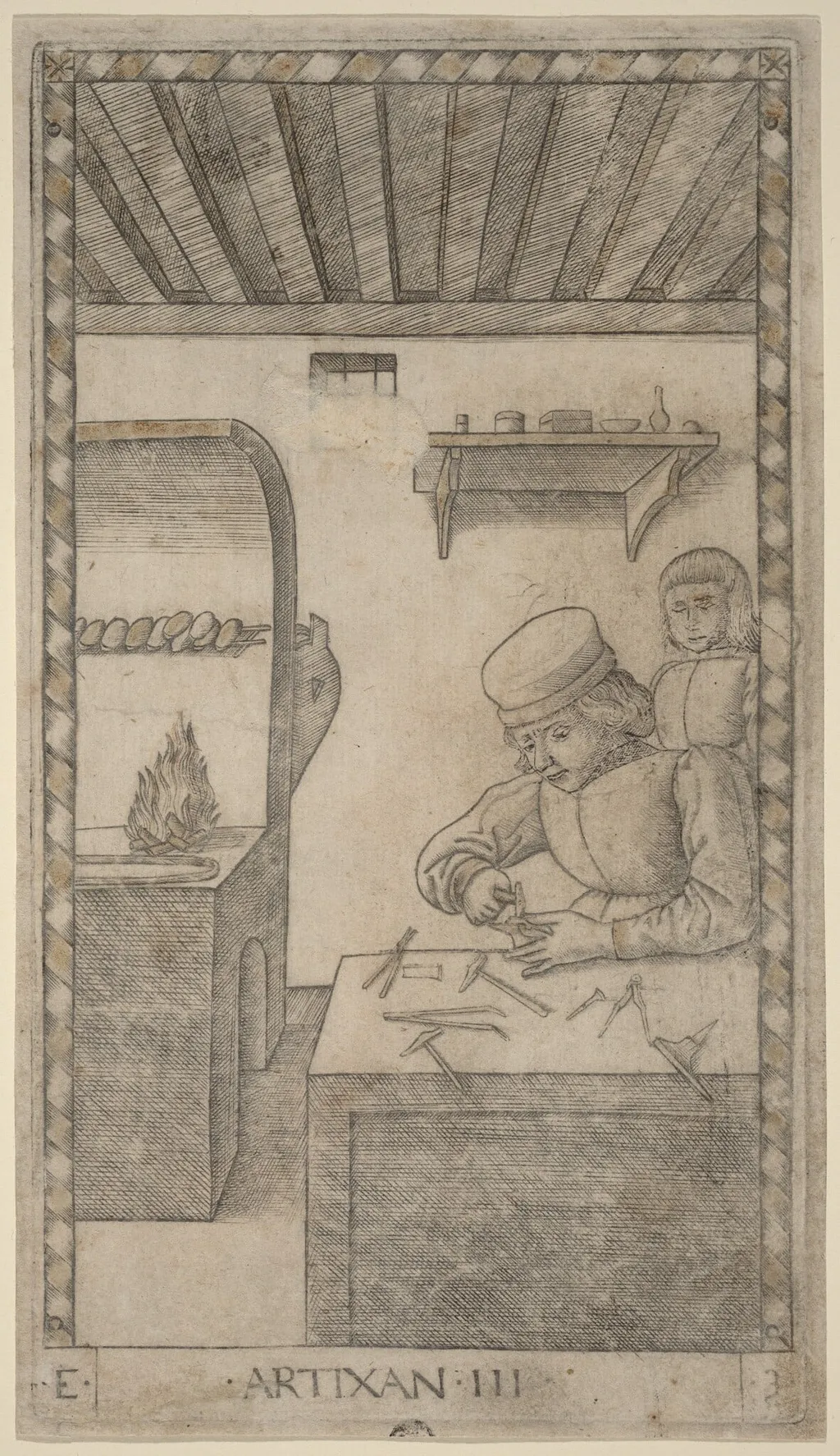
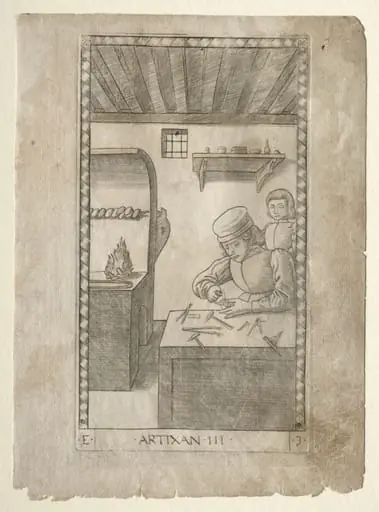
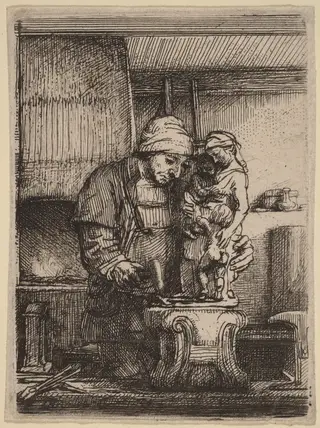
Artixan (Artisan) is an ink print by the Renaissance artist Master of the E-Series Tarocchi. It dates from 1465 and is held in the collection of the National Gallery of Art.
About this work
Overview
Created around 1465, this engraving with gilding is attributed to the Master of the E-Series Tarocchi, an anonymous artist active in northern Italy.
Created around 1465, this engraving with gilding is attributed to the Master of the E-Series Tarocchi, an anonymous artist active in northern Italy. The work is part of a small group of prints that depict laborers in domestic or workshop settings. Unlike many contemporary prints focused on religious or mythological themes, this piece centers on the quiet intensity of skilled craftsmanship, rendered with precision and subtle metallic accents.
Subject & Meaning
The scene portrays two figures engaged in metalworking: one seated at a worktable, shaping tools under focused light, while another stands nearby near a small forge. The title 'Artixan', an archaic term for artisan, emphasizes the dignity of manual labor. The cramped interior, bare walls, and functional objects suggest a working-class environment, elevating the artisan’s trade as worthy of visual record rather than mere background detail.
Technique & Style
The artist employed fine, controlled engraving lines to model form and suggest texture, particularly in the metal tools and the glow of the forge. Gilding was applied selectively to highlight metallic surfaces, enhancing the illusion of light reflecting off polished steel. The shallow space and compressed perspective reflect early engraving conventions, where depth was suggested through overlapping forms rather than linear perspective.
History & Provenance
The print belongs to a series of engravings known as the E-Series Tarocchi, likely produced in the Veneto region. Its survival is rare, as many early engravings were printed in small, fragile editions. No definitive ownership record exists before the 19th century, but its stylistic ties to other workshop scenes suggest it was made for a local audience familiar with artisanal trades, not for elite collectors.
Context
In mid-15th-century Italy, the rise of urban guilds elevated the status of craftsmen, yet few artworks depicted their daily labor. This engraving stands apart from religious or aristocratic imagery of the period, offering a rare glimpse into the material culture of skilled labor. Its production coincides with the early spread of printmaking, allowing images of ordinary life to circulate beyond manuscript illumination.
Legacy
Though the artist’s identity remains unknown, this work influenced later Northern European prints that celebrated craftsmanship, such as those by Dürer. Its focus on the artisan as a subject of quiet dignity helped shift artistic attention toward everyday labor. As one of the earliest known depictions of a metalworker’s workshop in print form, it remains a significant document of pre-modern vocational culture.
Artist & collection
Artist
Master of the E-Series Tarocchi
Master of the E-Series Tarocchi (b. 1400) was an Italian artist.

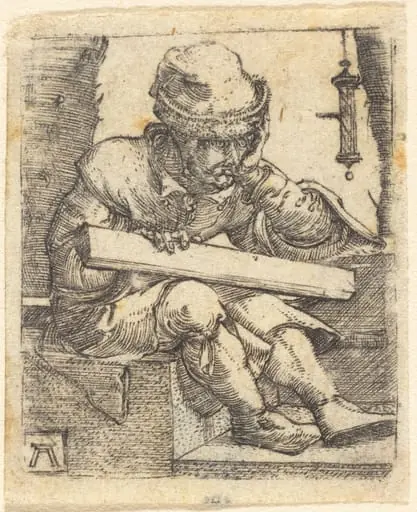 The Pensive Carpenter
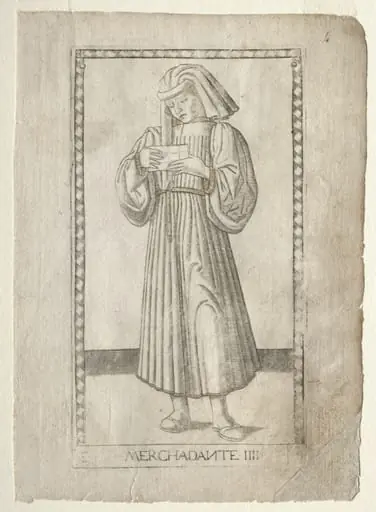 The Merchant (from the Tarocchi, series E: Conditions of Man, #4)
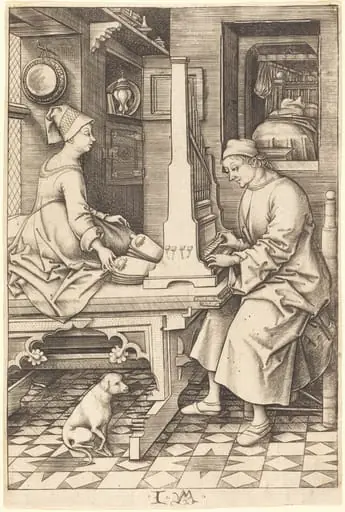 The Organ Player and His Wife
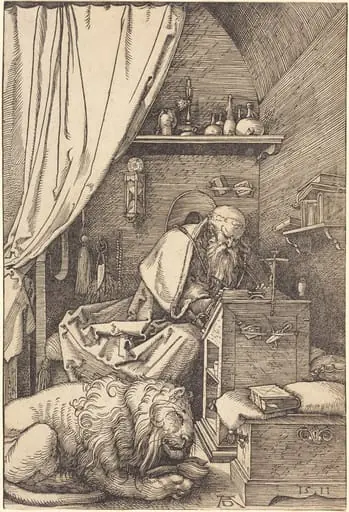 Saint Jerome in His Cell
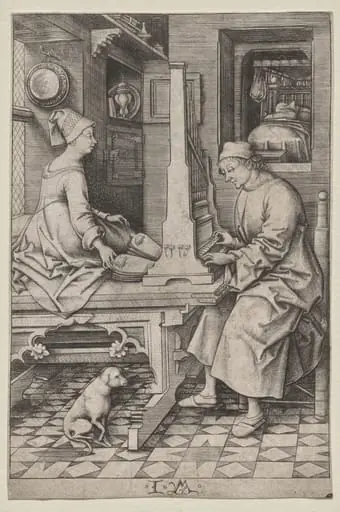 The Organ Player and His Wife
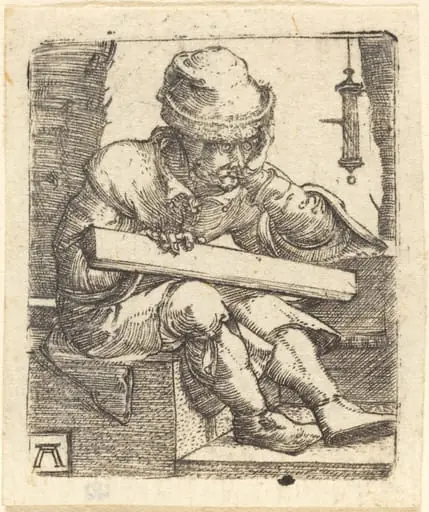 The Pensive Carpenter
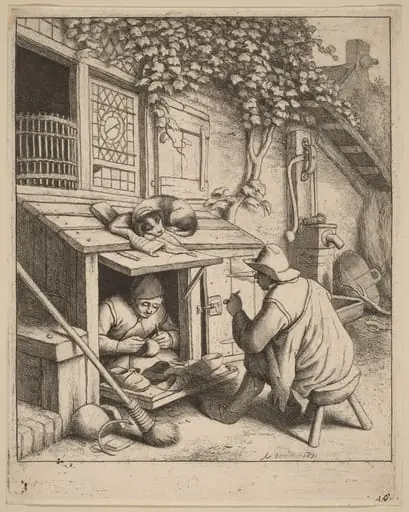 Smoker on a Stool Conversing with a Cobbler at Work
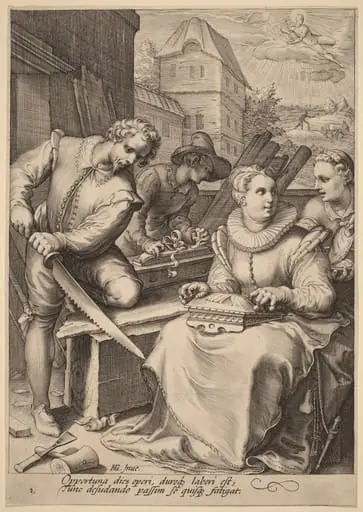 Midday
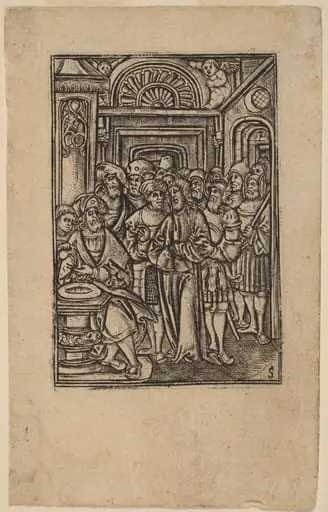 Pilate Washing His Hands
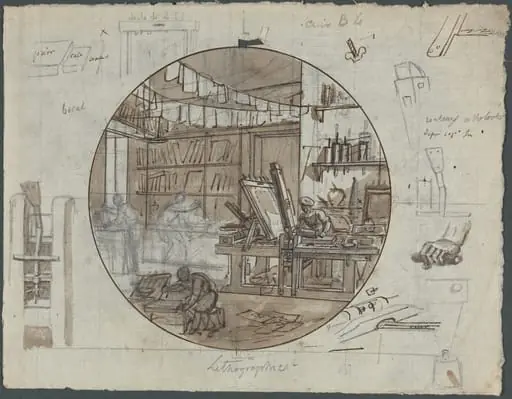 Lithographic Workshop
 The Goldsmith
- The Artisan (from the Tarocchi, series E: Conditions of Man, #3)