Artwork
The Pyramid of Cestius, Rome
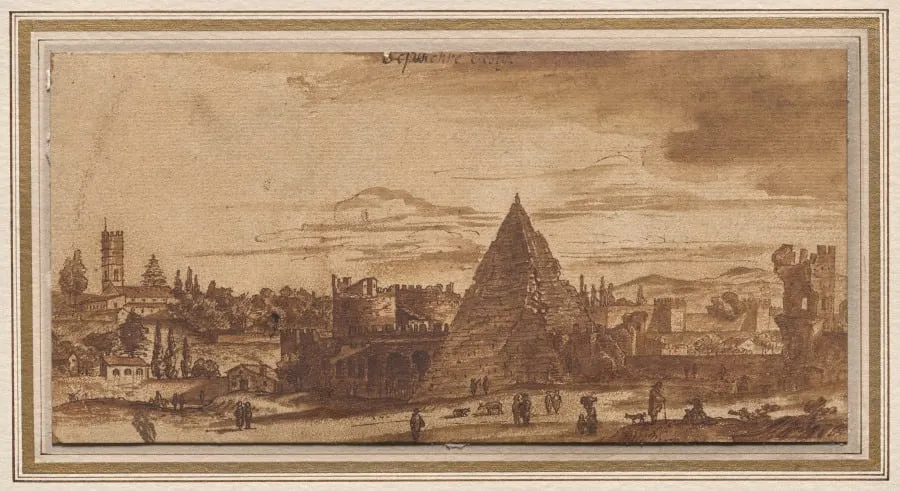
The Pyramid of Cestius, Rome is a drawing by the Baroque artist Michiel van Overbeek. It dates from 1665 and is held in the collection of the Cleveland Museum of Art.
- Accession no.
- 2021.144
About this work
Overview
The Egyptian structure in the Roman countryside attracted many tourists, and artists, for its singularity within the Roman architectural landscape.
The Dutch artist Michiel Van Overbeek drew The Pyramid of Cestius, Rome from southwest of the site, looking toward the 12 BC Pyramid of Cestius, and the 3rd- to 4th-century Porta Ostiensis (Porta Santo Paulo). The Egyptian structure in the Roman countryside attracted many tourists, and artists, for its singularity within the Roman architectural landscape. The careful attention given to the rise of the land at left, with small abodes tucked into the hills, and the crumbling ruin at the right, suggest that Van Overbeek wanted to record the scene as accurately as possible.
Did you know?
The Pyramid of Cestius was constructed in Rome as a tomb in 12 BC during a fad for Egyptian things just a few years after Rome had conquered Cleopatra’s Egypt (30 BC).
Artist & collection

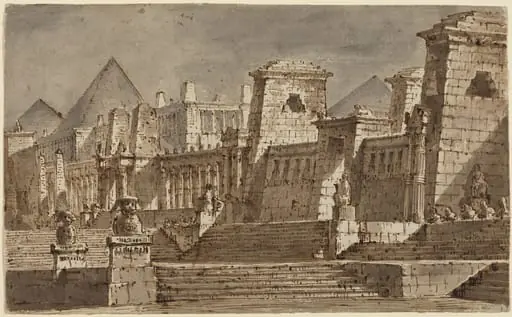 An Egyptian Stage Design
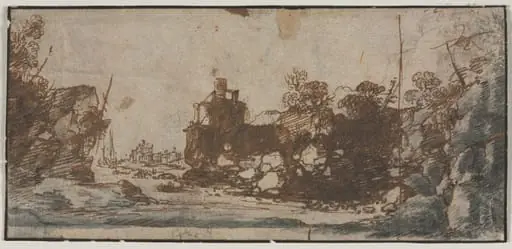 Rocky Inlet with Boats and Buildings (recto)
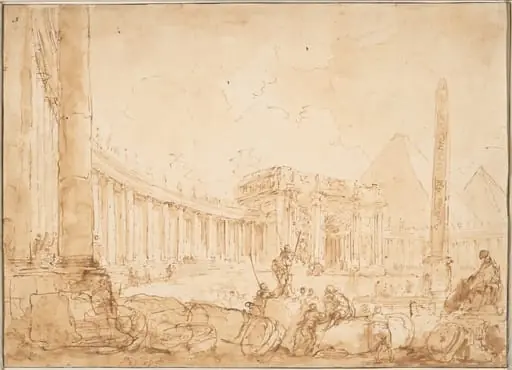 A Roman Capriccio
 Sketches of Castles (verso)
 River Landscape with Boats
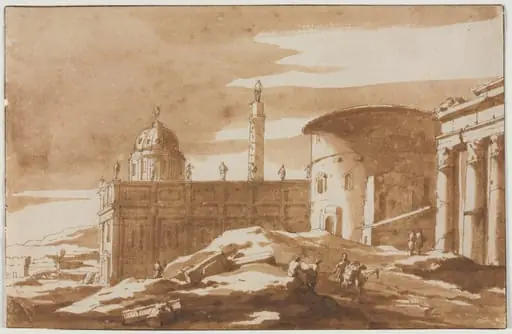 View of Ancient Buildings
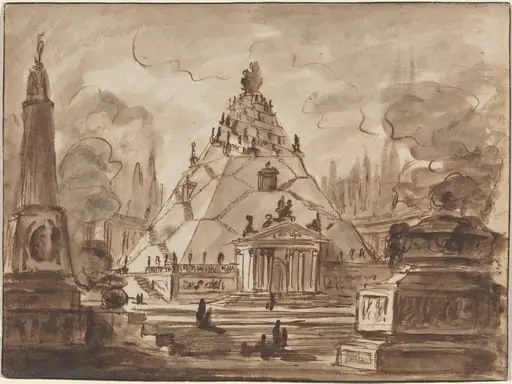 Architectural Fantasy with a Pyramidal Mausoleum
 Egyptian Stage Design
 Roman Rooftops
 River Landscape with View of St. Peter's Basilica
 Heroic Landscape
 Pyramids and Sphinx - Sun setting