Artwork
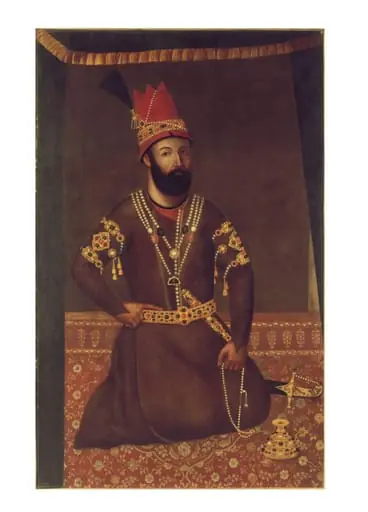
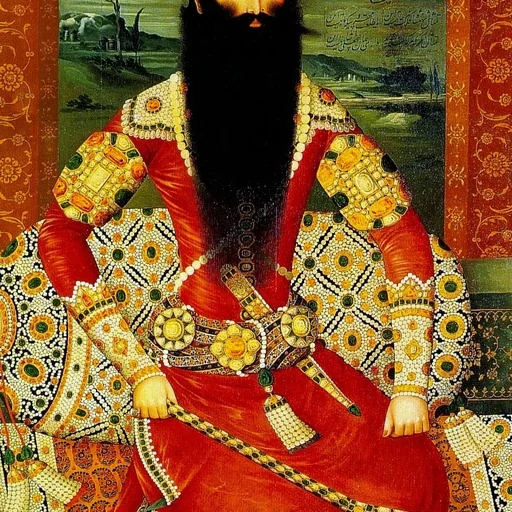
Portrait of Fath Ali Shah Seated
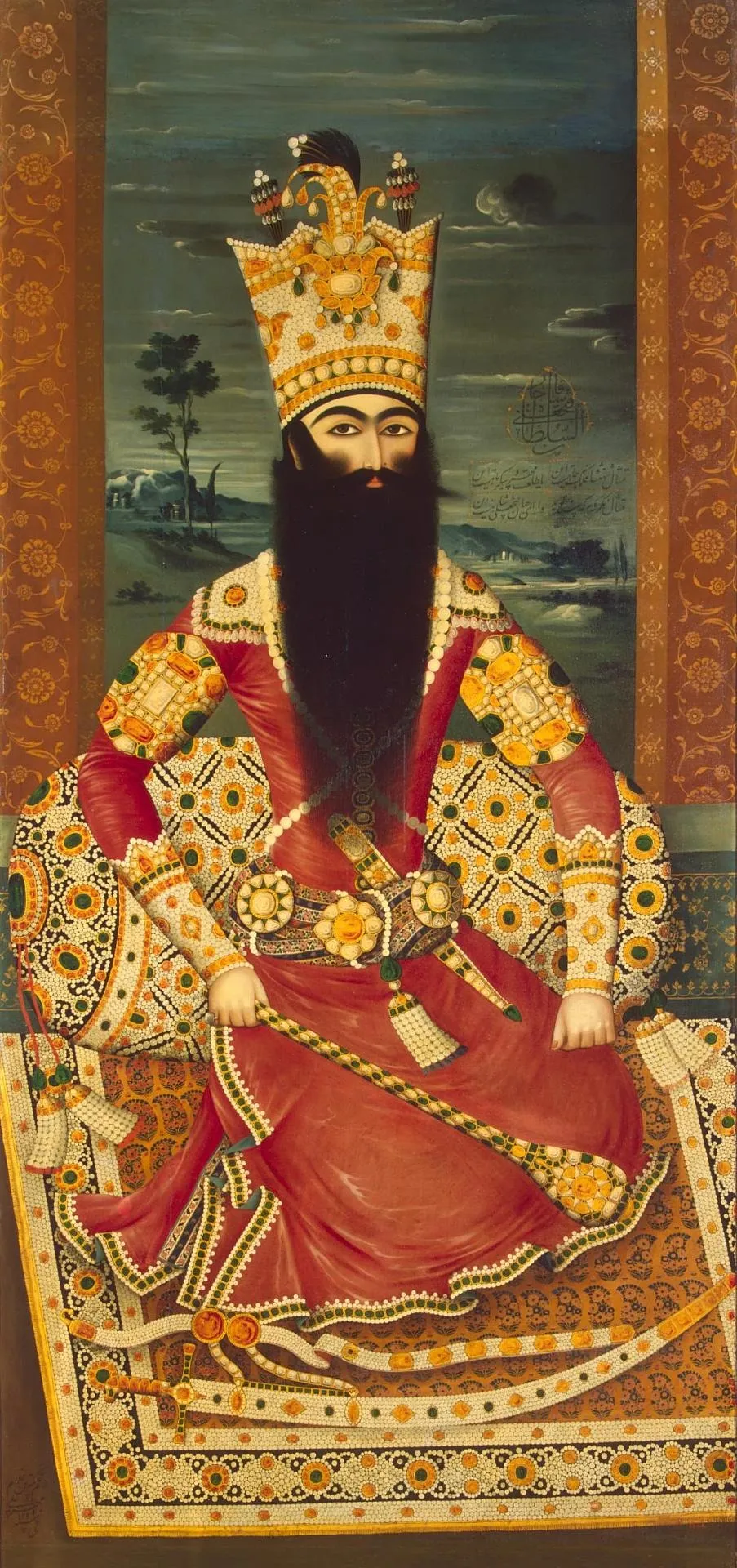
Portrait of Fath Ali Shah Seated is an oil painting by the Mughal Painting artist Mihr 'Ali. It dates from 1813 and is held in the collection of the Hermitage Museum.
About this work
Subject & Meaning
This portrait serves as both a record of the Shah's appearance and a statement of his political and cultural dominance in early 19th-century Iran.
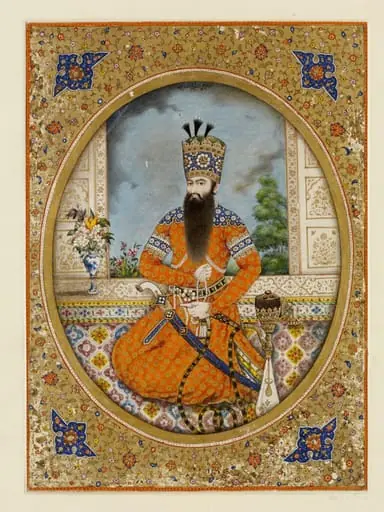
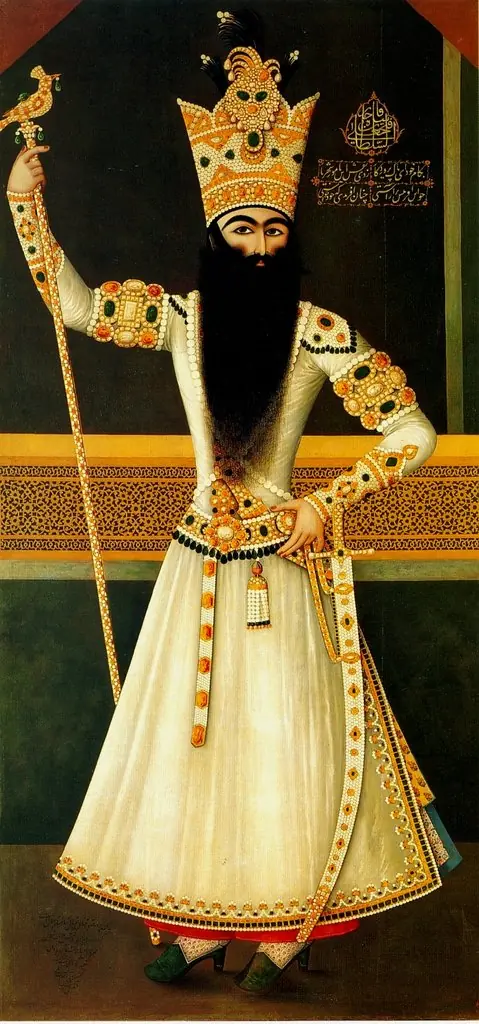
The painting shows Fath-Ali Shah Qajar, the second ruler of the Qajar dynasty of Persia, seated on a throne. He is depicted with a long beard, a jeweled turban, and formal robes, symbols of royal authority and Persian court hierarchy. The composition emphasizes his status through regalia and a direct gaze that conveys imperial power and continuity.
This portrait serves as both a record of the Shah's appearance and a statement of his political and cultural dominance in early 19th-century Iran.
Technique & Style
Executed in oil on canvas in 1813, the portrait employs fine, controlled brushwork to render Fath Ali Shah’s facial features, costume, and jewelry with smooth transitions and subtle modeling.
The painting adheres to Qajar court conventions, emphasizing symmetrical composition, a central seated pose, and a hieratic scale. Rich mineral pigments heighten the shimmer of brocades and the sheen of jewelry, while the dark, unmodulated background isolates the figure and focuses attention on the monarch’s regalia and gaze.
History & Provenance
Portrait of Fath Ali Shah Seated was painted by the Qajar court artist Mihr 'Ali in 1813, using oil paint on canvas. The work depicts the Shah seated, emphasizing his beard and regal attire, and measures approximately 253 cm in height and 118 cm in width. According to the sources, the painting entered the Hermitage Museum’s collection and is currently housed there.
No earlier ownership or commission details are provided in the available records, so the known provenance begins with its accession to the Hermitage. The inception date is recorded as 1 January 1813.
The painting is held by the State Hermitage Museum in Saint Petersburg, where it is inventoried as accession number ЭРЖ‑1546.
It was included in the exhibition “Qajar: The Absolute Court” held at the Hermitage from 28 November 2024 to 2 March 2025.
Legacy
The portrait of Fath Ali Shah Seated by Mihr 'Ali has become a key reference in studies of Qajar-era royal iconography, influencing later state portraiture in Iran and inspiring scholarly discourse on the visual representation of power. Its presence in the Hermitage Museum's collection has ensured sustained academic attention to its stylistic nuances and historical context, cementing its reputation as a significant example of early 19th-century Persian court painting.
Overview
Created in 1813 by Mihr ‘Ali, a leading court painter of the Qajar dynasty, this oil on canvas portrays Fath‑Ali Shah seated on an elaborate throne. The work is part of the State Hermitage Museum’s collection and exemplifies early Qajar portraiture, reflecting the period’s emphasis on regal authority and elaborate visual presentation.
Artist & collection
Artist
Mihr 'Ali also spelt Mir Ali or Mehr Ali (Persian: مهرعلی نقاش; fl. 1795 – c. post 1830) was one of the great royal painters of the Qajar court during the reign of Fath-Ali Shah Qajar. Mihr 'Ali is regarded as the most…