Artwork
The Gate of Calais, or The Roast Beef of Old England
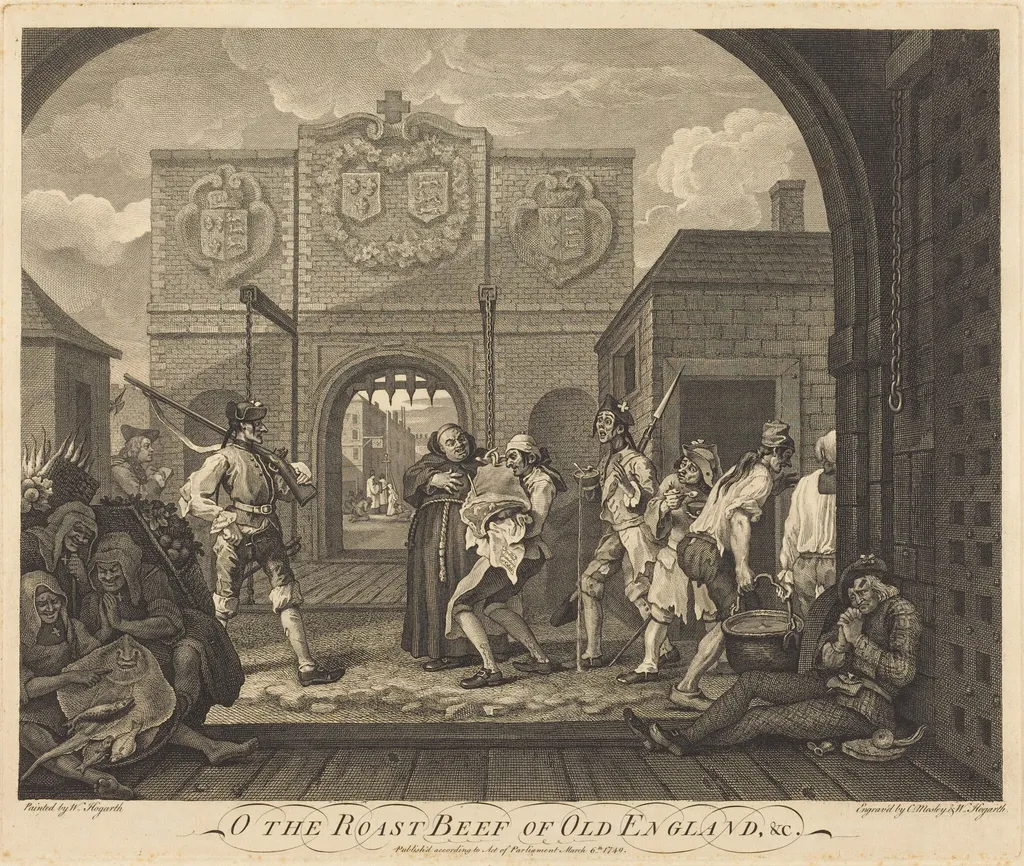
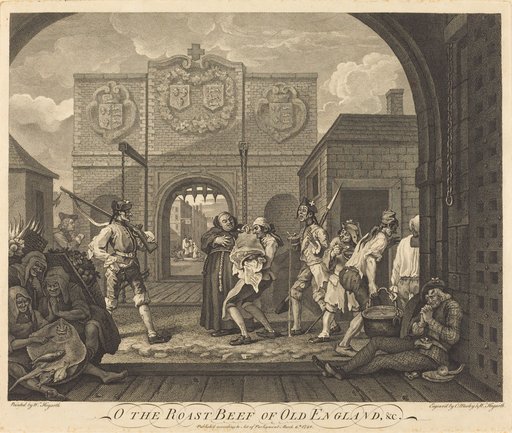
The Gate of Calais, or The Roast Beef of Old England is an ink print by the Baroque artist Charles Mosley. It dates from 1748 and is held in the collection of the National Gallery of Art.
About this work
Overview
The composition extends into a background of additional structures and distant figures, creating a sense of organized disorder.
Charles Mosley’s 1748 print, titled The Gate of Calais, or The Roast Beef of Old England, combines etching and engraving to depict a bustling scene beneath a stone arch. A crowd gathers around a central figure in a long coat, while others brandish swords, firearms, or food. The composition extends into a background of additional structures and distant figures, creating a sense of organized disorder.
Subject & Meaning
The work portrays a public disturbance at a city gate, with a man being seized by the arm while onlookers react with a mixture of aggression and curiosity. The inscription below the image alludes to a satirical reference to a French levy on English beef, suggesting the scene functions as a visual commentary on contemporary trade tensions and national rivalry.
Technique & Style
Mosley employs the fine lines of etching alongside the deeper, more defined strokes of engraving, allowing for intricate detailing of clothing, weaponry, and architectural elements. The contrast between delicate hatching and bold incisions emphasizes the chaotic energy of the crowd while maintaining clarity in the spatial arrangement of figures and the archway.
History & Provenance
Created in 1748, the print reflects mid‑eighteenth‑century British print culture, where satirical and topical subjects were popular. Though specific ownership records are scarce, the work has been catalogued in several collections of British prints, illustrating Mosley’s engagement with political humor and the market for affordable, reproducible images.
Context
During the 1740s, Anglo‑French relations were marked by disputes over trade, including a controversial French tax on imported English beef. Mosley’s image taps into this climate, using a public disturbance as an allegory for the perceived affront to English commerce, aligning with other contemporary visual critiques of foreign policy.
Legacy
The piece stands as an example of how printmakers used the relatively inexpensive medium of etching and engraving to disseminate political satire. Its blend of narrative detail and social commentary offers insight into the ways eighteenth‑century visual culture engaged public opinion on international economic issues.
Own this work as a print
Artist & collection