Artwork
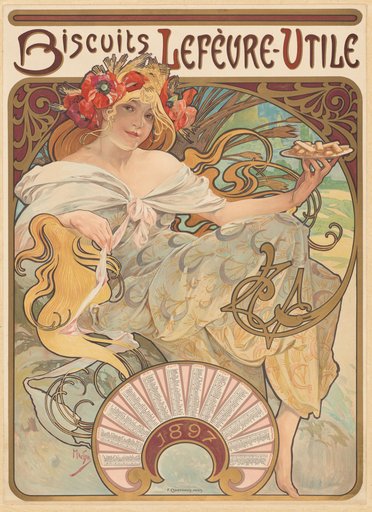
Biscuits Lefèvre-Utile
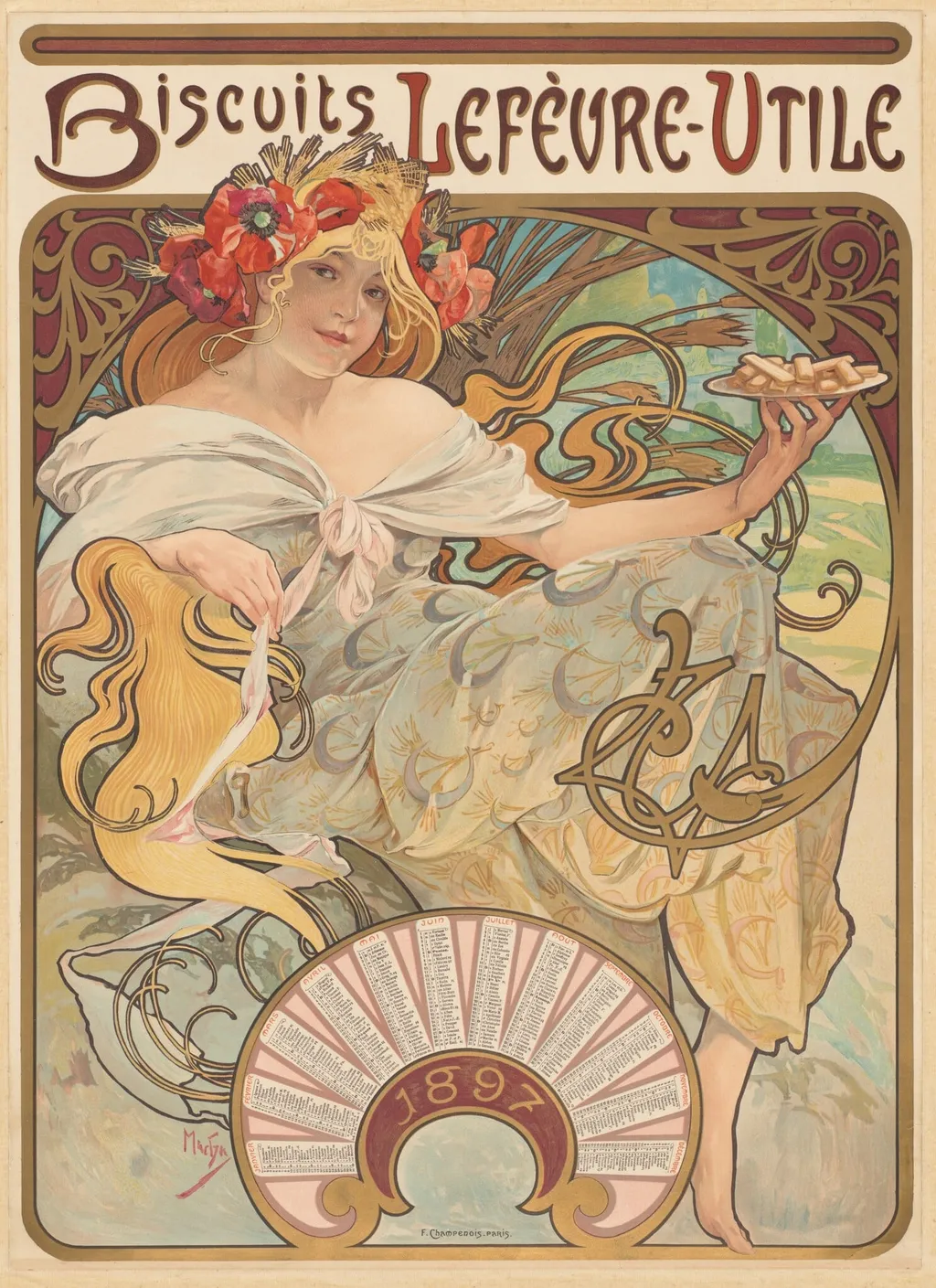
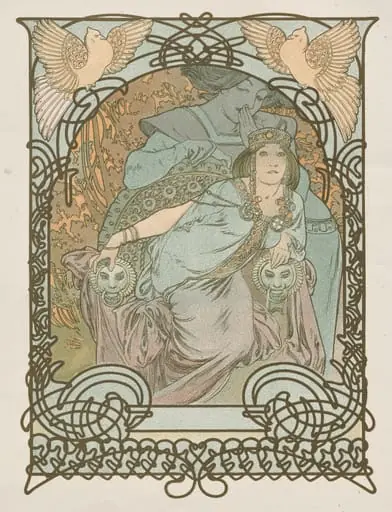
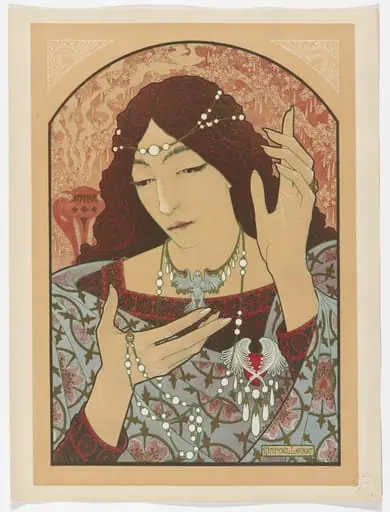
Biscuits Lefèvre-Utile is an ink print by the Impressionist artist Alphonse Marie Mucha. It dates from 1896 and is held in the collection of the National Gallery of Art.
- Inscription
- Inscribed:on stone, in image, across top: Biscuits Lefèvre-Utile; on stone, in image, at lower left: Mucha; on stone, in image, at bottom center: F. Champenois. Paris.
About this work
Overview
Created in 1896 by Alphonse Mucha, this color lithograph was produced as a commercial poster for the French biscuit manufacturer Lefèvre-Utile.
Created in 1896 by Alphonse Mucha, this color lithograph was produced as a commercial poster for the French biscuit manufacturer Lefèvre-Utile. Printed on paper and mounted on linen, it exemplifies the decorative logic of late 19th-century advertising, blending artistic refinement with commercial function. The work belongs to Mucha’s series of posters that elevated product promotion to the level of fine art.
Subject & Meaning
The central figure is a serene woman with flowing blonde hair, adorned in a white gown patterned with delicate florals and crowned with a wreath of blossoms. She holds a plate of biscuits in one hand and a ribbon in the other, suggesting both abundance and grace. The imagery evokes purity and domestic elegance, aligning the product with ideals of refinement and natural beauty rather than overt salesmanship.
Technique & Style
Mucha employed color lithography to achieve soft gradients and intricate linework, characteristic of Art Nouveau. The composition is structured around sinuous curves, with floral motifs extending from the figure’s dress into the border framing the text. The ribbon and hair flow in rhythmic arcs, unifying the figure with the ornamental frame. Gold accents on the plate and border add subtle luminosity without excessive ornamentation.
History & Provenance
Commissioned by the Lefèvre-Utile company, the poster was widely distributed in Paris and beyond during the 1890s. It was part of a broader trend in which artists collaborated with manufacturers to create visually compelling advertisements. The original prints were displayed in public spaces, contributing to Mucha’s rising reputation. Surviving examples are now held in museum collections and private archives.
Context
This work emerged during the height of Art Nouveau’s popularity in France, a movement that sought to dissolve boundaries between fine and applied arts. Mucha’s posters responded to urban visual culture, where advertising was becoming an artistic medium. His style contrasted with the rigid geometry of earlier commercial graphics, offering instead an organic, feminine aesthetic that resonated with contemporary tastes.
Legacy
The poster helped define Mucha’s signature style and influenced the visual language of advertising for decades. It remains a touchstone for Art Nouveau’s integration of beauty into everyday commerce. While no longer promotional, its enduring presence in exhibitions and publications reflects its role in redefining the cultural value of graphic design.
Own this work as a print
Artist & collection