Artwork
Title Page
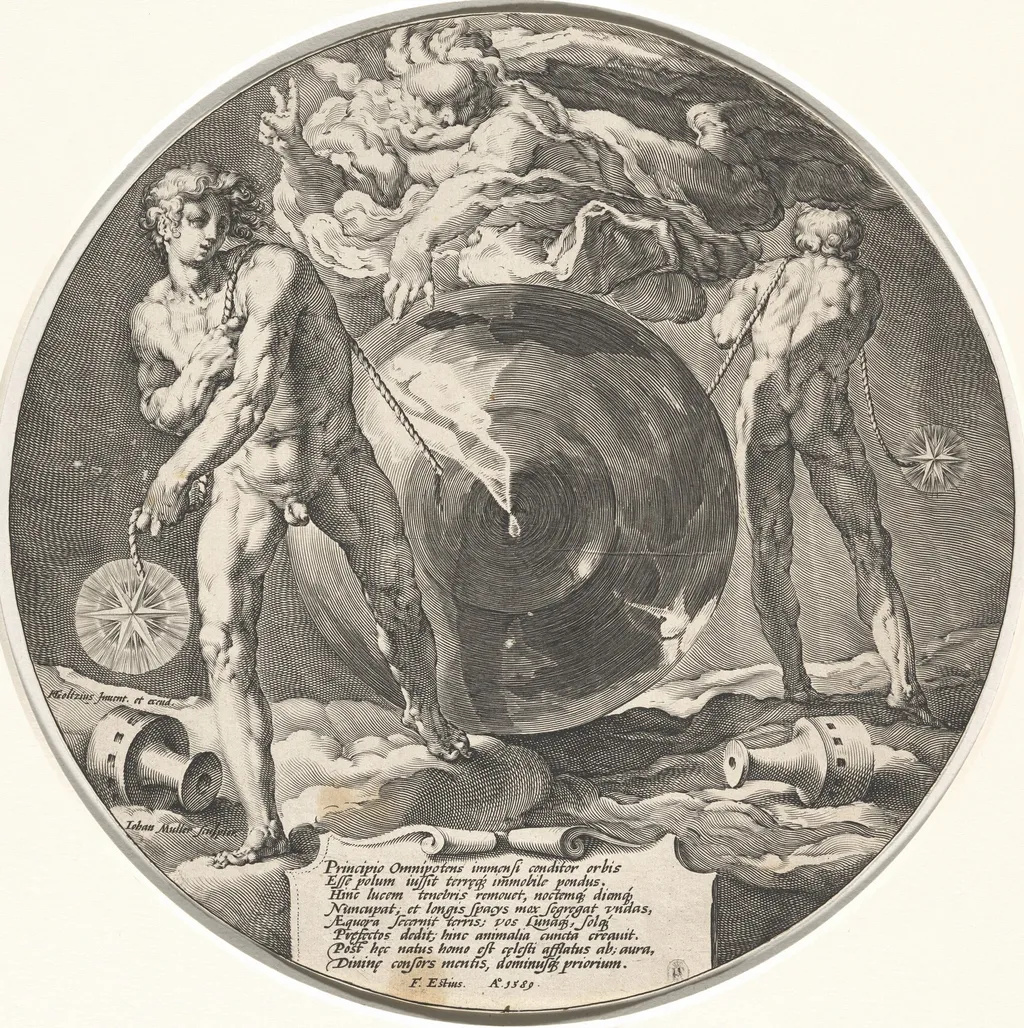
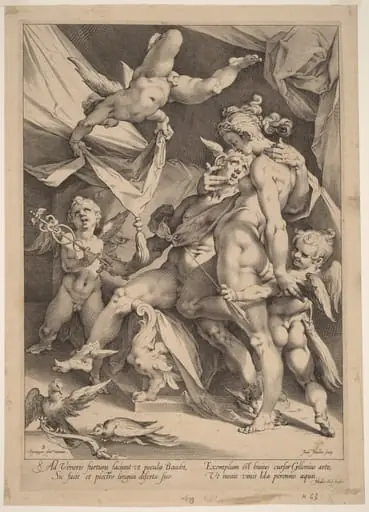
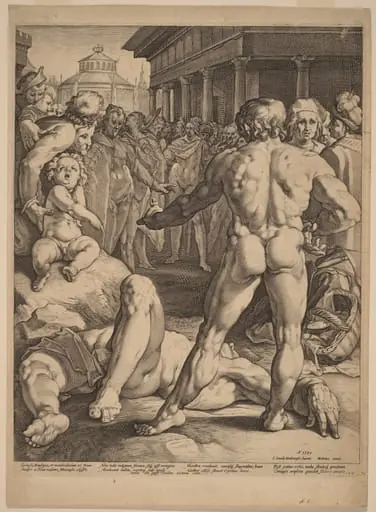
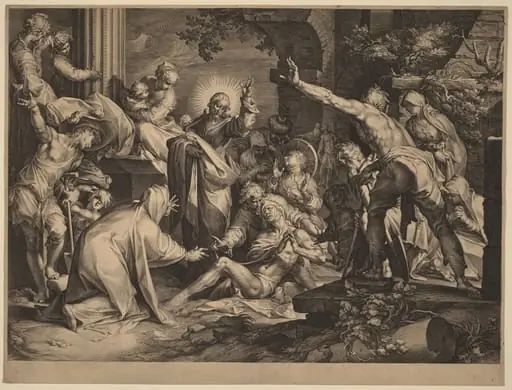
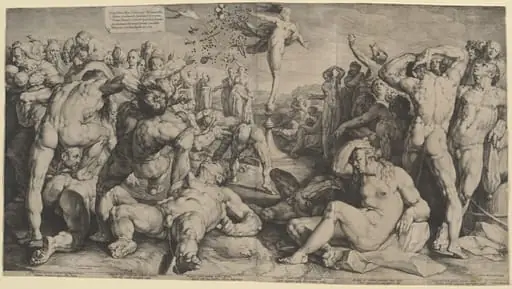
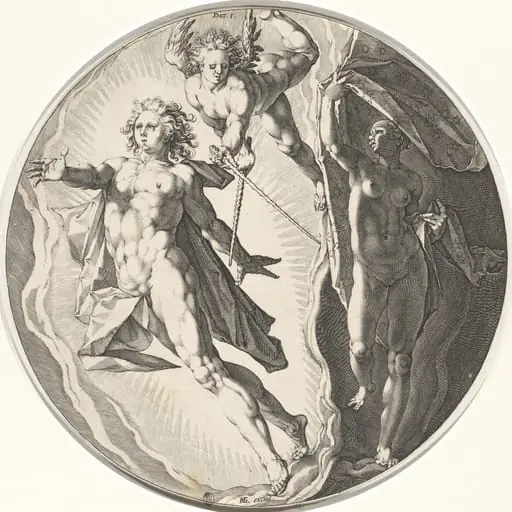
Title Page is an ink print by the Renaissance artist Jan Muller. It dates from 1589 and is held in the collection of the National Gallery of Art. Created in 1589 by Jan Harmensz.
- Inscription
- Inscribed:lower left, in plate: HGoltzius Inuent. et excud.; lower left, in plate: Iohan Muller sculptor; within cartouche at bottom, in plate: Principio Omnipotens immensi conditor orbis / Esse polum iussit terraque immobile pondus. / Hinc lucem tenebris removet, noctemque diemque / Nuncupat; et longis spacys mox segregat undas, / Aequora secernit terris; vos Lunaque, solque / Praefectos dedit; hinc animalia cuncta creavit. / Post haec natus homo est caelesti afflatus ab aura, / Divinae consors mentis, dominusque priorum. / F. Estius. Anno 1589. (In the begning, the Almighty creator of the immeasurable world / Called heaven and the immovable weight of the earth into being. / He then divided light from darkness, and named day and night; And in the void he presently separated the waters, / Divided the sea from the land; he placed you, moon and sun, at the head. / He then created all living things. / Whereupon man was born, fanned by the breath of heaven, / Partner in the divine spirit, and ruler of all higher beings.) [Latin translation from Ger Luijten, et al. _Dawn of the Golden Age: Northern Netherlandish Art, 1580-1620._ Amsterdam: Rijksmuseum, 1993, p. 355.]; on mount, at lower center in graphite in later hand: B. 35 / W. 35 II / D IV. 497,1; on mount, at lower center in red ink in later hand: 8792.
- Markings
- Marked:recto: Friedrich August, King of Saxony (Lugt 971); verso: none
About this work
Overview
Muller, this engraving on laid paper serves as a decorative title page, likely intended for a scholarly or astronomical publication.
Created in 1589 by Jan Harmensz. Muller, this engraving on laid paper serves as a decorative title page, likely intended for a scholarly or astronomical publication. Muller, trained in his father’s printmaking workshop in Amsterdam, produced this work before his travels to Italy.
The print’s intricate detail and Latin inscription reflect the intellectual currents of late 16th-century Northern Europe, where visual art and scientific inquiry often intersected.
Subject & Meaning
The composition centers on a globe marked with a compass rose, symbolizing global or cosmic order. Two standing figures, one gesturing toward the heavens and the other holding a staff, may represent celestial and terrestrial knowledge. A smaller figure seated below gazes upward, suggesting contemplation or learning.
The surrounding clouds, sun, and moon reinforce a cosmological theme, while the Latin text likely frames the globe as an object of universal study.
Technique & Style
Executed in fine-line engraving, the image relies on precise incisions into a metal plate to create tonal variation through cross-hatching and stippling. The use of laid paper, with its characteristic chain lines, was standard for high-quality prints of the period. Muller’s handling of texture and depth, particularly in the clouds and globe’s surface, demonstrates technical mastery and an attention to detail typical of Northern European printmakers of the time.
History & Provenance
Jan Harmensz. Muller inherited his father’s print business in Amsterdam and later expanded his practice after studying in Italy. This engraving was made early in his career, before his Italian sojourn.
It entered the National Gallery of Art’s collection in Washington, D.C., as part of a broader acquisition of early modern prints, where it remains a representative example of Dutch engraving from the late Renaissance.
Context
In the late 1500s, printed title pages often functioned as visual introductions to scholarly texts, blending art with intellectual themes. The globe, celestial bodies, and Latin inscriptions align with the era’s growing interest in astronomy and cartography. Muller’s work reflects the fusion of humanist learning and artisanal skill, common in Dutch print shops that catered to academic and elite audiences seeking both information and aesthetic refinement.
Legacy
Though not widely reproduced or celebrated in its time, this engraving exemplifies the craftsmanship of Dutch printmakers who bridged art and science. Muller’s career helped sustain the family business as a center for scholarly imagery. Today, the print contributes to understanding how visual symbols were used to convey complex ideas in pre-modern printed culture, preserving a quiet but significant moment in the history of print.
Own this work as a print
Artist & collection

Artist
Jan Harmensz. Muller (1571–1628) was a Dutch engraver and painter. Muller was born in Amsterdam. His father was a book printer, engraver and publisher. He learned the engraving trade while working in the family…