Artwork
The Return of Rip Van Winkle
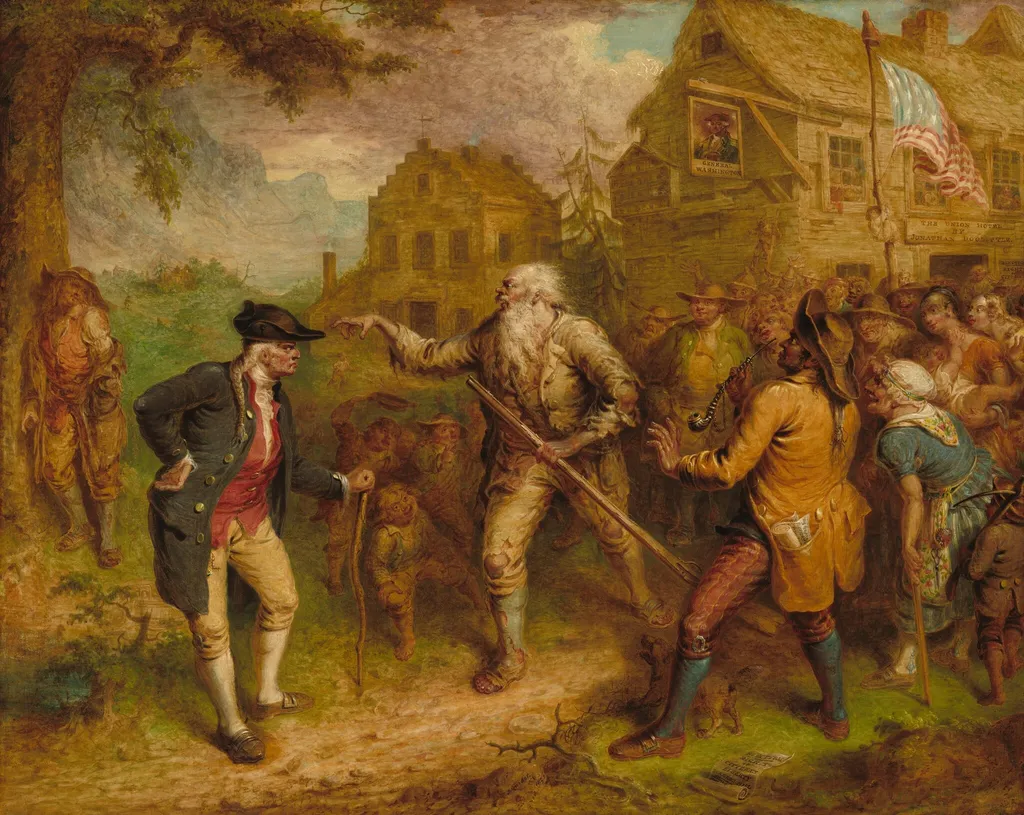
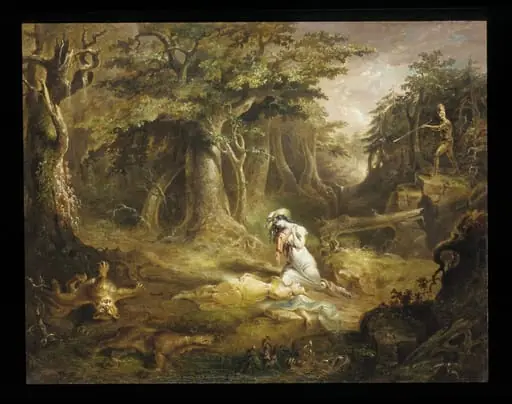
The Return of Rip Van Winkle is an oil painting by the Romanticist artist John Quidor. It dates from 1849 and is held in the collection of the National Gallery of Art.
- Inscription
- Inscribed:lower center on rock: J. Quidor, / N.Y. / 18[4?]9
About this work
John Quidor shows Rip Van Winkle waking in the Catskill woods, small against towering trees after his twenty-year sleep. His dog sniffs nearby and his rifle lies broken, time having passed him by. Drawn from Washington Irving's 1819 story, the scene captures Rip's return to the real world rather than his meeting with the ghosts.
Subject & Meaning
John Quidor's 1849 painting The Return of Rip Van Winkle illustrates the titular protagonist of Washington Irving's famous American folktale.
John Quidor's 1849 painting The Return of Rip Van Winkle illustrates the titular protagonist of Washington Irving's famous American folktale. The artwork captures the moment of Rip Van Winkle's return after his prolonged supernatural sleep. Iconographically, the composition prominently features a tree alongside the disoriented protagonist.
The tree serves as a key visual and symbolic element, traditionally representing the passage of time, enduring nature, and the deep-rooted landscape of the American wilderness that contrasts with the profound societal changes Van Winkle encounters upon his reawakening. Ultimately, the work visualizes the themes of temporal displacement and the irrevocable loss of one's past.
Technique & Style
John Quidor's The Return of Rip Van Winkle (1849) is executed in oil on canvas, a medium typical of mid-19th-century American narrative painting. The work measures 101 × 126.5 cm, providing a horizontal format conducive to depicting the expansive Catskill landscape. Quidor's handling emphasizes linear clarity and sharp delineation of forms, aligning with the illustrative tradition of his Hudson River School contemporaries.
Figures and foliage are rendered with precise, almost graphic contours, while the muted palette, dominated by earthy greens, ochres, and deep shadows, enhances the scene's folkloric mood. The composition balances dramatic narrative focus, as the bewildered Rip returns to his village and is confronted by a crowd of townspeople, against atmospheric detail in the gnarled trees and receding background, where Quidor employs subtle glazing to suggest depth and recession.
History & Provenance
John Quidor painted The Return of Rip Van Winkle in 1849 in oil on canvas. Shortly after its completion, Quidor offered the work for sale to the American Art Union in 1850; the Union declined the offer and returned the painting to him by February 1851. The painting subsequently entered the collection of Augustus W. Oberwalder (also referred to as Augustus De Forest) in New York.
On 13 December 1920, Thomas B. Clarke (1848–1931) of New York purchased the work. It remained with Clarke's estate and was sold as part of the Clarke collection on 29 January 1936, through M. Knoedler & Co. of New York, to The A.W. Mellon Educational and Charitable Trust in Pittsburgh. The Trust gave the painting to the National Gallery of Art in 1942, where it remains in the Andrew W. Mellon Collection.
Overview
John Quidor's 1849 oil painting, The Return of Rip Van Winkle, captures a pivotal moment from Washington Irving’s celebrated tale. The canvas presents Rip Van Winkle awakening in the Catskill Mountains after his two-decade slumber. He appears diminished against the vast, ancient trees, symbolizing the profound passage of time.
His loyal dog investigates the unfamiliar surroundings, while his antique rifle, now broken, underscores the world that has moved on without him.
Context
Quidor drew inspiration from Washington Irving’s influential 1819 short story, 'Rip Van Winkle,' a foundational work of American literature. Rather than depicting the supernatural encounter with Hendrick Hudson's ghostly crew, Quidor chose to focus on the poignant aftermath. His painting emphasizes Rip’s solitary return to consciousness and his confrontation with a changed world, a moment rich with themes of memory, identity, and the relentless progression of history.
Own this work as a print
Artist & collection
Artist
John Quidor (January 26, 1801 – December 13, 1881) was an American painter of historical and literary subjects.