Artwork
Portrait of a Lion
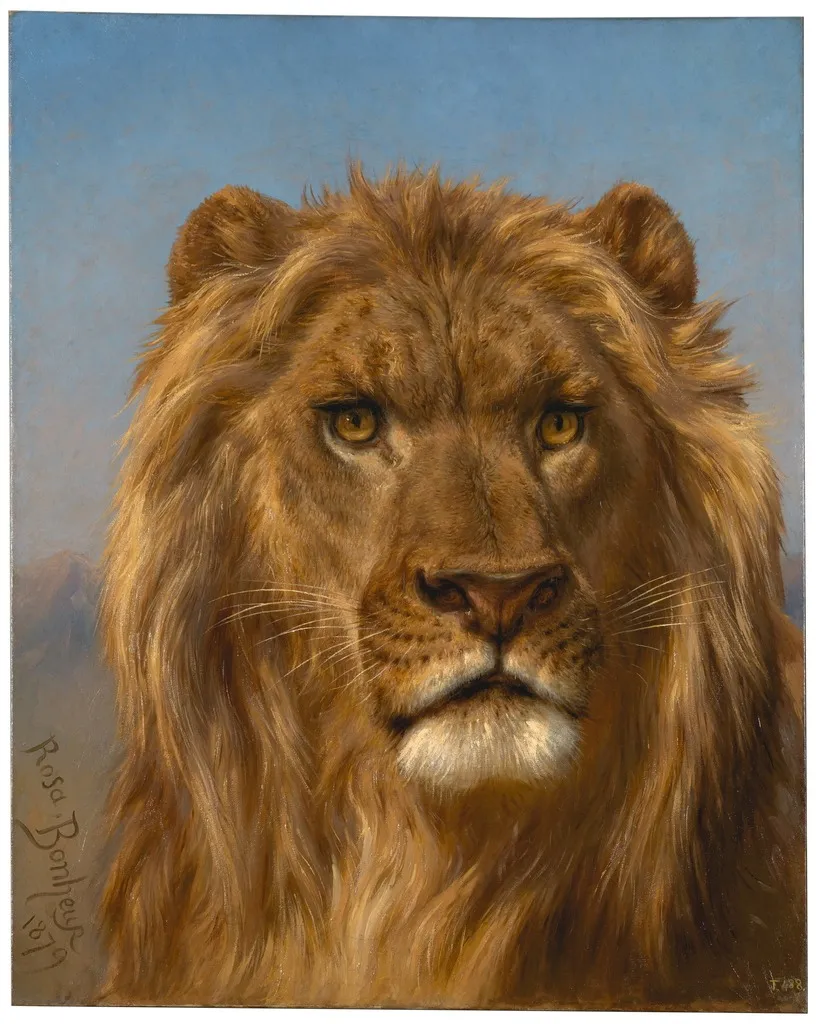
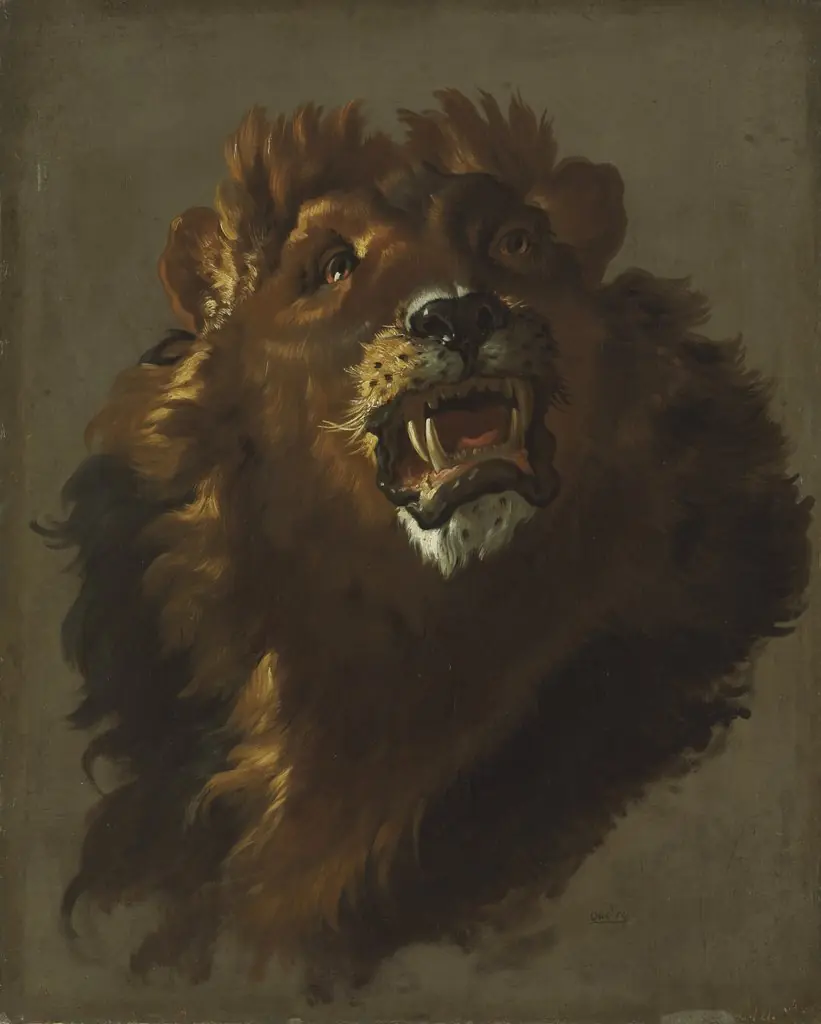
Portrait of a Lion is an oil painting by the Realist artist Rosa Bonheur. It dates from 1890 and is held in the collection of the Museo del Prado.
About this work
Subject & Meaning
The work, titled *El Cid* (also known as *Portrait of a Lion*), depicts the head of a majestic lion facing forward, executed in the style of a human portrait.
The work, titled *El Cid* (also known as *Portrait of a Lion*), depicts the head of a majestic lion facing forward, executed in the style of a human portrait. The animal is identified as likely being an Atlas lion, suggested by the distant mountains visible behind its mane. Symbolically, the title *Cid* references an Arabic term for 'lord' or 'master,' alluding to an archetype that opposes servility. Through this depiction, the artist, Rosa Bonheur, is understood to have advocated for a femininity defined by its own strength and identity rather than a male perspective. The lion itself represents a powerful and noble nature, a quality the artist recognized in her models and sought to transmit through her realistic and naturalist style.
Technique & Style
The work is executed in oil paint on a vertical canvas support (sources 1,2,3). Bonheur renders the lion’s head in a portrait‑like close‑up, using a naturalistic technique that captures the animal’s bright eyes and luminous mane (sources 3,4). The painting aligns with the realist and naturalist schools and belongs to the animalier genre, reflecting the influence of Barbizon painter Constant Troyon and British animal specialist Edwin Landseer (source 4).
History & Provenance
Completed in 1879, this oil painting was created by Rosa Bonheur during a period when she frequently utilized Atlas lions as models. The work was gifted to the Museo del Prado in Madrid that same year by the art dealer Ernest Gambart, a close friend of the artist. This donation significantly bolstered Bonheur's reputation in Spain, leading to her receipt of the Grand Cross of the Order of Isabella the Catholic. Following its arrival, the canvas remained in the museum's storage facilities for nearly 140 years, unseen by the public until 2017. It was briefly displayed during the exhibition "La mirada del otro" before entering the permanent collection in September 2019. The painting later formed part of the Léon Henri Lefèvre donation to the museum; Lefèvre was Gambart's nephew. The painting is held by the Museo Nacional del Prado, Madrid, with accession details recorded in the museum’s online catalogue. It entered the collection as a gift from the dealer Ernest Gambart in 1879 and later formed part of a donation by his nephew, Léon Henri Lefèvre. After decades in storage, the work was publicly shown for the first time in the Prado’s 2017 exhibition La mirada del otro. Escenarios para la diferencia, marking its only documented public display until its inclusion in the permanent galleries from September 2019. It subsequently traveled to Invitadas. Fragmentos sobre mujeres, ideología y artes plásticas en España (1833-1931) at the Prado, Rosa Bonheur at the Musée d’Orsay, and the exhibition in Bordeaux where it served as the show’s promotional image.
Context
Rosa Bonheur’s animal portraits, including Portrait of a Lion (also known as El Cid), consolidated her reputation within the nineteenth‑century animalier tradition. The work is cited in Anna Klumpke’s 1908 monograph under the title A Young Prince (Head of a Lion), underscoring its recognition within Bonheur’s oeuvre and the artist’s own framing of the feline subject as a noble subject akin to portraiture. Scholars situate El Cid within Bonheur’s late period, when she turned repeatedly to lions, studied at Paris’s Ménagerie and later at her By estate, to convey majesty and strength. The painting’s inclusion in the 2017 Prado exhibition La mirada del otro marked its first public display since entering the collection in 1879, reflecting its long dormancy in storage and subsequent rehabilitation within art‑historical narratives of queer and feminist readings of nineteenth‑century visual culture.
Legacy
The painting's arrival at the Museo del Prado in 1879, donated by the dealer Ernest Gambart, helped elevate Bonheur's reputation in Spain, where she was subsequently awarded the Grand Cross of the Order of Isabella the Catholic. The work was copied by artists such as Ramón Martí Alsina, evidencing the prestige it attained upon entering Spanish collections, and a print by Gilbert, retouched by Bonheur herself in pencil, also circulated as a reproduction. After roughly 140 years in storage, the canvas resurfaced for the 2017 exhibition La mirada del otro at the Prado, prompting the social-media campaign #UnaRosaParaElPrado. Since September 2019 it has been part of the museum's permanent collection and has been loaned to exhibitions at the Museo de Orsay and the Musée des Beaux-Arts de Bordeaux, the latter selecting it as the exhibition's image.
Artist & collection

Artist
Rosa Bonheur was a French artist known best as a painter of animals (animalière).