Artwork
The Horse Fair
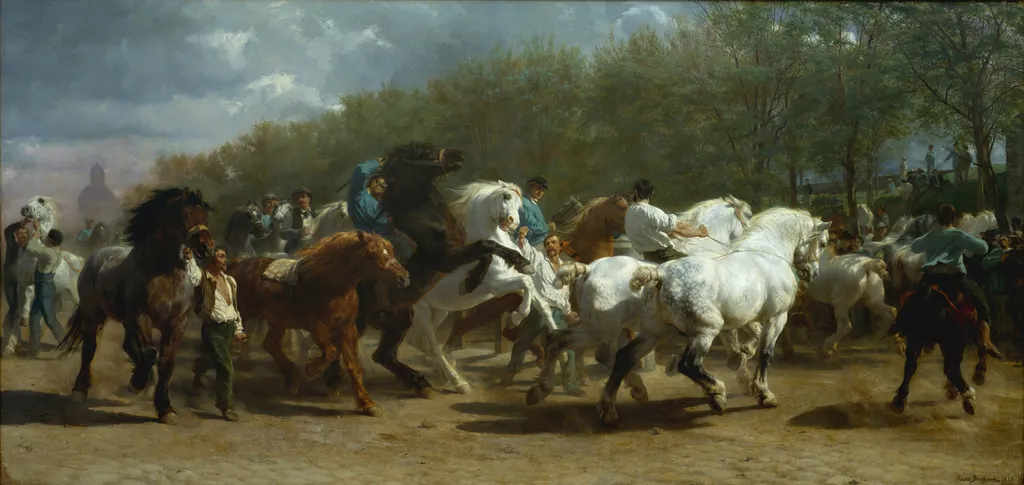
The Horse Fair is an oil painting by the Academic Art artist Rosa Bonheur. It dates from 1853 and is held in the collection of the Metropolitan Museum of Art.
About this work
The result was an enormous canvas, over eight feet high and sixteen long, of Percheron horses rearing as handlers strain to hold them.
For a year and a half, Rosa Bonheur dressed in men's clothing to sketch twice a week at the Paris horse market. The result was an enormous canvas, over eight feet high and sixteen long, of Percheron horses rearing as handlers strain to hold them. When it appeared at the 1853 Salon, one critic wrote that he wanted to flee before the hooves reached him. Cornelius Vanderbilt gave it to the Metropolitan Museum of Art in 1887.
Subject & Meaning
The painting depicts a horse market on the Boulevard de l'Hôpital in Paris, where dealers trade draft horses, primarily Percherons, with the Pitié-Salpêtrière Hospital visible in the background. Bonheur broke from tradition by representing the horses' eyes realistically rather than anthropomorphically, emphasizing animal vitality over sentimental portrayal. The work’s subject, a mundane commercial scene, is elevated by its monumental scale and dynamic composition, which Bonheur likened to her own Parthenon Frieze.
This classical reference, combined with her practice of dressing as a man to sketch the market unobtrusively, imbues the painting with a dual meaning: it is both a naturalistic celebration of equine power and a quiet assertion of the artist’s defiance of gender norms. The strong sense of movement has also been described as proto-cinematic, reinforcing the work’s focus on the raw energy of the horse fair.
Technique & Style
Painted in oil on canvas, The Horse Fair measures 244.5 × 506.7 cm and belongs to the French Realist and academic art traditions. Bonheur prepared extensively by sketching at the Paris horse market twice weekly for eighteen months and studying horses from the Paris Omnibus Company. The work’s large scale, realistic style, and strong sense of movement have been described as proto-cinematic.
She depicted horse eyes without anthropomorphism, a departure from convention. Critics praised its fine execution and composition but also noted a certain coldness and monotony in its gray tones, precise detailing, and lack of impasto in the foreground. Influences include ancient Greek sculpture (the artist called it her own Parthenon Frieze) and painters such as Géricault, Delacroix, and Stubbs.
History & Provenance
Rosa Bonheur began sketches for The Horse Fair at the Paris horse market in summer 1850, attending twice weekly for eighteen months. The painting was started in 1852 and first exhibited, still unfinished, at the Paris Salon of 1853. Bonheur added final touches in 1855, signing the work “Rosa Bonheur 1853.5”.
The painting was not a state commission: Bonheur had offered two studies to minister Charles de Morny, but he chose the other. After the Salon, the work was briefly purchased by the French government, but Bonheur reclaimed it and sold it to British dealer Ernest Gambart in 1854 for 40,000 francs. It then passed to cotton trader William Parkinson Wright in 1857 for 30,000 francs, and to Alexander Turney Stewart in 1866.
Following Stewart’s death and his widow’s, Cornelius Vanderbilt II bought the painting at auction for $53,000 in March 1887 and immediately donated it to the Metropolitan Museum of Art, where the prime version remains.
The prime version of The Horse Fair has been housed at the Metropolitan Museum of Art in New York (accession number 87.25) since its donation by Cornelius Vanderbilt II in 1887; it is currently displayed in Gallery 812. Before arriving in the United States, the painting had a notable exhibition history. It was first exhibited at the Paris Salon of 1853, followed by showings in Ghent (1853) and Bordeaux (1854).
In 1855 it was presented at the Exposition Universelle. The work then toured Britain from 1855 to 1857, with a private viewing at Buckingham Palace requested by Queen Victoria.
Context
Upon its debut at the 1853 Paris Salon, The Horse Fair garnered critical acclaim for its fine execution and compositional skill, with reviewers hailing Rosa Bonheur as the most distinguished animal painter of the modern school and comparing her to Géricault. Some critics, however, noted a certain coldness and monotony in its grey tones. Bonheur was deliberately excluded from the first-class medal ceremony because of regulations barring women from that honor.
The painting’s realistic, unsentimental portrayal of horse anatomy and movement, and its sweeping composition inspired by the Parthenon Frieze, marked a departure from equestrian tradition. It is considered Bonheur’s masterwork and a landmark of French Realism, later influencing artists from Molly Luce to Wayne Thiebaud, and is frequently described as proto-cinematic.
Legacy
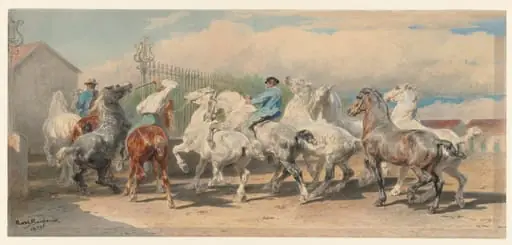
The Horse Fair remains Rosa Bonheur's most acclaimed work and is described by the Metropolitan Museum of Art as one of its best-known pieces. Its legacy began with early engravings by Jules Jacques Veyrassat and Thomas Landseer, the latter based on a half-size replica co-painted by Bonheur and Nathalie Micas, now at the National Gallery in London. Bonheur created several additional replicas and an autograph watercolor.
The painting influenced later artists: painter Molly Luce credited it with inspiring her artistic career, and it also motivated Wayne Thiebaud. In literature, it inspired a 2000 poetry anthology by Robin Becker. Its large scale, realistic style, and sense of movement have led to descriptions as proto-cinematic.
A bronze relief plaque by Bonheur's brother Isidore, part of her destroyed monument at Fontainebleau, survives in the Dahesh Museum of Art.
Overview
Rosa Bonheur's monumental oil painting, The Horse Fair, captures a dynamic scene of powerful horses and their handlers. Measuring over eight by sixteen feet, the canvas presents its equine subjects at life size, conveying a sense of raw energy and movement. Upon its debut at the Paris Salon of 1853, the work garnered significant critical acclaim, quickly establishing itself as a highlight of the exhibition and securing the artist's international reputation.
Artist & collection

Artist
Rosa Bonheur was a French artist known best as a painter of animals (animalière).