Artwork
Diderot
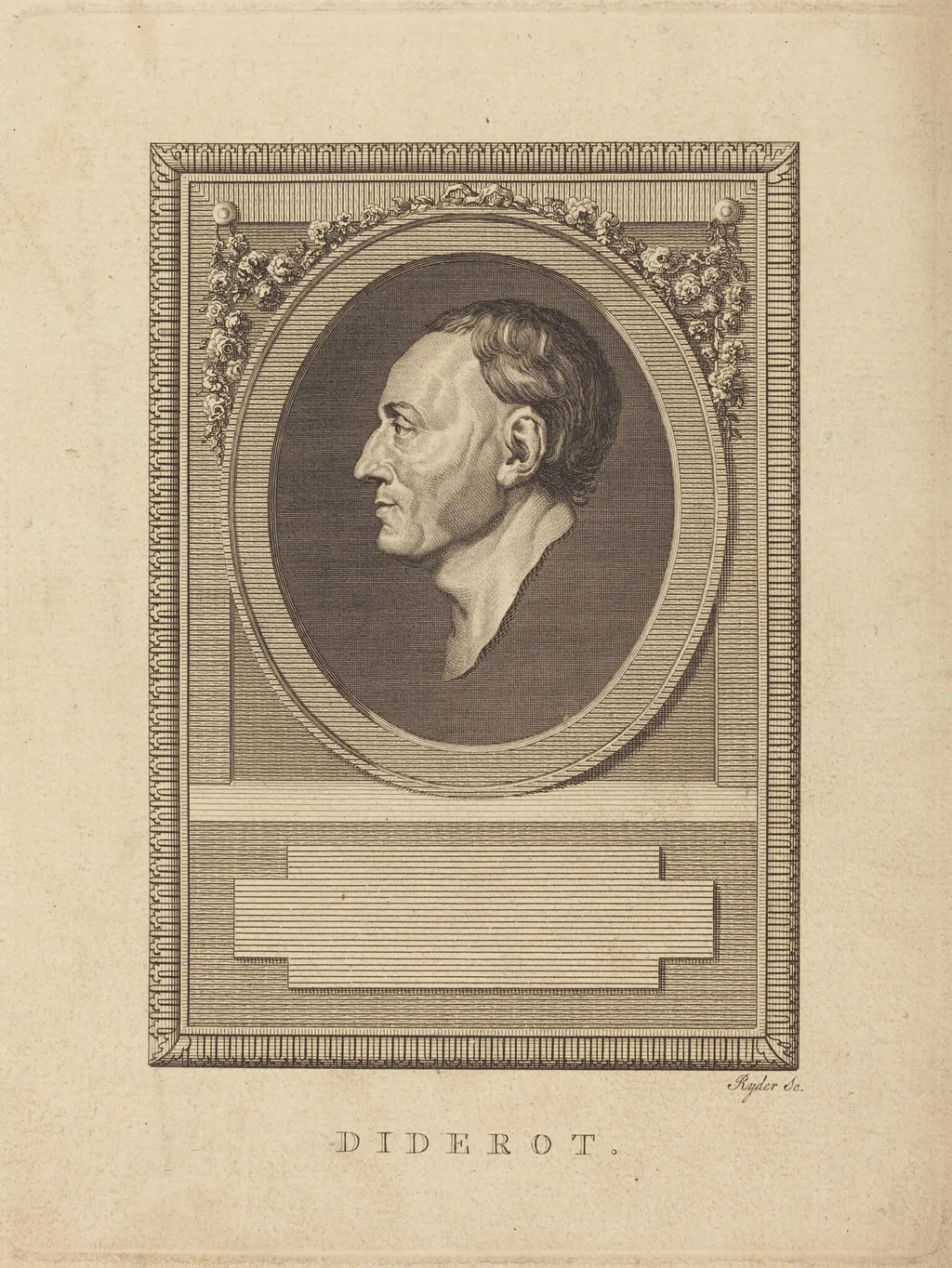
Diderot is an ink print by the Baroque artist Thomas Ryder. It dates from 1778 and is held in the collection of the National Gallery of Art.
- Inscription
- Inscribed:below image, lower right in plate: Ryder Sc.; below image, across bottom in plate: DIDEROT.
About this work
Overview
Thomas Ryder's 1778 engraving, Diderot, is a black-and-white print on laid paper, portraying the French philosopher Denis Diderot with a solemn expression, his hair neatly tied back.
Subject & Meaning
The subject, Denis Diderot, is depicted in a serious demeanor, reflecting his intellectual persona. The portrait conveys a sense of realism and depth, achieved through the artist's technical skill.
Technique & Style
Ryder employed cross-hatching, a technique involving intersecting fine lines, to create nuanced light and shadow. This method imparted a three-dimensional quality to Diderot's rounded face, distinguishing it from flat representations.
History & Provenance
Created in 1778, the engraving's provenance is not detailed here, though its production reflects 18th-century printmaking practices, evident in the faint grid pattern on the paper from the printing process.
Context
As an 18th-century engraving, Diderot belongs to a tradition of portrait prints commemorating influential figures of the Enlightenment, Diderot being a central figure.
Own this work as a print
Artist & collection