Artwork
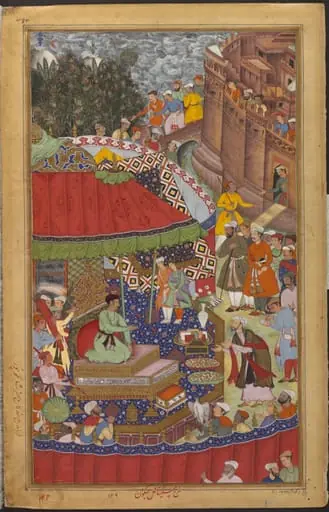
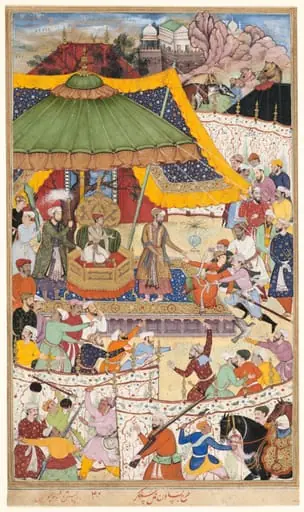
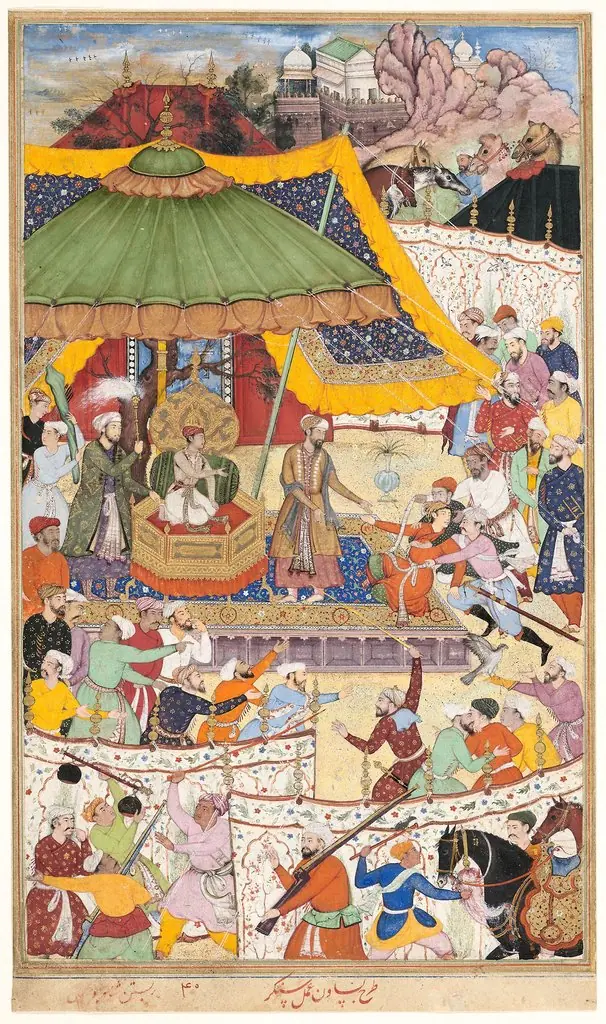
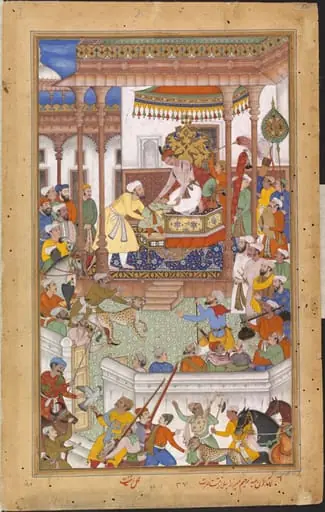
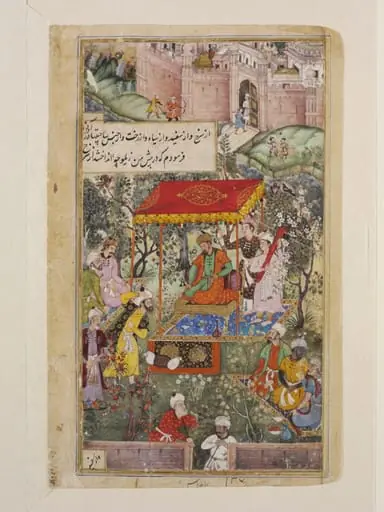
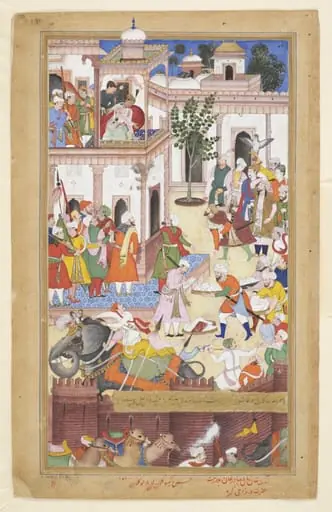
Babur receives booty and Humayun’s salute after the victory over Sultan Ibrahim in 1526, from an Akbar-nama (Book of Akbar) of Abu’l Fazl (Indian, 1551–1602)
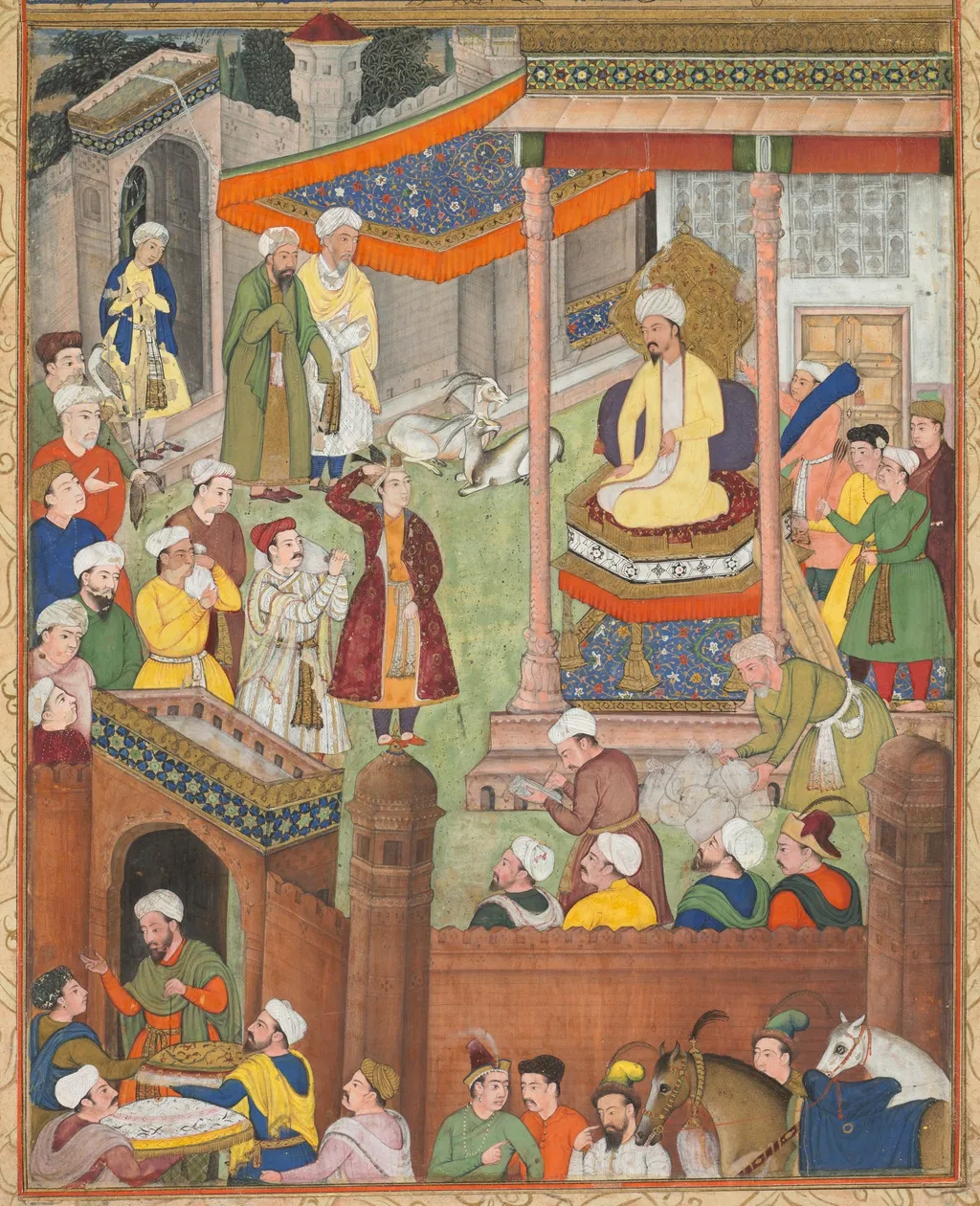
Babur receives booty and Humayun’s salute after the victory over Sultan Ibrahim in 1526, from an Akbar-nama (Book of Akbar) of Abu’l Fazl (Indian, 1551–1602) is an unspecified painting. It dates from 1600 and is held in the collection of the Cleveland Museum of Art.
About this work
Technique & Style
The work demonstrates technical mastery in line work and pigment application, typical of early 17th-century Indian manuscript production.
The miniature is executed in tempera and ink on paper, depicting a pivotal historical moment with precise narrative detail. The composition emphasizes hierarchical scale and formal clarity characteristic of Mughal manuscript painting, employing flat planes of color and intricate ornamental borders. The handling of figures conveys ceremonial dignity through controlled gestures and stylized forms, reflecting the manuscript's diplomatic and historiographical function. Formal stylization includes gold accents and patterned surfaces that enhance visual hierarchy without naturalistic modeling.
The work demonstrates technical mastery in line work and pigment application, typical of early 17th-century Indian manuscript production. Its condition is stable, preserving original materials without significant degradation. The stylistic choices underscore the fusion of Persianate traditions with regional aesthetics, serving both artistic and political documentation purposes within the Akbar-nama context.
History & Provenance
The painting depicting Babur receiving booty and Humayun’s salute after his 1526 victory over Sultan Ibrahim was created in 1600 as part of an Akbar-nama commissioned by Abu’l Fazl. It entered the collection of the Cleveland Museum of Art, where it remains on view.
The work is attributed to an unknown artist and was produced during the Mughal period, reflecting the patronage networks of Emperor Akbar’s court. Its creation is linked to the broader manuscript tradition of the Akbar-nama, a chronicle celebrating the reign of Akbar, which was compiled by Abu’l Fazl and illustrated by multiple artists.
The painting’s provenance traces its inclusion in the Cleveland Museum of Art’s holdings, with its inception recorded as January 1, 1600, aligning with stylistic and historical assessments of Mughal manuscript production.
Overview
The miniature illustrates the moment after Babur’s triumph over Sultan Ibrahim in 1526, as recorded in the Akbar‑nama compiled by Abu’l‑Fazl. Central to the composition is Babur seated on an elevated platform, receiving the spoils of war while Humayun offers a salute. The scene unfolds in a richly decorated courtyard, populated by courtiers in vivid garments, suggesting a ceremonial celebration of the victory.
Subject & Meaning
The work commemorates the consolidation of Babur’s authority in India, emphasizing the transfer of wealth and the acknowledgment of his son Humayun’s loyalty. By portraying the emperor surrounded by attentive officials and animals, the image conveys both the political legitimacy of the new ruler and the harmonious order of his court.
Context
The depiction follows Babur’s decisive victory at the Battle of Panipat, which opened the way for Mughal rule in northern India. The painting reflects the early Mughal court’s effort to legitimize its rule through visual narratives that blend Persian courtly conventions with Indian motifs, reinforcing the empire’s emerging identity.
Legacy
As one of the earliest surviving Mughal miniatures, the image informs scholars about the development of imperial portraiture and narrative painting in South Asia. Its composition and iconography have influenced subsequent generations of court artists, establishing visual conventions for depicting royal ceremonies and triumphs.
Artist & collection

- Babur receives booty and Humayun’s salute after the victory over Sultan Ibrahim in 1526, from an Akbar-nama (Book of Akbar) of Abu’l Fazl (Indian, 1551–1602)
 Untitled
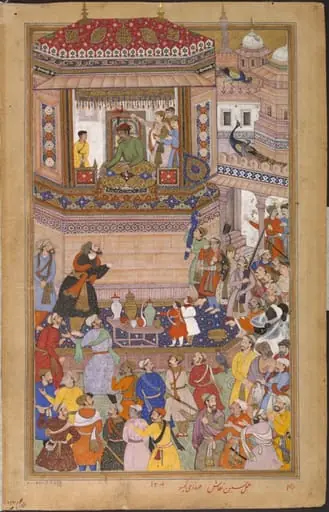 Untitled
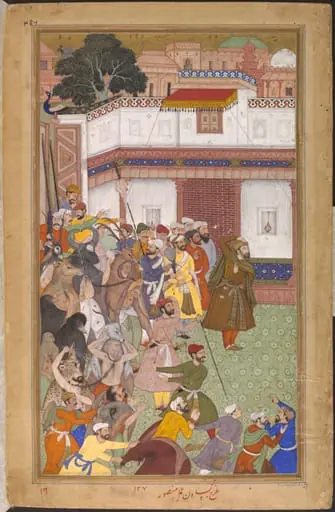 Husain Quli and Akbar
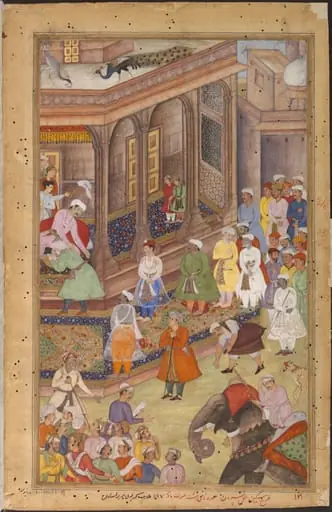 Untitled
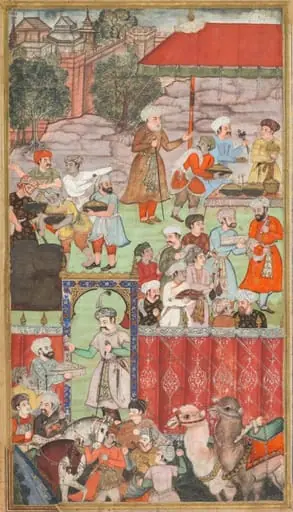 A feast for Babur hosted by his half-brother Jahangir Mirza in Ghazni in May 1505, from a Babur-nama (Memoirs of Babur)
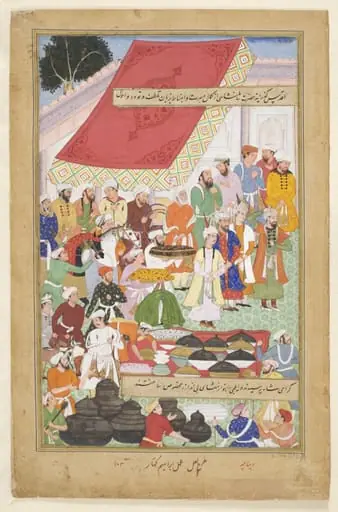 Akbar Receives the Iranian Ambassador Sayyid Beg in 1562
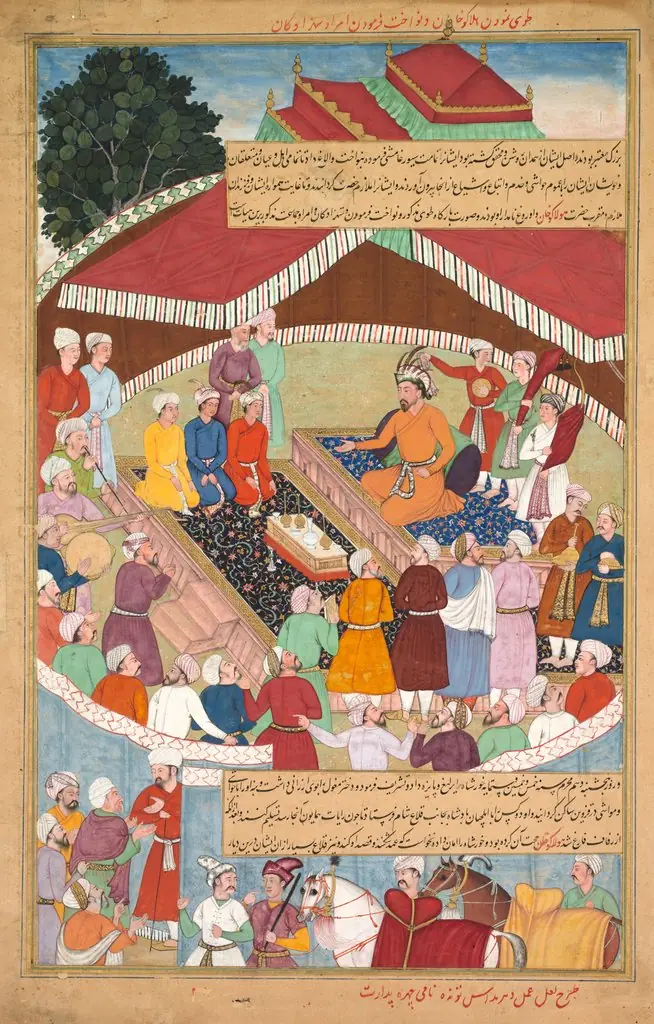 Hulagu Khan giving a feast and dispensing favor upon the amirs and princes, from a Chingiz-nama (Book of Chingiz Khan) of the Jami al-tavarikh (Compendium of Chronicles)
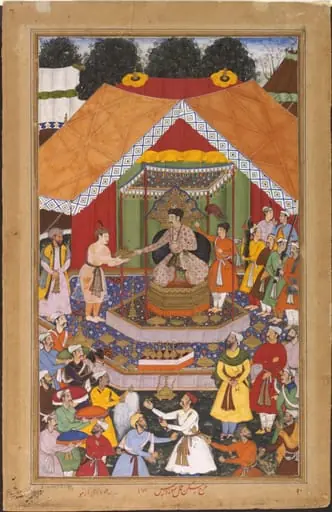 Akbar and Azim Khan at Dipalpur
 Ali Quli, Bahadur Khan and Akbar