Artwork
Calendar of Saints and Festivals
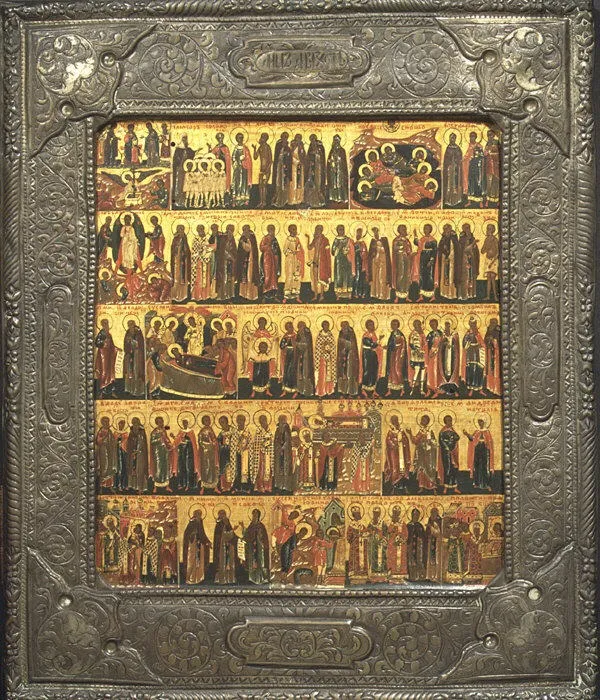
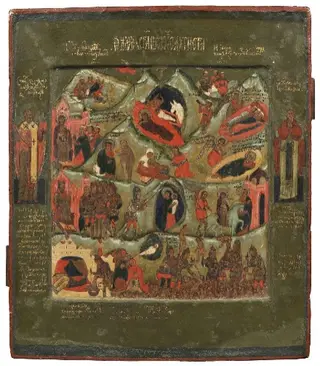
Calendar of Saints and Festivals is a tempera painting. It dates from 1700 and is held in the collection of the Metropolitan Museum of Art.
About this work
Subject & Meaning
By combining a temporal framework with holy figures, the painting visually maps the liturgical year, marking days dedicated to particular saints and festivals.
The work portrays a calendar system intertwined with images of saints, reflecting its religious genre. By combining a temporal framework with holy figures, the painting visually maps the liturgical year, marking days dedicated to particular saints and festivals. This juxtaposition suggests the piece functioned as a devotional reference, emphasizing the sanctity of time and the ongoing veneration of the saintly calendar within Orthodox tradition.
Technique & Style
The work is executed in tempera, a pigment bound in an emulsion medium characteristic of traditional Russian icon and panel painting. It is painted on a wooden panel support, with the relatively modest dimensions of 31.4 cm in height by 26 cm in width. The subject matter, a calendar of saints and festivals, suggests a structured, hieratic compositional arrangement typical of religious devotional imagery, in which figures and feast days are organized systematically across the picture field. The painting is held in the collection of the Metropolitan Museum of Art.
History & Provenance
The Calendar of Saints and Festivals is a tempera painting on panel dated to 1700 and attributed to an anonymous Russian artist. The work entered the collection of the Metropolitan Museum of Art, where it is recorded under accession number 1975.1.1140. The tempera painting measures 31.4 cm in height and 26 cm in width. No earlier owners or commission details are recorded in the available sources.
Overview
This tempera painting, titled "Calendar of Saints and Festivals," features numerous figures arranged in a schedule-like format. It uses gold leaf extensively, creating a bright, flat aesthetic. The artwork depicts various scenes, including people in a boat and around tables, alongside rows of standing figures. Its overall presentation is formal and highly decorative, framed by intricate metalwork with carved designs.
Context
This painting exemplifies artistic conventions prevalent in periods where religious instruction and veneration were central. The use of gold backgrounds and a flattened perspective aligns with traditions often seen in Byzantine icons or early medieval illuminated manuscripts, where spiritual significance was prioritized over naturalistic representation. Such works served both as devotional objects and as visual aids for understanding the ecclesiastical calendar and its associated narratives.
Artist & collection

- Coborârea în iad
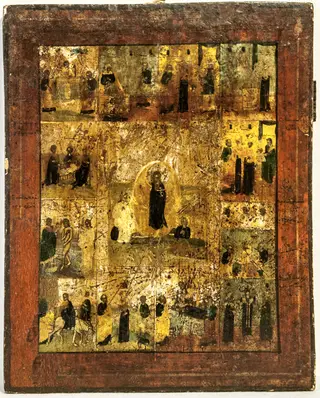 Compoziție complexă, (13 scene), centrată pe scena Învierii. Scena ridicării din mormânt a Mântuitorului, într-o mandorlă, lângă piatra mormântului, îngerul în veșminte albe, în fața pietri de mormânt probabil un soldat. În celelalte casete sunt reprezentate scene din viața lui Iisus Hristos și a Maicii Domnului, cu un număr redus de personaje (3 – 4, maxim 5): „Sfânta Treime”(ospitalitatea lui Avraam), Nașterea Fecioarei Maria”, „Intrarea Maicii Domnului în biserică(Ovidenia), „Buna Vestire”, „Nașterea lui Iisus Hristos”, Întâmpinarea Domnului(Stretenia), „Botezul lui Hristos” „Schimbarea la față” „Intrarea Domnului în Ierusalim”, „Înălțarea Domnului, Adormirea Maicii Domnului, „Înălțarea Sfintei Cruci”. Toate personajele au nimburi trasate cu alb.Desen schematic, trasat cu finețe, ușor dezordonat, ca și inscripțiile. Cromatica specifică, tonuri calde, brun, galben, roșu în contrast cu verde, albastru, negru, valorate de foița de aur. Chenarul lat, roșu(tipul de icoană krasnushka) Stratul pictural prezintă deteriorări, zgârieturi și lacune, deteriorări cromatice. Pictura se remarcă prin finețea execuției miniaturale.
 Prăznicar cu Învierea Mântuitorului Iisus Hristos
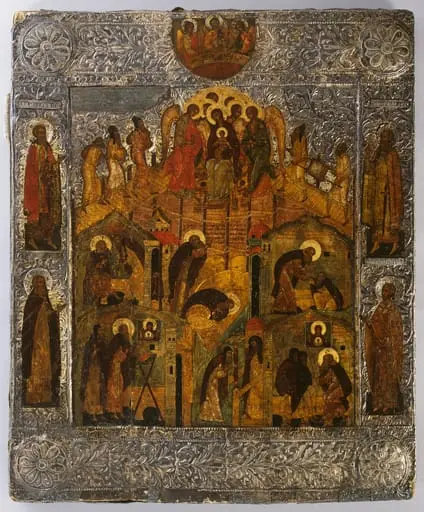 Neitsyt Marian ilmestyminen pyhittäjä Aleksanteri Syväriläiselle kirkon perustuksella
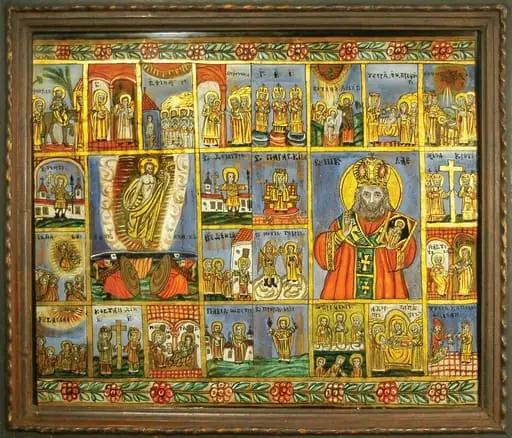 Învierea lui Iisus și Sf. Nicolae, cu 24 scene de praznic
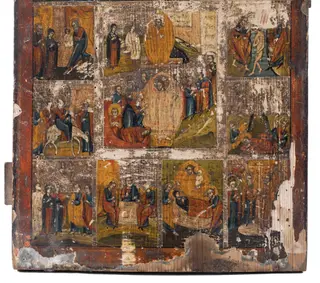 Scene biblice
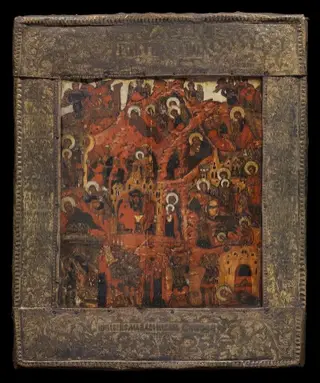 The Nativity of Jesus Christ
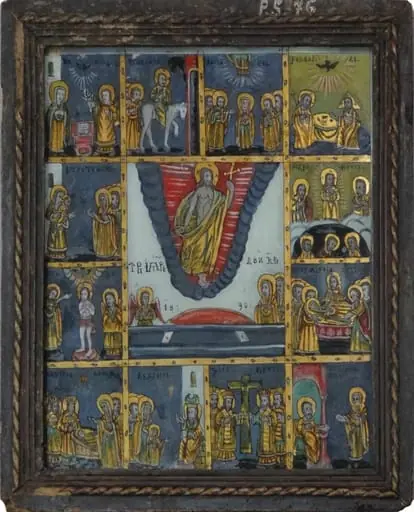 Învierea lui Iisus, cu 12 scene de praznic
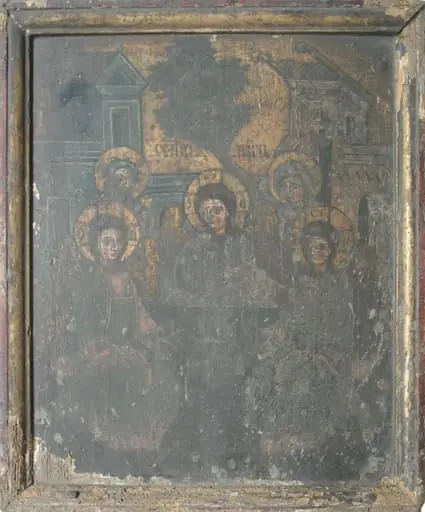 Cina de la Mamvri
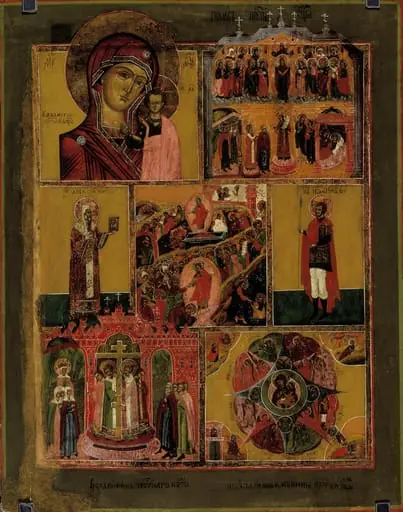 Pääsiäinen ja kirkkovuoden juhlia, venäläinen ikoni
 The Creation of the World
 The Birth of Christ