Artwork
Deep Dish
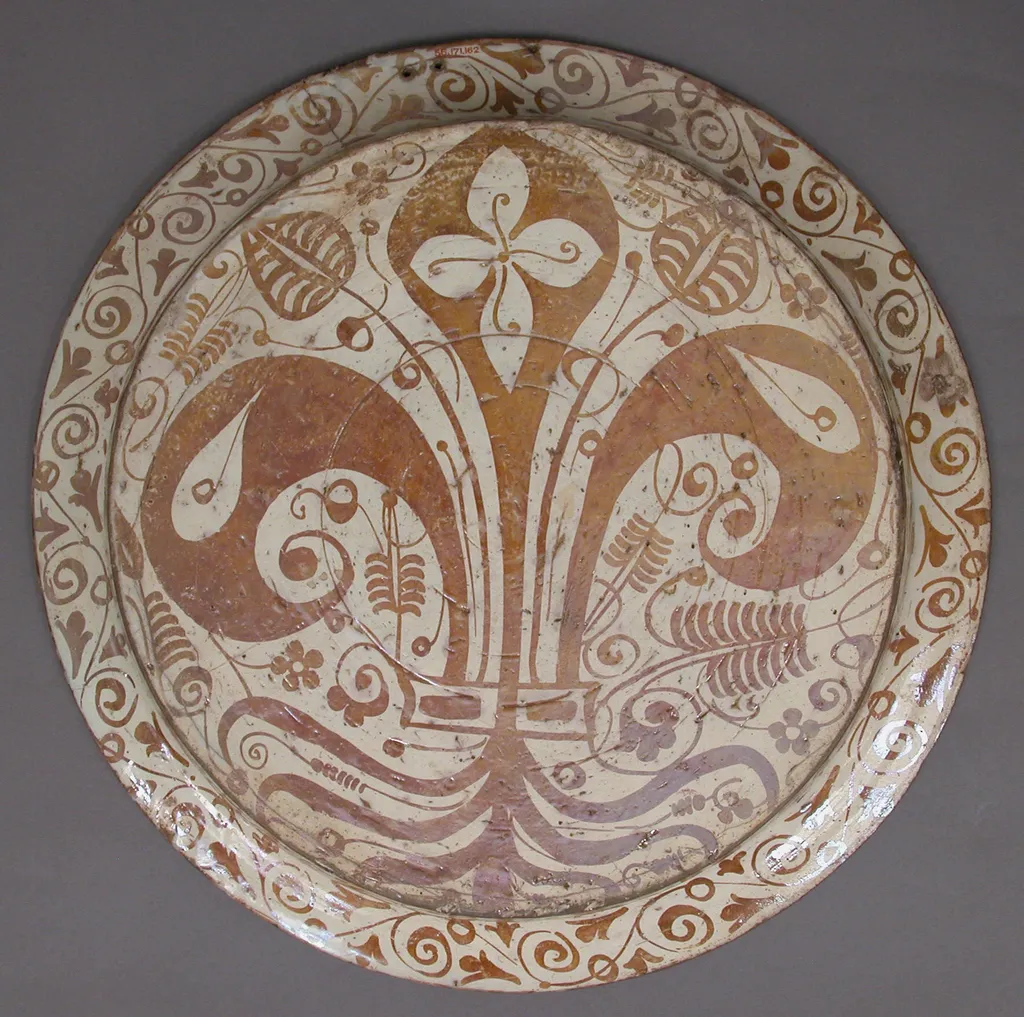
Deep Dish is an unspecified painting. It dates from 1430 and is held in the collection of the Metropolitan Museum of Art.
About this work
History & Provenance
The painting Deep Dish is held in the collection of the Metropolitan Museum of Art. Created in 1430, the work measures 6 cm in height and 45.1 cm in width. No specific inventory number or exhibition history for this piece is provided in the available records.
Context
Deep Dish is a 1430 painting housed in the Metropolitan Museum of Art, reflecting early artistic practices documented in its collection records.
Deep Dish is a 1430 painting housed in the Metropolitan Museum of Art, reflecting early artistic practices documented in its collection records.
Scholarly attention to this work remains limited, with minimal dedicated analysis in major art historical literature.
Its classification as an anonymous painting situates it within broader medieval artistic traditions, emphasizing attribution challenges common to works of its period.
Legacy
Deep Dish (1430) influenced later artists through its innovative composition and treatment of space, establishing a precedent for spatial depth in subsequent painting. Its reputation grew following inclusion in the Metropolitan Museum of Art's collection, where it remains on view as part of the European paintings galleries. The work's legacy is anchored in its role as an early example of naturalistic detail and balanced perspective, cited in art historical studies of 15th-century Italian art.
Overview
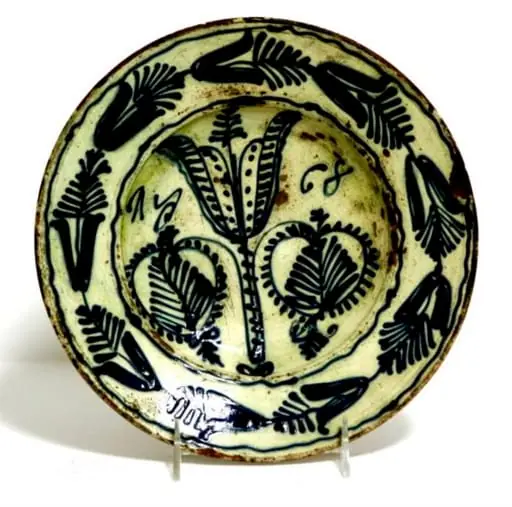
The work titled “Deep Dish” is a circular painted surface featuring a composition of swirling motifs rendered in subdued earth tones, browns, creams, and muted reds. Central to the design are three prominent forms that converge, two resembling stylized foliage or blossoms and a third taking the shape of a teardrop with an interior detail. The surrounding rim is filled with looping lines that suggest vines or undulating waves, giving the piece a sense of rhythmic movement.
Subject & Meaning
The central trio of shapes creates a focal point that balances the surrounding decorative elements, inviting interpretation of natural or botanical symbolism. The leaf‑like and floral forms may reference growth or fertility, while the teardrop figure, marked by a smaller internal pattern, could imply a droplet of water or a seed, contributing to an overall theme of organic cycles.
Technique & Style
Paint is applied in thin layers that have softened with age, producing a gentle, weathered surface. The artist employs a restrained palette of earthy hues, allowing the intricate swirls and looping lines to generate visual motion despite the muted coloration. The composition’s symmetry and repetitive motifs reflect a decorative aesthetic common in folk or vernacular traditions.
Artist & collection

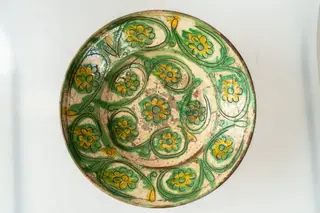 Farfurie de formă adâncă, cu buză răsfrântă. Piesa este modelată la roată, angobată cu humă albă pe fața interioară. Decorul este realizat prin pictare cu pensula, cu smalțuri colorate (verde și galben) și prin sgrafitare. Motivele decorative sunt florale și vegetale stilizate (flori cu frunze) dispuse pe întreaga suprafață a farfuriei. Bordura interioară a farfuriei este marcată cu o linie groasă sub formă de cerc, de culoare verde. Pe fața interioară a farfuriei este aplicat un strat de smalț transparent. Cromatica: alb, verde, galben.
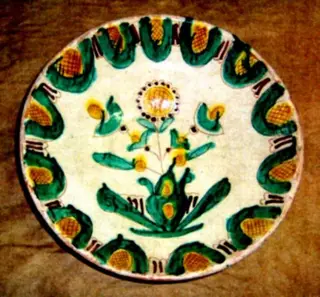 strachină
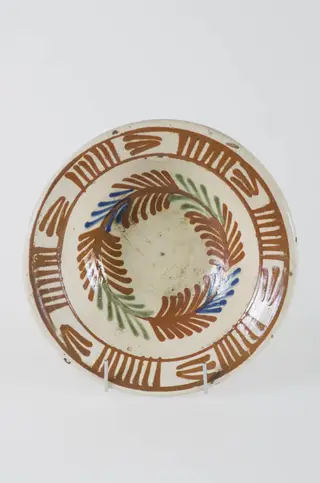 Blid de formă tronconică, lucrat la roată fiind smălțuit la interior cu smalț alb. Prezintă la exterior scurgeri de smalț și de vopsea. Buza este puternic profilată, îngroșată. Motivele decorative sunt vegetale, motivul brăduțului, pe fundul vasului, dispuse într-un registru circular, iar pe buza interioară se identifică un alt registru circular în interiorul căruia sunt pictate linii verticale paralele. Cromatică: fond: alb-gălbui; motive: cărămiziu; albastru; verde.
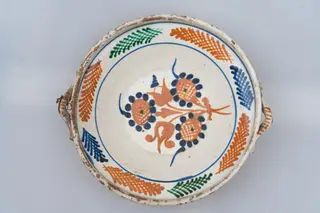 Farfurie adâncă de tip castron, cu corp tronconic și buză verticală. Este prevăzută cu două torți mici laterale, inserate orizontal, pe exteriorul buzei. Este modelată la roata olarului și angobată cu humă albă pe fața interioară și pe exteriorul buzei. Decorul este realizat prin pictare cu cornul și se compune din motive florale și geometrice: central pe fundul farfuriei este reprezentat un buchet format din cinci flori stilizate, dintre care două sunt lalele iar celălalte trei au centrul rotund, umplut cu linii hașurate intersectat și petale rotunde de culoare albastră. Partea superioară a peretelui vasului, imediat sub buză, conține un registru decorativ format din opt grupuri de motive formate din linii hașurate intersectat, de culoare verde, albastră și galben ocru, înscrise între două linii circulare albastre. Exteriorul buzei este decorat cu mici motive formate din linii curbe, crescătoareca mărime, de culoare albastră și galben ocru. Torțile sunt decorate cu mici linii paralele de culoare galben ocru. Suprafața ornamentată a farfuriei este acoperită cu un strat de smalț transparent. Cromatica: alb, albastru, verde, galben ocru.
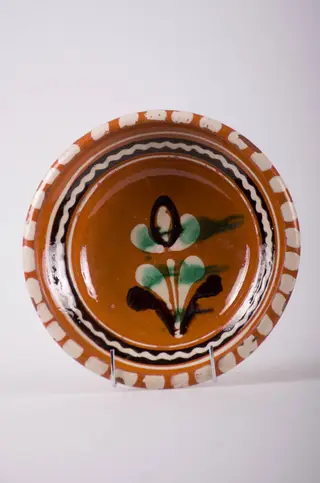 Vas de formă tronconică, adâncită. Pe fund are gaură pentru agățare; este smălțuit interior și exterior (doar buza); este decorat cu motive geometrice: linie, linie în val; în interior este decorat cu motive florale. Cromatică: fond: cărămiziu; motive: cărămiziu; maro; negru; verde.
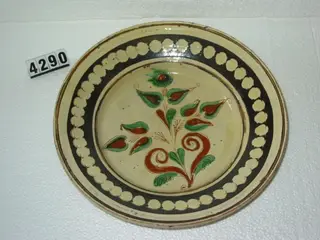 blid/talger
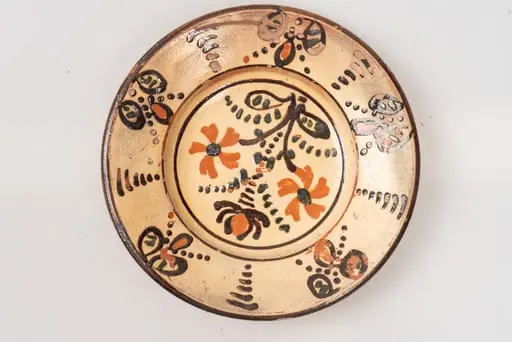 Farfurie de formă semi-adâncă, acoperită pe suprafața interioară cu un strat de angobă albă, peste care este pictat cu cornul și cu pensula decorul format din motive geometrice și florale stilizate: central pe fundul farfuriei, înscris într-un cerc maro, este pictată o tulpină de culoare maro, cu frunze și elemente vegetale de culoare verde închis și trei flori, două de culoare siena arsă, iar cea centrală cu petale maro. Buza farfuriei este decorată cu mici motive vegetale geometrizate cu contur maro, formate din câte două frunze cu două linii verzi în interior și un boboc de culoare galben ocru, completate cu linii punctate; între aceste motive se găsesc intercalate motive formate din linii mici paralele și descrescătoare ca mărime. Bordura interioară a farfuriei este marcată cu o linie circulară subțire iar muchia buzei cu o dungă de culoare maro. Suprafața ornamentată a farfuriei este acoperită cu un strat de smalț transparent. Cromatica: siena arsă, verde-închis, maro.
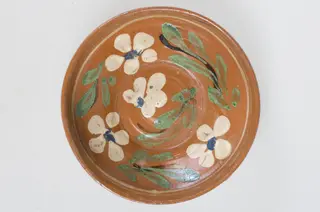 Blidul de formă tronconică adânc, smălțuit (la interior). Acesta este ornamentat cu motive florale, având cu buza înaltă. Blidul este neornamentat la exterior, fiind smălțuit (la exterior) doar pe buză. Pe exteriorul buzei este incizată o linie. Fundul obiectului are formă circulară, fiind prevăzut cu două orificii pentru prindere. Cromatică: fond: cărămiziu (exterior); alb (interior); decor: verde; alb; albastru; maro.
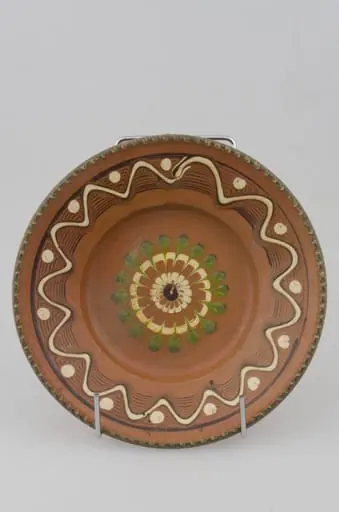 Farfurie cu pereții rotunjiți, marginea oblică lată și buza crestată. Prezintă decor geometric pe margine: linii frânte și curbe; pete de culoare; central avem o floare stilizată. Cromatică: fond: maro; motive: verde; alb.
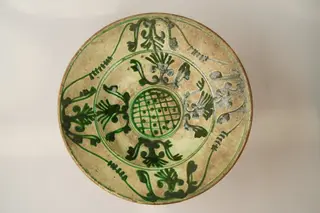 Farfurie mare, adâncă, cu buză lată dreaptă, evazată; suprafața interioară a piesei este acoperită cu un strat de angobă albă peste care este pictat cu cornul decorul monocromatic format din motive vegetale stilizate și geometrice, dispuse astfel: centrul farfuriei este decorat cu un cerc cu linii hașurate intersectat, de culoare verde, cu puncte verzi în interior; pe exteriorul acestui cerc, pe peretele farfuriei, sunt pictate patru motive vegetale aproximativ identice, formate din două frunze ce conțin în interior câte o floare formată din linii în formă de V (acest motiv poate fi interpretat și ca o floare de crin cu petalele deschise). Același motiv vegetal de pe peretele farfuriei se repetă de patru ori și pe buza acesteia, legătura între motive făcându-se cu o linie în formă de S ce are, perpendiculare pe mijloc, mici linii drepte verzi. Suprafața ornamentată a farfuriei este acoperită cu un strat de smalț transparent. Cromatica: alb, verde.
 farfurie
- Dish