Artwork
Japanese Drawing
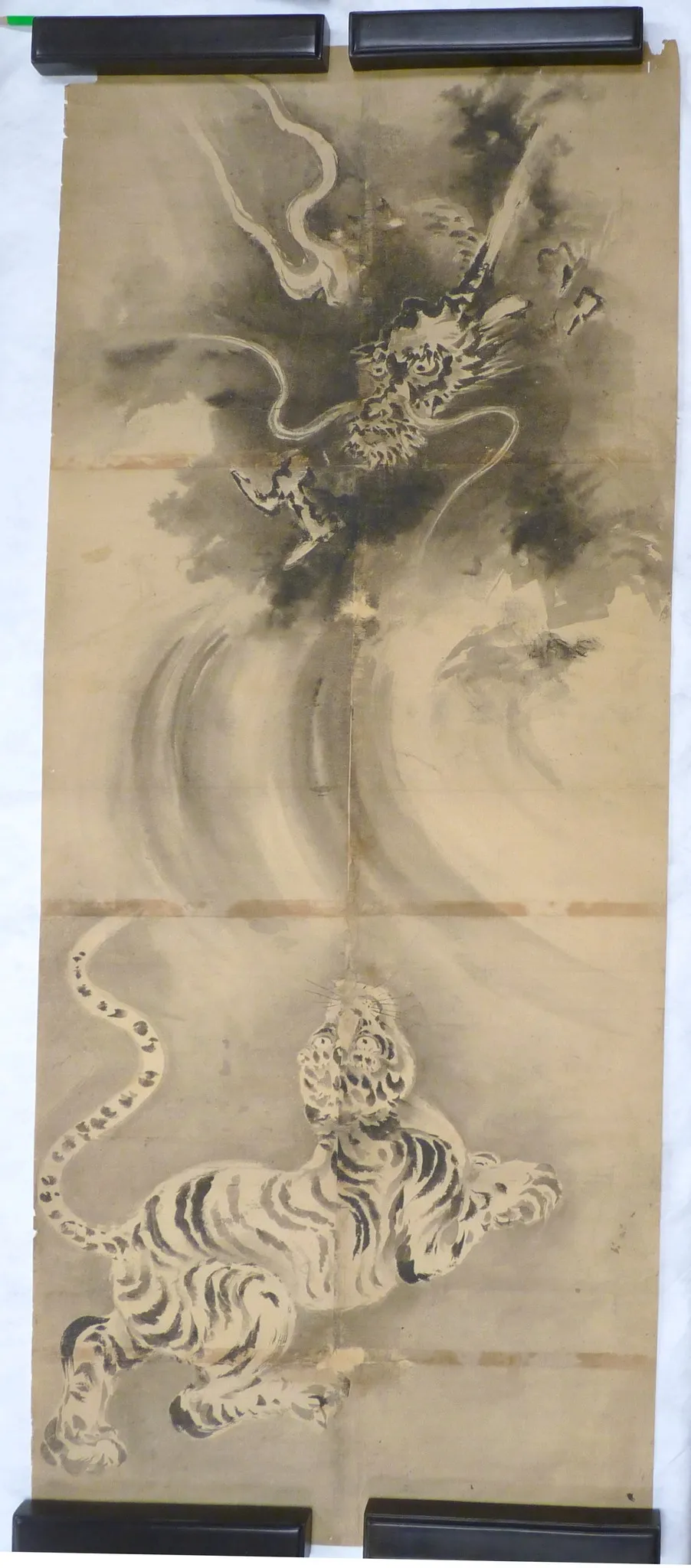
Japanese Drawing is an unspecified painting. It dates from 1816 and is held in the collection of the Metropolitan Museum of Art. The work is a monochrome ink drawing that portrays two tigers captured in the act of leaping.
About this work
History & Provenance
Beyond its permanent placement at the institution, no loans, displays, or prior exhibition venues are documented in the sources provided.
Japanese Drawing is a painting dated 1816, produced in Japan. It is held in the collection of the Metropolitan Museum of Art, where it is catalogued as MET 07.246.19. The work is attributed to an anonymous painter. No further details regarding commission, prior ownership, or chain of custody are documented in the available sources.
The accession number 07.246.19 suggests the work entered the Metropolitan Museum of Art's collection in 1907, though the sources do not explicitly confirm the acquisition date or circumstances.
Japanese Drawing is held in the collection of the Metropolitan Museum of Art. Its accession number is 07.246.19, as indicated by the MET prefix in the cataloguing reference. The work is located at the Metropolitan Museum of Art, where it has been documented as part of the museum's holdings. No exhibition history is recorded in the available sources.
The painting was produced in Japan in 1816 and entered the Metropolitan Museum of Art's collection, where it remains held. Beyond its permanent placement at the institution, no loans, displays, or prior exhibition venues are documented in the sources provided.
Legacy
The work's legacy is anchored to its presence in the Metropolitan Museum of Art collection, where it is catalogued as a painting by an anonymous Japanese artist created in 1816. Its inclusion in a major Western institution has contributed to broader recognition of early Japanese draftsmanship, influencing scholarship on pre-modern Asian drawing practices.
Overview
The work is a monochrome ink drawing that portrays two tigers captured in the act of leaping. The composition is dominated by stark black strokes on a light, paper-like ground, with the animals positioned one above the other. Empty space surrounds them, while swirling, smoke‑like lines suggest movement and atmosphere.
Subject & Meaning
Both felines are rendered with fierce expressions; the upper tiger bares an open mouth, emphasizing aggression, while the lower animal bears a crown‑shaped mark on its head, a motif that may allude to power or mythic symbolism. The dynamic poses and intertwined bodies convey a sense of conflict or primal energy.
Technique & Style
The artist employs bold, fluid ink lines to define musculature and motion, contrasting sharply with the pale background. The curling tail of the top tiger and the swirling background marks demonstrate a mastery of line work that creates depth without shading, echoing principles of chiaroscuro through the interplay of dense black and empty space.
Context
Rendered in a traditional Japanese format, the piece reflects the ink‑wash (sumi-e) tradition where simplicity and expressive brushwork are paramount. The emphasis on negative space and the stylized representation of animals align with aesthetic values found in Japanese animal studies and martial-themed scrolls.
Artist & collection