Artwork
Matsya, Fish Avatara of Vishnu
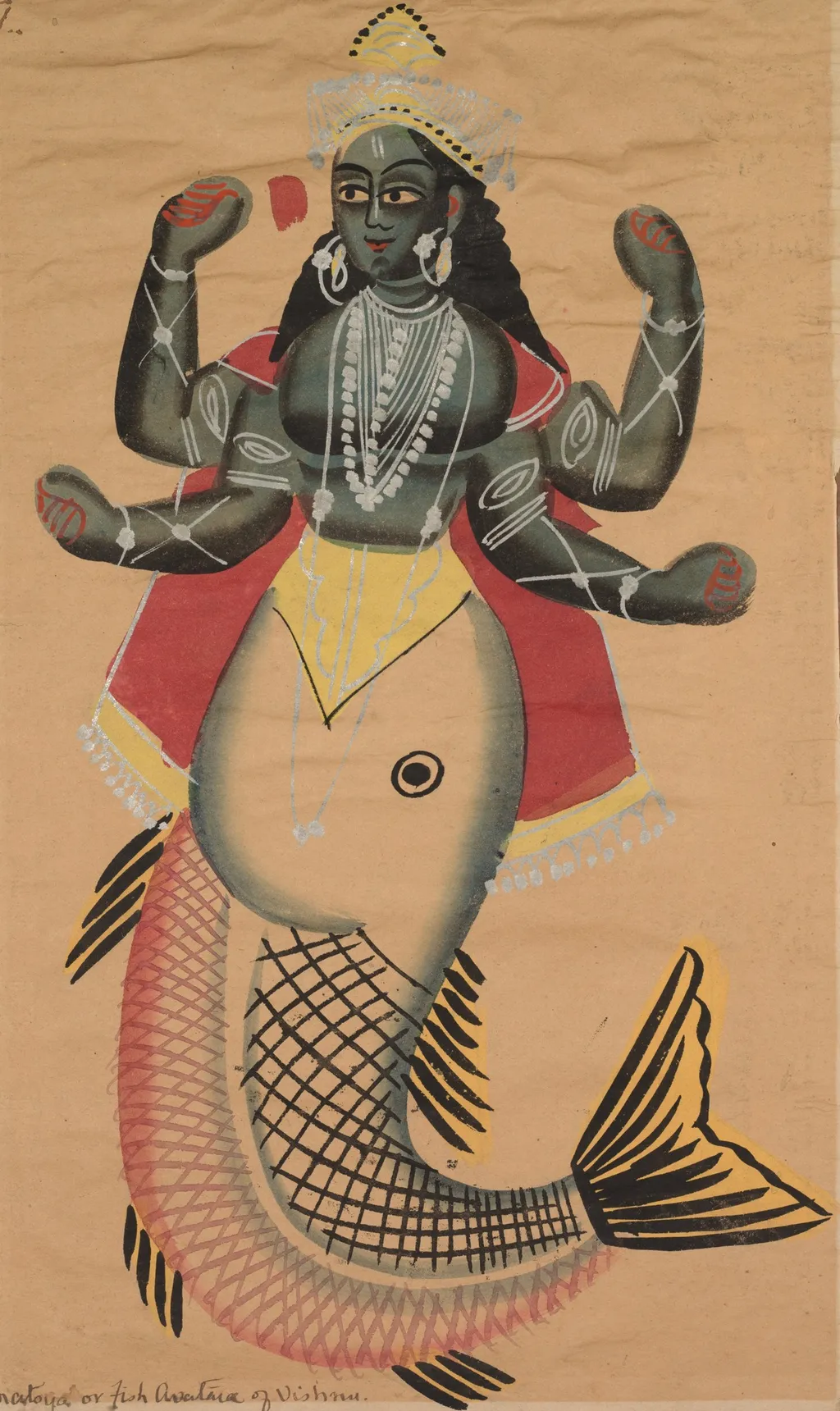
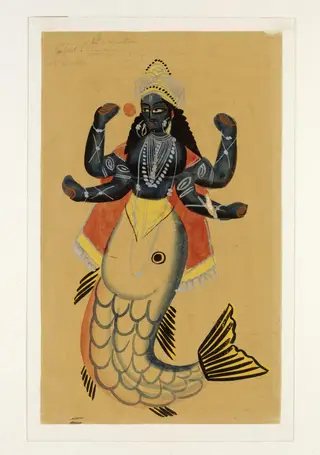
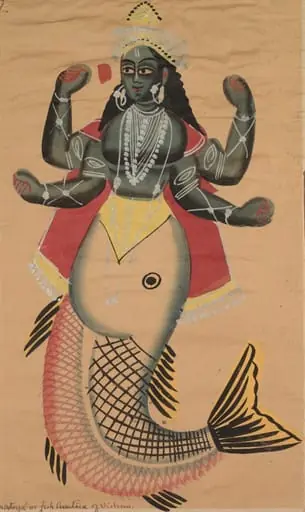
Matsya, Fish Avatara of Vishnu is an unspecified painting. It dates from 1896 and is held in the collection of the Cleveland Museum of Art. The work depicts a dark‑skinned deity with four arms seated upon a fish’s tail.
About this work
History & Provenance
No earlier ownership records, commission details, or later transfers are described in the available sources, leaving the provenance prior to 2003 undocumented.
The Matsya, Fish Avatara of Vishnu is a painting dated to 1890 and created in Kolkata by an unidentified artist. Its inception is recorded as 1890‑01‑01, confirming the year of production. The work is held by the Cleveland Museum of Art, where it is registered under accession number 2003.102, indicating its entry into the collection in 2003.
No earlier ownership records, commission details, or later transfers are described in the available sources, leaving the provenance prior to 2003 undocumented.
The painting Matsya, Fish Avatara of Vishnu, dated to 1890 and created in Kolkata, is held in the collection of the Cleveland Museum of Art. The work is cataloged under the accession number 2003.102. The piece was attributed to an unknown artist within the museum's records.
No specific exhibition history is provided in the available documentation.
Context
Scholarship on Matsya, Fish Avatara of Vishnu remains sparse, with limited critical analysis focused on its iconographic context within 19th-century Hindu theological revivalism. The work's attribution to an unknown artist and its creation in Kolkata during 1890 situates it within colonial-era artistic production, though specific reception details are undocumented. It is held by the Cleveland Museum of Art, which provides provenance but no published critical commentary on its contemporary or historical reception. The painting's stylistic and theological significance is noted primarily through cataloging data rather than scholarly discourse.
Legacy
The Matsya, Fish Avatara of Vishnu, painted in 1890 in Kolkata, influenced later representations of Vishnu's avatars in Indian art and scholarship. Its inclusion in the Cleveland Museum of Art's collection brought scholarly attention to the depiction of Hindu iconography in colonial-era works, contributing to broader recognition of cross-cultural artistic exchanges in the 19th century.
The painting's legacy is documented in museum records and academic discussions on Indian religious art, highlighting its role in shaping interpretations of Vishnu's avatars in modern contexts.
Overview
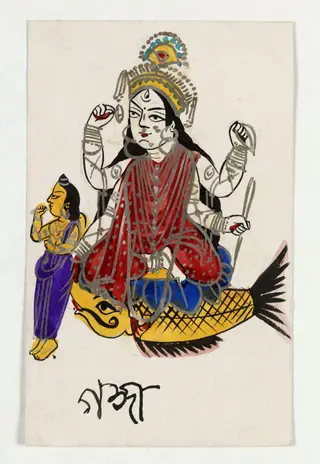
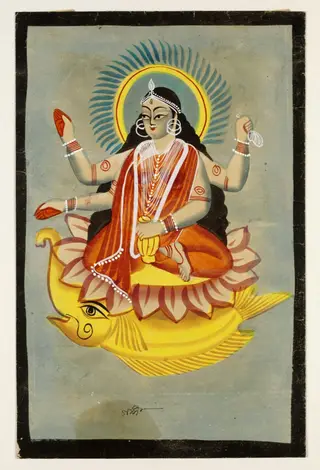
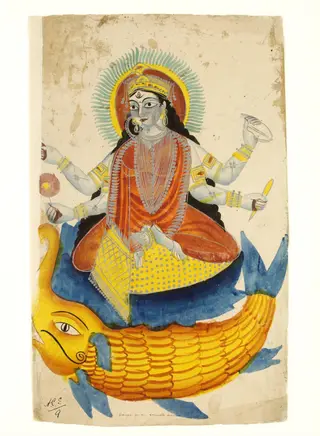
The work depicts a dark‑skinned deity with four arms seated upon a fish’s tail. He is dressed in a red skirt accented by a yellow sash, and his limbs are adorned with white ornamental jewelry. One hand clasps a red object, another gestures upward, while his face is rendered with a composed expression outlined in bold lines.
Subject & Meaning
The figure represents Matsya, the fish incarnation of the Hindu god Vishnu, who is traditionally shown emerging from the ocean to rescue sacred texts. The upward pointing hand suggests divine guidance, and the red object may symbolize the cosmic weapon or a ritual implement associated with the avatar’s protective role.
Technique & Style
Executed in a manner reminiscent of Kalighat painting, the piece combines flat, vivid coloration with strong contour lines. The fish tail features black scales and a contrasting yellow fin, illustrating the synthesis of human and animal forms typical of folk visual language. The overall composition relies on simplified forms and decorative detailing rather than realistic modeling.
Artist & collection