Artwork
Peace Urges the Churches to Tolerance
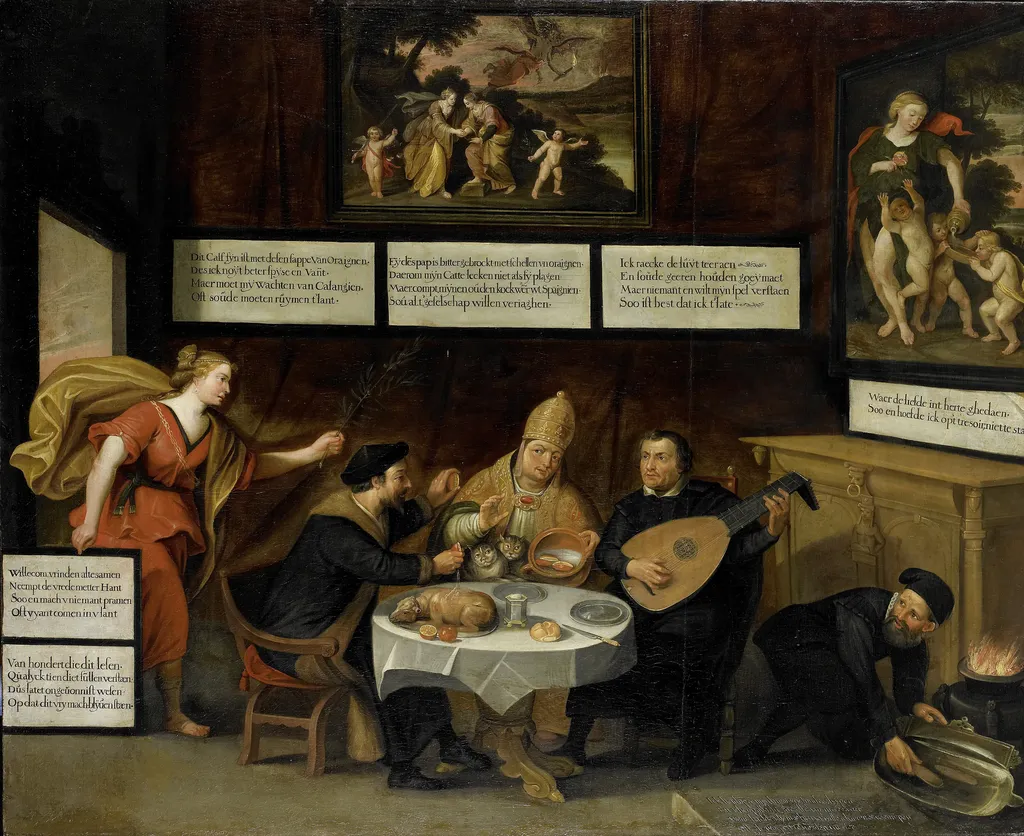
Peace Urges the Churches to Tolerance is an oil painting. It dates from 1620 and is held in the collection of the Museum Catharijneconvent.
About this work
The painting was donated to the Rijksmuseum in 1968 by a collector named Bosman.
This painting is called Peace Urges the Churches to Tolerance. It's an allegorical work made with oil paint.
The painting was donated to the Rijksmuseum in 1968 by a collector named Bosman. It had been purchased anonymously in France earlier that year. Since 1977, it has been on loan to the Catharijneconvent Museum in Utrecht.
You can learn more about this kind of art by looking up the museum: Rijksmuseum.
Subject & Meaning
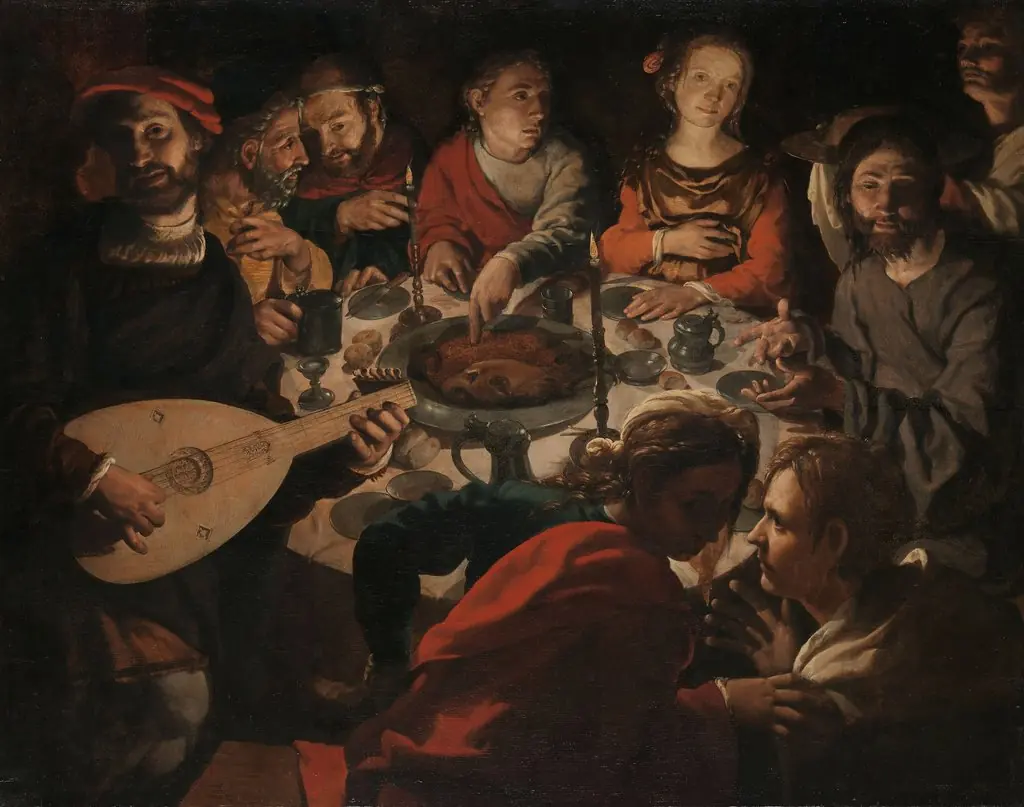
The painting depicts a satirical allegory of religious tolerance in the Low Countries during the early seventeenth century. At the center, three key figures from the Reformation sit at a table: the pope, Martin Luther playing a lute, and John Calvin, who squeezes half an orange over the pope's pot while offering the other half to him. The orange symbolizes Calvinism's ties to the House of Orange. A female personification of Peace enters bearing an olive branch, underscoring the theme of reconciliation.
In the background, two paintings hang on the wall: one pairing Peace with Justice, the other Charity with her children, reinforcing the moral message. Menno Simons, leader of the Anabaptists, kneels by a hearth holding a tray of bread, further representing diverse Christian groups. Explanatory verses on the walls clarify the scene's intent: to advocate tolerance among rival denominations rather than rigid adherence to one faith.
Technique & Style
The painting is executed in oil paint on canvas, a standard support for Dutch allegorical works of the early seventeenth century. Its dimensions are 131.5 cm in height by 162.5 cm in width, giving it a horizontal orientation suited to the multi-figure table scene it contains.
Stylistically, the work is an allegorical religious composition in which a female personification of Peace enters from the left bearing an olive branch, while the central figures, Jean Calvin, an unidentified pope and Martin Luther, are seated around a table. Luther plays a lute, and Calvin squeezes half an orange, using the fruit as a symbol of the link between Calvinism and the House of Orange. To the right, the Anabaptist Menno Simons crouches by a fireplace with a tray of bread.
Two smaller framed pictures hang on the background walls, depicting Peace with Justice, and Charity with her children, alongside explanatory verses inscribed on the room's walls.
History & Provenance
Created in the Low Countries between 1620 and 1637, this anonymous allegorical painting dates to the early seventeenth century. It remained in private hands until 1968, when it was purchased anonymously in France by Bosman, a Brussels collector, who donated it to the Rijksmuseum in Amsterdam that same year. The work is held in the Rijksmuseum collection under inventory number SK-A-4152 and has been on long-term loan to the Museum Catharijneconvent in Utrecht since 1977, where it remains on display. It was subsequently shown in the Rijksmuseum's "Luther" exhibition.
Context
Created by an anonymous artist in the Low Countries around 1620, this allegorical painting reflects the religious complexities of the early seventeenth-century Netherlands. The work belongs to a tradition of allegorical representations emphasizing that Christians need not adhere to a single denomination but should prioritize the love of Christ and mutual tolerance. The composition features Martin Luther, John Calvin, and a pope, alongside the Anabaptist Menno Simons, illustrating a call for unity amidst doctrinal divisions.
Symbolic elements, including an orange squeezed by Calvin to represent the House of Orange and a lute played by Luther, convey specific theological and political nuances. The painting was acquired in 1968 by a Brussels collector before entering the Rijksmuseum, and later moved to long-term loan at the Museum Catharijneconvent in 1977.
Overview
Peace Urges the Churches to Tolerance is an allegorical oil painting from the early 17th century, created sometime between 1600 and 1624. The artist responsible for this work remains unknown. As an allegorical piece, it employs symbolic figures and scenes to convey abstract ideas, likely addressing themes of religious unity or reconciliation during a period of significant confessional strife in Europe.
Artist & collection

- Sinful Mankind Surprised by the Day of Judgment
 Sinful Mankind Surprised by the Day of Judgment
 The Rich Man and Lazarus
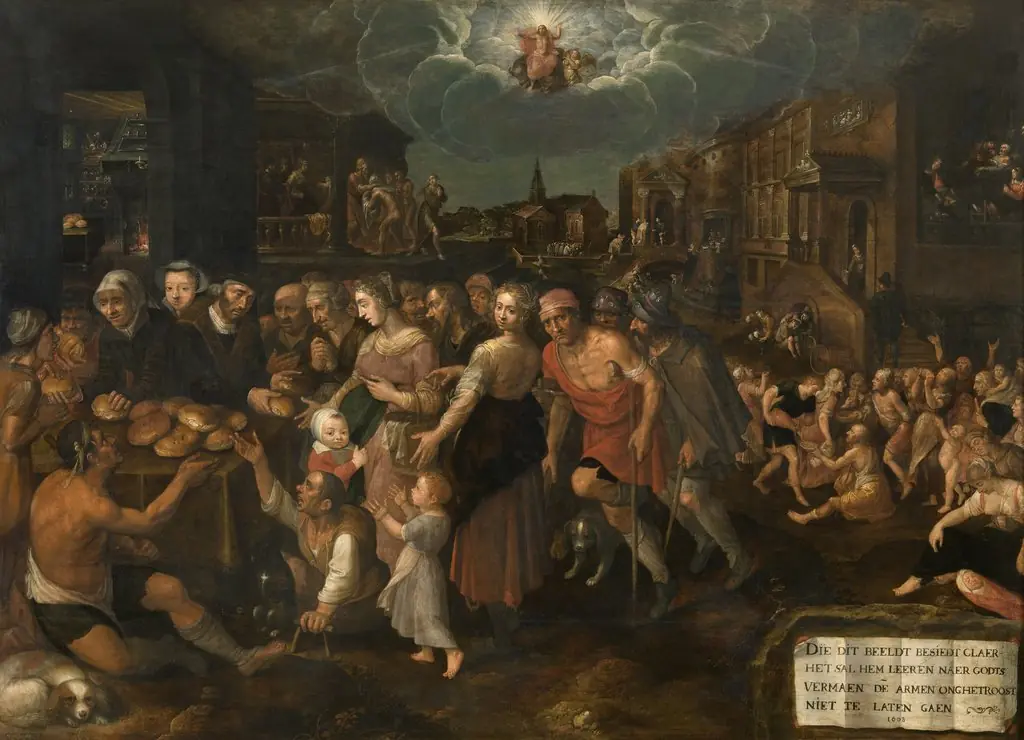 The Acts of Mercy
 Company at the table
 The Calling of Saint Matthew
 Musisoiva seurue
 Wise virgins and foolish virgins (Matthew 25:1-13)
 The city of Antwerp begs Emperor Ferdinand to open the Scheldt again
 Parable of the Wise and Foolish Virgins
 Lazarus and Dives
 The Marriage at Cana