Artwork
Self-portrait with thistle
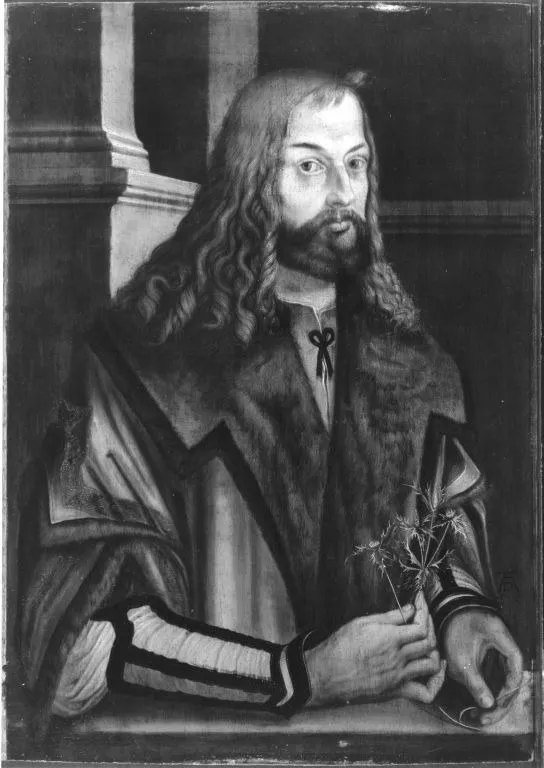
Self-portrait with thistle is an unspecified painting. It dates from 1550 and is held in the collection of the Bavarian State Painting Collections.
About this work
Subject & Meaning
The painting is a self-portrait depicting the German Renaissance artist Albrecht Dürer, shown in a manner consistent with his own self-portraiture tradition.
The painting is a self-portrait depicting the German Renaissance artist Albrecht Dürer, shown in a manner consistent with his own self-portraiture tradition. The central iconographic element is a thistle held by the sitter, a motif that has been read as a symbolic device rather than a mere attribute. In the visual language of the period, the thistle carried connotations of constancy, fidelity, and steadfastness, and its inclusion in a self-portrait is generally understood to convey a statement about the artist's character and self-conception.
Because the work is catalogued as being in the manner of Dürer rather than by his own hand, the thistle motif also functions as a deliberate quotation of his iconographic vocabulary, aligning the image with the master's established visual identity.
History & Provenance
The work known as Self-portrait with thistle is dated to 1550. It is classified as a painting executed in the manner of Albrecht Dürer, depicting the artist himself. The creation is attributed to the mid-16th century, with the specific inception year established as 1550.
The artwork is currently held within the collection of the Bavarian State Painting Collections, where it is housed at the Alte Pinakothek in Munich.
Overview
The work is a portrait of a bearded man with long hair, dressed in a dark coat trimmed with fur over a lighter shirt whose sleeves are rolled up. He holds a small bunch of thistle leaves in his right hand, and his expression is serious. The composition is dominated by deep shadows, with the thistle providing the sole bright element.
Technique & Style
The painting employs strong chiaroscuro, using pronounced contrasts between light and dark to model form and create depth. The thistle is rendered with a lighter palette that catches the viewer’s eye, while the rest of the scene recedes into shadow, emphasizing volume and the tactile quality of the fur‑trimmed coat.
Context
Executed in a period when portraiture often served both personal and symbolic purposes, the work reflects a tendency to embed emblematic flora within self‑portraiture. The dark, atmospheric background aligns with contemporary approaches to dramatize the sitter’s inner character through lighting.
Artist & collection

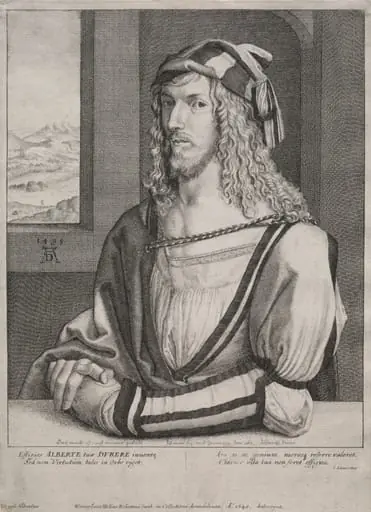
- Portrait of Albrecht Dürer, at the age of 26
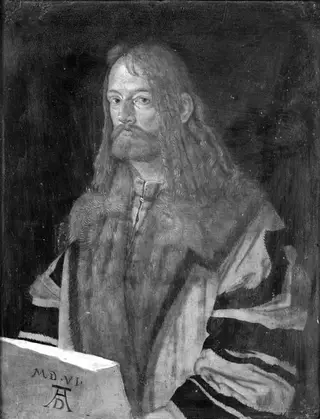 Portrait of the Artist
 Portrait of the Artist
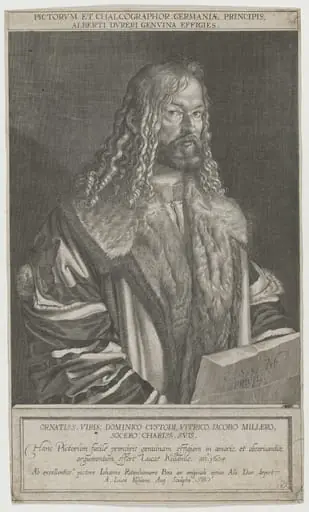 Albrecht Durer
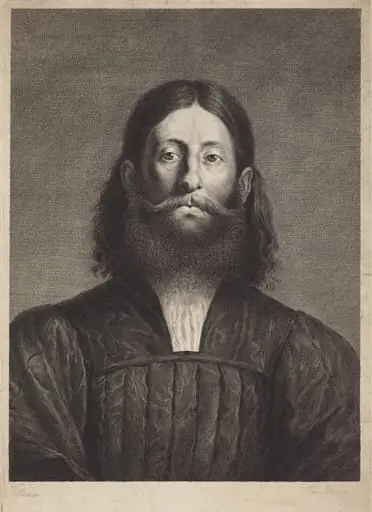 Giorgione Barbarelli
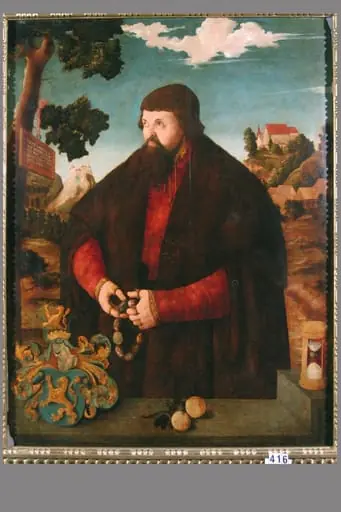 Lucas Hirscher, judele Brașovului
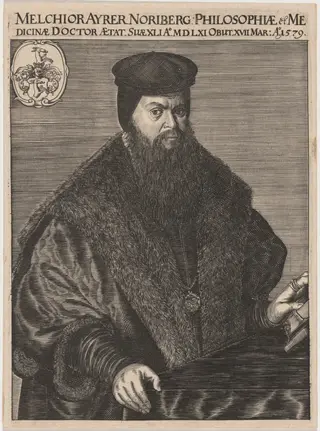 Melchior Ayrer, Philosopher and Doctor
 Portrait of a Man, Possibly Jean de Langeac (died 1541), Bishop of Limoges
 Portrait of Frederick III of Saxony
 Kurfürst Ludwig V. der Friedfertige, Pfalzgraf bei Rhein
 Maximilian I
 Charles Howard, First Earl of Nottingham