Artwork
Text, folio 20 (verso) from a Gandavyuha-sutra (Scripture of the Supreme Array)

Text, folio 20 (verso) from a Gandavyuha-sutra (Scripture of the Supreme Array) is an unspecified painting. It dates from 1100 and is held in the collection of the Cleveland Museum of Art.
About this work
History & Provenance
The Gandavyuha-sutra folio (verso) is a religious painting dated to 1099 (or 1099‑01‑01) and created in Nepal by an unidentified artist.
The Gandavyuha-sutra folio (verso) is a religious painting dated to 1099 (or 1099‑01‑01) and created in Nepal by an unidentified artist. Classified as a painting, it forms part of the Scripture of the Supreme Array. The sources record no earlier ownership, commission, or intermediate custodians; the work’s documented provenance begins with its arrival at the Cleveland Museum of Art, where it is catalogued as accession 1955.49.1.b. No further details about its subsequent exhibition history or later transfers are supplied in the available material.
The work is held in the collection of the Cleveland Museum of Art in Cleveland. It is cataloged under the accession number 1955.49.1.b. The provided sources do not list any specific exhibitions in which this folio has appeared.
The manuscript was created in Nepal in 1099 and is classified as a religious painting.
Overview
This wooden tablet represents folio 20 (verso) from a Gandavyuha-sutra, an important Buddhist scripture also known as the "Scripture of the Supreme Array." Its surface is meticulously covered with handwritten text, arranged in two columns, reflecting its function as a carrier of religious teachings. The aged appearance of the wood, marked by wear and discoloration along the edges, indicates its considerable age and historical journey as a devotional or scholarly artifact.
Subject & Meaning
As a component of the Gandavyuha-sutra, this folio contains a segment of a foundational Buddhist text. The sutra is renowned for its intricate narratives and profound philosophical teachings, often exploring the path to enlightenment through the journey of the bodhisattva Sudhana. The dense, word-packed script on this tablet would have conveyed a specific portion of these spiritual lessons or narrative elements to its original readers, contributing to a broader understanding of Buddhist doctrine.
Technique & Style
The tablet showcases a precise calligraphic style characteristic of medieval Indian manuscripts. The script is neatly handwritten, forming a dense block of text across the wooden surface. It is organized into two distinct columns, subtly separated by faint dividing lines, which aids readability.
The choice of wood as a medium, combined with the careful inscription, reflects the traditional methods of creating sacred texts during that historical period, emphasizing durability and reverence for the written word.

Artist & collection

- Text, folio 115 (verso) from a Gandavyuha-sutra (Manuscript of the Supreme Array)
 Text, folio 37 (verso) from a Gandavyuha-sutra (Scripture of the Supreme Array)
 Text, folio 22 (verso) from a Gandavyuha-sutra (Scripture of the Supreme Array)
 Text, folio 94 (verso) from a Gandavyuha-sutra (Scripture of the Supreme Array)
 Text, folio 73 (verso) from a Gandavyuha-sutra (Scripture of the Supreme Array)
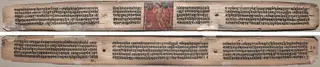 Folio 37 from a Gandavyuha-sutra (Scripture of the Supreme Array): Sudhana and a pair of antelopes (recto); text (verso)
 Text, folio 37 (verso) from a Gandavyuha-sutra (Scripture of the Supreme Array)
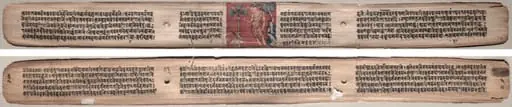 Folio 73 from a Gandavyuha-sutra (Scripture of the Supreme Array): Sudhana and an antelope (recto); text (verso)
 Text, folio 20 (verso) from a Gandavyuha-sutra (Scripture of the Supreme Array)
 Text, Folio 42 (verso), from a Manuscript of the Perfection of Wisdom in Eight Thousand Lines (Ashtasahasrika Prajnaparamita-sutra)
 Text, Folio 139 (verso), from a Manuscript of the Perfection of Wisdom in Eight Thousand Lines (Ashtasahasrika Prajnaparamita-sutra)
 Text, folio 166 (recto), from a Manuscript of the Perfection of Wisdom in Eight Thousand Lines (Ashtasahasrika Prajnaparamita-sutra)