Artwork
The battle between Carnival and Lent
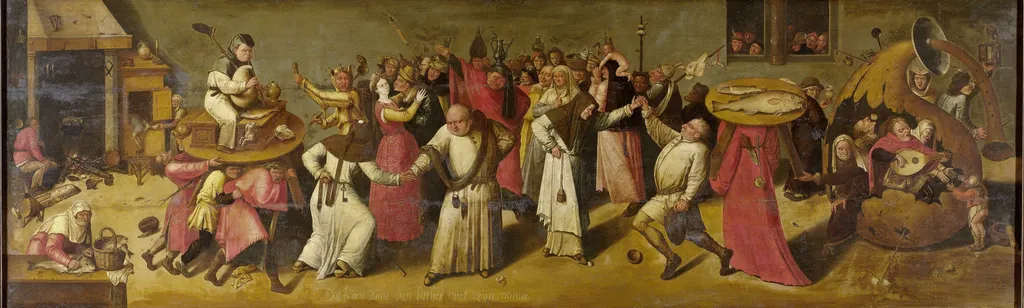
The battle between Carnival and Lent is an oil painting. It dates from 1600 and is held in the collection of the Rijksmuseum.
About this work
Subject & Meaning
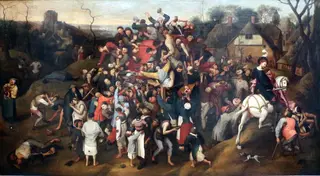
The painting depicts the allegorical struggle between Carnival and Lent, symbolizing the contrast between excess and moderation.
The painting depicts the allegorical struggle between Carnival and Lent, symbolizing the contrast between excess and moderation. Carnival is personified as a man playing a bagpipe, carried on a table from a kitchen, while Lent appears as a woman bearing a table with two fish, reflecting the custom of eating fish during the 'forbidden meat days.' Between these figures, a diverse crowd engages in a final dance, featuring symbols of folly such as a fool's staff, a turning wheel, and unusual headgear, alongside numerous beer and wine jugs.
Clergy members are notably present within this assembly. The composition is flanked by subsidiary scenes: a kitchen on the left showing wafer dough and fish cleaning, and musicians inside a giant, cracked bagpipe on the right, emitting symbols of foolishness. An inscription beneath the scene reads, 'This is the dance of Luther with his nun,' linking the satire to religious reform.
Technique & Style
The work is executed in oil paint on an oak panel support, consistent with Early Netherlandish practice of the late sixteenth century. The composition displays a pronounced horizontal format, measuring approximately 74.7 cm in height and 240 cm in width, allowing for an expansive, frieze-like arrangement of figures and scenes. Stylistically, the painting employs a vivid, descriptive palette with meticulous attention to costume, gesture, and emblematic detail, aligning it with the Antwerp circle of Bosch followers active around 1560.
The handling combines sharply delineated figures with a lively, almost caricatured expressiveness, underscored by the inclusion of satirical motifs such as fool’s staves, windmills, and oversized drinking vessels. The surface remains in generally stable condition, though the horizontal format and oak support suggest susceptibility to warping and paint layer stress over time.
History & Provenance
The painting, dated circa 1600, is attributed to a follower of Jheronimus Bosch rather than the master himself. Dendrochronological analysis indicates the oak panel was created no earlier than 1583, suggesting an origin in Antwerp around 1560 within the circle of Bosch imitators like Frans Huys and Jan Verbeeck. The work was acquired by the Rijksmuseum in March 1896 from the Parisian art dealer François Kleinberger.
It subsequently served as a loan to Muiderslot from 1949 until 1978. In 1984, the piece entered the long-term loan collection of the Museum Catharijneconvent in Utrecht, where it remains housed. While other versions exist, including a grisaille in 's-Hertogenbosch dated between 1540 and 1550, the Utrecht version represents a later iteration of the composition.
Context
The work is recognized as a creation by a follower of Jheronimus Bosch rather than the master himself, reflecting the enduring influence of Bosch's style in the mid-to-late sixteenth century. Art historical scholarship, notably by Gerd Unverfehrt, dates the original composition to approximately 1560 in Antwerp, linking it to the circle of Bosch imitators such as Frans Huys and Jan Verbeeck. Dendrochronological analysis places the specific Utrecht version, currently housed in the Museum Catharijneconvent, around 1583 or later.
The painting serves as a satirical religious allegory contrasting excess with moderation, a theme central to Early Netherlandish art. Its inclusion in major exhibitions, such as the 1967 and 2001 Bosch retrospectives in 's-Hertogenbosch, underscores its significance within the broader trajectory of Bosch reception, even as it is categorized as a work in his manner.
Overview
The oil painting titled The Battle between Carnival and Lent depicts a boisterous and densely populated scene. It captures a moment of intense activity where numerous figures engage in a chaotic interplay of revelry and conflict. The composition is filled with individuals dancing, struggling, and transporting large platters laden with food, creating a dynamic visual narrative.
This work exemplifies a common allegorical theme in art, rendered with an emphasis on human interaction and disarray.
Artist & collection