Artwork
Fire
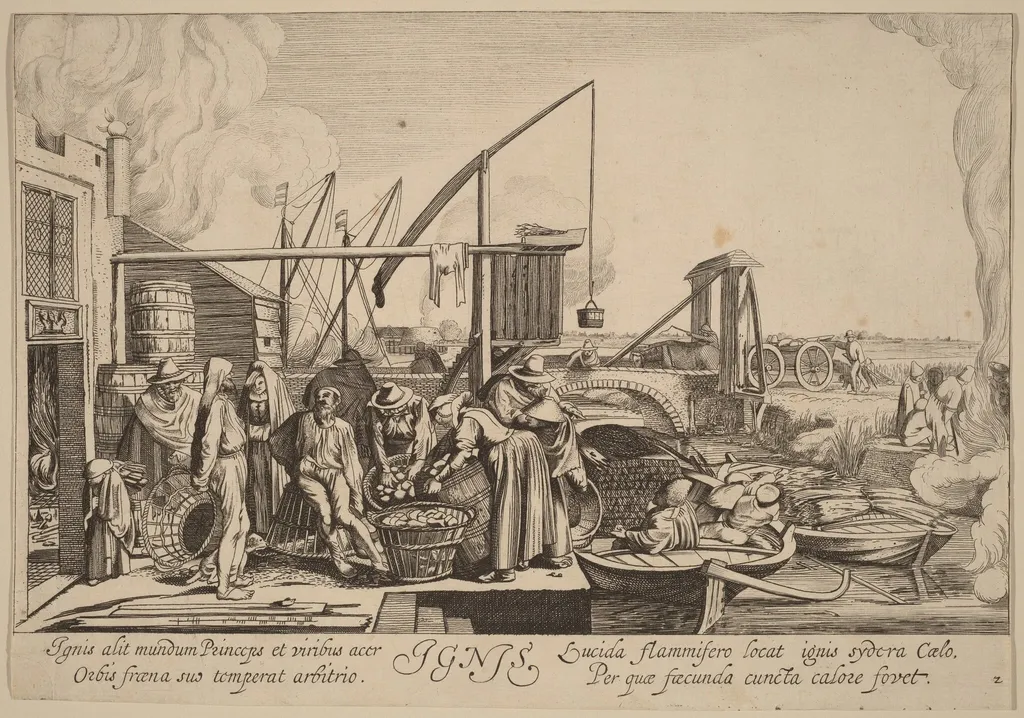
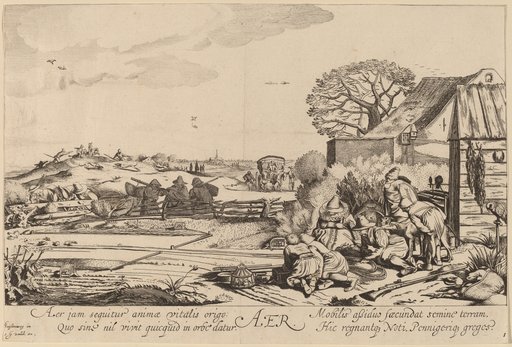
Fire is an ink print by the Renaissance artist Velde, Jan van de, II. It dates from 1617 and is held in the collection of the National Gallery of Art.
About this work
Overview
Created in 1617, Fire is an etching by Jan van de Velde the Younger, a Dutch artist known for his detailed depictions of everyday life.
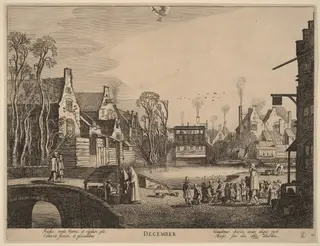
Created in 1617, Fire is an etching by Jan van de Velde the Younger, a Dutch artist known for his detailed depictions of everyday life. The print captures a moment of chaos along a riverbank, where a blaze consumes a wooden structure. Van de Velde’s skill in etching allowed him to render complex scenes with fine, controlled lines, reflecting his technical precision and interest in transient, dynamic subjects.
Subject & Meaning
The scene portrays a community responding to an urban fire, with figures engaged in rescue, observation, and routine activity. A crane lifts debris, boats are loaded with hay and barrels, and a group gathers near food, suggesting life continues amid crisis. The juxtaposition of urgency and normalcy implies a quiet commentary on human resilience, without overt moralizing or symbolism.
Technique & Style
Van de Velde employed fine, incised lines to convey smoke, motion, and light. The glow of the fire is suggested through subtle tonal variations rather than bold contrasts, a challenging effect in etching. His attention to atmospheric perspective and the interplay of figures with architecture demonstrates a mature command of the medium, balancing detail with compositional flow.
History & Provenance
Jan van de Velde the Younger came from a family of artists; his father and son were also printmakers. Fire belongs to a series of prints he produced in the early 1610s, often depicting rural and urban labor. While its early ownership is undocumented, the work entered major collections in the 18th and 19th centuries, reflecting its recognition among connoisseurs of Dutch graphic art.
Context
In early 17th-century Holland, etching was gaining popularity as a medium for capturing contemporary life. Van de Velde’s work aligns with a broader trend among Dutch artists to document ordinary moments with observational rigor. Unlike grand historical scenes, his prints emphasized immediacy and the quiet drama of daily existence, resonating with a growing urban audience.
Legacy
Van de Velde’s Fire exemplifies the potential of etching to convey narrative and atmosphere with subtlety. His influence extended through his family and contemporaries, contributing to the development of Dutch printmaking as a serious artistic discipline. The work remains a reference for its nuanced handling of light, movement, and human activity in a moment of crisis.
Own this work as a print
Artist & collection
Artist
Jan van de Velde the younger (1593 – c. 1 November 1641) was a Dutch Golden Age painter and printmaker, mostly of animal, landscape and still-life subjects. He was the son of Jan van de Velde the Elder and the father of…