Artwork
Orpheus
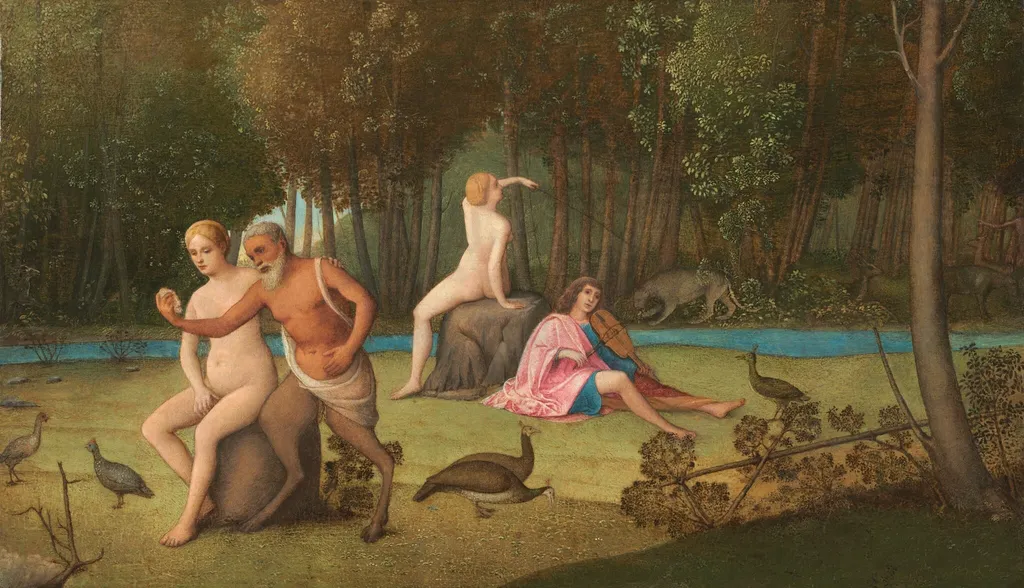
Orpheus is an oil painting. It dates from 1515 and is held in the collection of the National Gallery of Art.
About this work
A man in old-fashioned dress kneels in a dark wood, holding a lyre and looking up at a woman in white, a small dog at his side. He is Orpheus, the musician of Greek myth whose playing calmed wild beasts. The woman may be his lost Eurydice. By a Venetian painter of the 16th century.
Subject & Meaning
The subject matter aligns with the 16th-century Venetian interest in classical narratives, presenting the hero as the sole focus of the composition.
The painting depicts the mythological figure Orpheus, a central subject of classical legend known for his musical prowess. As a work of mythological genre, the composition centers on this specific character from ancient tradition. The subject matter aligns with the 16th-century Venetian interest in classical narratives, presenting the hero as the sole focus of the composition.
While the specific actions or accompanying figures are not detailed in the available records, the identification of the figure as Orpheus establishes the work's primary symbolic association with music, poetry, and the power of art to influence the natural world and even the underworld. The depiction serves as a visual representation of this enduring mythological archetype.
Technique & Style
The work titled Orpheus, dated 1515, is executed in oil on a wooden panel that has been transferred to canvas, a technique typical of Venetian painting of the early 16th century. Its support now consists of canvas, measuring approximately 39.5 cm in height by 81 cm in width. The painting belongs to the mythological genre and portrays the legendary musician Orpheus.
As a piece in the National Gallery of Art’s collection, it reflects the stylistic conventions of Venetian art, including rich coloration and delicate modeling of figures, though specific details of its current condition are not recorded in the available documentation.
History & Provenance
Dated to 1515, this oil painting on panel (later transferred to canvas) was created by an anonymous Venetian sixteenth-century artist. The work's early ownership history suggests it may have belonged to Giovanni Cornaro in Venice by approximately 1520 and potentially entered the collection of Charles I of England. In the modern era, the piece was held by the Florentine dealer Stefano Bardini and presumably passed to his heir, Ugo Bardini, in Paris.
In 1925, it was sold to the London firms Thomas Agnew & Sons and Arthur J. Sulley & Co. on a joint account. Later that year, the painting was acquired using funds from the estate of Peter A.B. Widener. Joseph E. Widener subsequently gifted the work to the National Gallery of Art in Washington, D.C., in 1942.
The painting Orpheus, attributed to a Venetian artist of the early sixteenth century and dated 1515, is housed in the National Gallery of Art in Washington, D.C. Its provenance traces from possible ownership by Giovanni Cornaro and Charles I to the Bardini family, a 1925 sale to Thos. Agnew & Sons, and a 1942 gift from the estate of Peter A. B. Widener to the NGA. The work is accessioned in the museum’s collection without a separate inventory number listed in the available records. Exhibition history is not documented in the cited sources.
Overview
The painting Orpheus, executed in oil on panel and later transferred to canvas, depicts a scene from classical mythology. A male figure, identified as Orpheus, kneels within a somber woodland setting, holding a lyre. He directs his gaze upwards towards a woman dressed in white, who may be his lost love, Eurydice. A small dog is seated beside him.
Context
The myth of Orpheus is a recurring theme in ancient literature and art, appearing in numerous classical narratives. His journey to the underworld to retrieve Eurydice, and his eventual failure, has inspired countless interpretations across centuries. This painting contributes to a long tradition of artistic engagement with his story.
Artist & collection