Artwork
Circe and Her Lovers in a Landscape
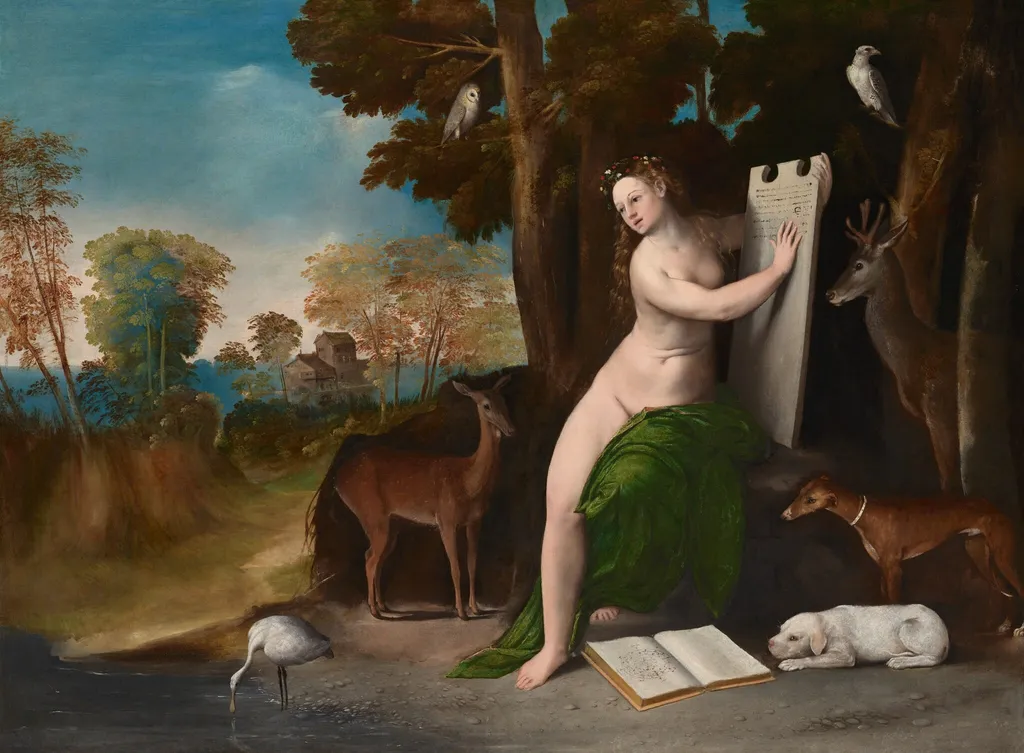
Circe and Her Lovers in a Landscape is an oil painting by the Mannerist artist Dosso Dossi. It dates from 1525 and is held in the collection of the National Gallery of Art.
About this work
Subject & Meaning
The composition is set in a wooded landscape with distant buildings, a flushed horizon and blue sky.
Circe appears crowned with flowers, half seated and half standing, nude save for a green drapery over her left leg, and she gestures toward a stone tablet inscribed with legal formulas. Around her gather the lovers transformed into birds and beasts, a greyhound, a white puppy, a stag with velvet-like horns, a hawk, an owl, a spoonbill, and a familiar hind, while an open spellbook rests at her feet. The composition is set in a wooded landscape with distant buildings, a flushed horizon and blue sky.
These iconographic elements convey her role as a magician who turns human desire into animal form, a theme that art historians link to the playful, semi-mythical atmosphere characteristic of Dosso Dossi's early works.
Technique & Style
Executed circa 1525 in oil on canvas measuring 100.8 x 136.1 cm, the work belongs to Dosso Dossi's mature Ferrarese manner. Handling emphasizes softly blended passages, with Circe's flesh rendered in warm, luminous glazes that grade into cooler shadows, while the surrounding animals and landscape retain a more schematic, almost whimsical precision. The composition is anchored by a central, half-reclining Circe draped in a single emerald-green cloth; she holds a stone tablet inscribed with magical precepts and gazes toward an open grimoire at her feet.
The surrounding fauna, stag, hound, owl, spoonbill, greyhound, puppy, and hind, are depicted with delicate linearity against a hazy, wooded backdrop of bulbous, cottony foliage. The horizon dissolves in a luminous, blue-tinged sky, typical of Dossi's atmospheric lyricism.
History & Provenance
Dating to approximately 1525, the work is attributed to Dosso Dossi and likely originated for the court of Ferrara, possibly for Alfonso I d'Este's Camera d'Alabastro, though it was not part of the specific Aeneid frieze due to differing dimensions. The painting's documented history begins in the 19th century within the London collection of William Graham. Following Graham's death, it was sold at Christie's in April 1886 and subsequently handled by the dealer Colnaghi.
It later entered the ownership of Robert Henry and Evelyn Benson, who sold it in 1927 to Duveen Brothers. The New York firm sold the painting in 1942 to the Samuel H. Kress Foundation, which donated it to the National Gallery of Art in Washington, D.C., in 1943.
Circe and Her Lovers in a Landscape is held by the National Gallery of Art in Washington, D.C. The work entered the museum as a gift from the Samuel H. Kress Foundation in 1943, having previously been owned by William Graham, sold through Colnaghi in 1886, and acquired by Robert Henry and Evelyn Benson before Duveen Brothers purchased it in 1927. It is documented as part of the Kress Collection. No exhibition history beyond display within the museum's permanent collection is recorded in the cited sources.
Context
Scholars have linked Circe and Her Lovers in a Landscape to Dosso Dossi's activity in the Camerini d'Alabastro of Alfonso I d'Este at Ferrara, where fantastical imagery and literary culture intersected during the 1520s. Early commentary by Robert Henry Benson characterizes the painting as an early work shaped by contact with Giorgione and Titian, noting a playful approach to mythological subject matter that aligns with Ferrarese taste for witty invention. Later assessments emphasize its alignment with the Este court's patronage of Ariosto and similar literary milieux, treating the sorceress's tableau as a visual counterpart to poetic evocations of magic and metamorphosis.
The work's reception has also been framed by its modern market trajectory, passing from the Graham collection through Colnaghi and Duveen to the Samuel H. Kress Foundation before entering the National Gallery of Art in 1943, a path that underscores its status as a prized example of the School of Ferrara within American collecting.
Overview
Dosso Dossi's oil painting, Circe and Her Lovers in a Landscape, created around 1525, depicts the mythological sorceress amidst a natural setting. This work, rendered on canvas, is a notable example of Italian Renaissance art and is housed in the collection of the National Gallery of Art in Washington, D.C. The composition features Circe surrounded by figures and animals, seemingly engaged in an act of enchantment within a verdant scene.
Own this work as a print
Artist & collection

Artist
Giovanni di Niccolò de Luteri, better known as Dosso Dossi (c. 1489–1542) was an Italian Renaissance painter who belonged to the School of Ferrara, painting in a style mainly influenced by Venetian painting, in…