Artwork
Allegory
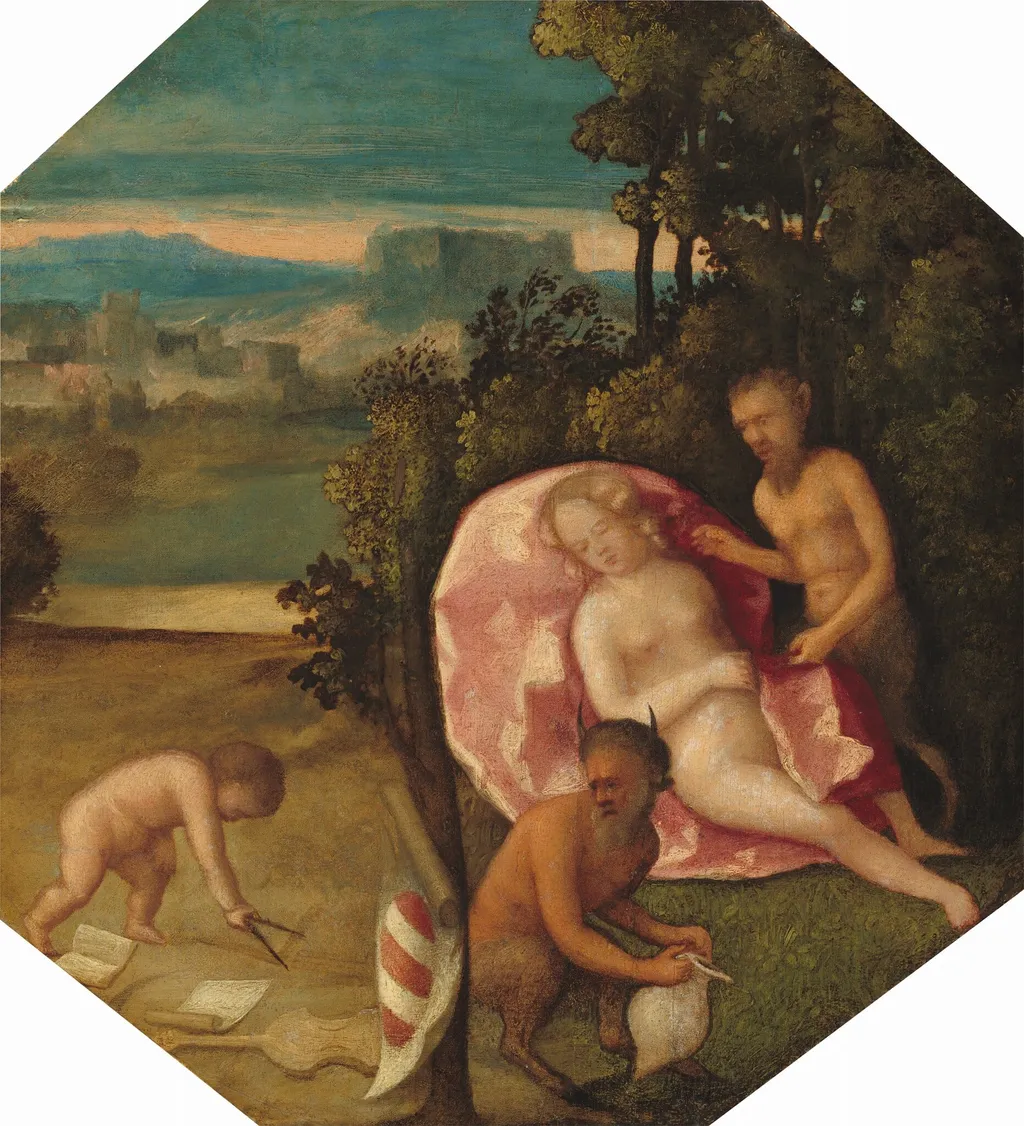
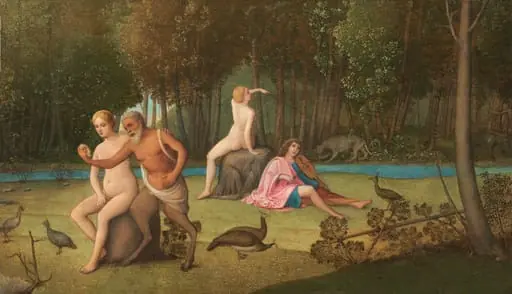
Allegory is an oil painting by the Mannerist artist Pietro degli Ingannati. It dates from 1520 and is held in the collection of the National Gallery of Art.
About this work
Technique & Style
Allegory is executed in oil on panel, a standard support for Venetian painting of the early sixteenth century.
Allegory is executed in oil on panel, a standard support for Venetian painting of the early sixteenth century. The work is relatively small in scale, measuring 43 cm in height by 39.2 cm in width, and is classified as a painting within the allegory genre. Its modest dimensions and panel support are consistent with cabinet pictures produced in the Veneto during this period, a format suited to private devotional or contemplative viewing rather than large-scale display.
The painting is held in the collection of the National Gallery of Art in Washington, D.C., where it has been preserved as part of the museum's holdings since its 1948 gift.
History & Provenance
Pietro degli Ingannati's Allegory is dated to 1520. Its early provenance is uncertain, though it may have belonged to the Fletcher family in Asolo, Italy, during the 18th century. By 1936, the painting had probably been acquired in Italy by Sigmund Pollak, who sold it in 1941 to his brother-in-law, Felix Laurence of New York.
Laurence then sold it to Dr. and Mrs. George H. Alexander Clowes of Dover, Massachusetts. The Cloweses donated the work to the National Gallery of Art in 1948, where it remains.
Since 1948, Allegory has been held in the permanent collection of the National Gallery of Art in Washington, D.C. The painting was accessioned under inventory number 1948.1.1 following its donation by Dr. and Mrs. George H. Alexander Clowes. No public exhibition history before 1948 is documented in the available sources.
Context
The Allegory by Pietro degli Ingannati, dated 1520, exemplifies Venetian allegorical painting of the early sixteenth century. Executed in oil on panel, the work measures 43 × 39.2 cm and belongs to the genre of allegory, as recorded in both the National Gallery of Art catalog and scholarly references. Its provenance follows a documented chain from the Fletcher family in Asolo, through Sigmund Pollak, to Felix Laurence, and finally to the Clowes family before its 1948 donation to the National Gallery of Art.
Art historical analysis places the work within the broader tradition of Venetian allegories, highlighting its stylistic connections to contemporary Venetian allegorical practices.
Overview
Pietro degli Ingannati, an Italian Renaissance painter, created Allegory around 1520. This oil on panel painting exemplifies the Mannerist style, a movement that emerged from the High Renaissance. The work presents a complex narrative through its allegorical subject matter, inviting viewers to interpret its symbolic elements. Ingannati was active between 1529 and 1548, and is also known for his religious compositions and portraiture.
Subject & Meaning
The painting depicts a tranquil outdoor scene featuring a reclining nude woman on a striped fabric, attended by three male figures. One man stands behind her, another crouches nearby holding a white object, while a third is visible in the distance. In the foreground, a child interacts with papers and a stick.
These elements combine within a serene landscape, suggesting a symbolic narrative rather than a literal event, characteristic of allegorical works.

Own this work as a print
Artist & collection
Artist
Pietro degli Ingannati, also Pellegrino di Giovanni di Antonio, (active 1529–1548) was an Italian Renaissance painter who is known for his paintings of the Virgin and Child and his portraits.