Artwork
The Ghost Story
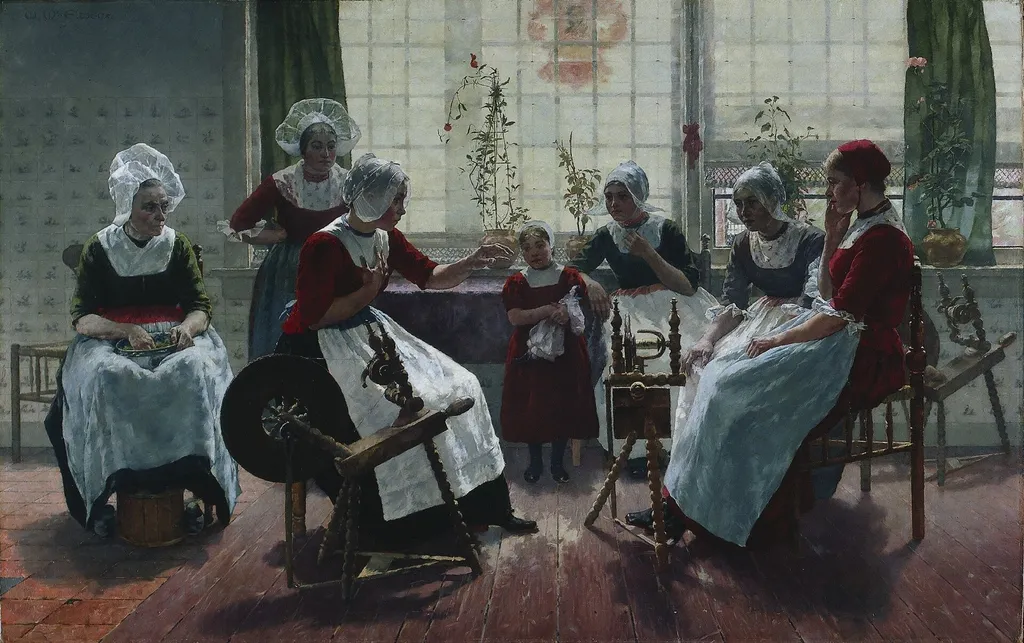
The Ghost Story is an oil painting by the Post-Impressionist artist Walter MacEwen. It dates from 1894 and is held in the collection of the Cleveland Museum of Art.
About this work
Technique & Style
The physical dimensions and material composition define the formal scale of the artwork, which remains part of the Cleveland Museum of Art collection.
Walter MacEwen's The Ghost Story is an oil painting executed on a canvas support. Created in 1894, the work measures 121 cm in height and 191.5 cm in width. Classified as a genre scene, the piece utilizes oil paint to depict its narrative content within the American context.
The physical dimensions and material composition define the formal scale of the artwork, which remains part of the Cleveland Museum of Art collection.
History & Provenance
The Ghost Story is an oil on canvas painting executed in 1894 by American artist Walter MacEwen. The work was produced in the United States and subsequently entered the collection of the Cleveland Museum of Art, where it has been held since its acquisition. Its dimensions measure 121 cm by 191.5 cm, and it is classified as a genre scene.
The painting carries the accession number 1923.416. The provided records do not list specific exhibitions or further provenance details beyond its current institutional location.
Context
The Ghost Story is an 1894 oil on canvas genre scene by American painter Walter MacEwen, recorded in the Cleveland Museum of Art collection and documented in its catalogue. Its dimensions of 121 cm by 191.5 cm place it among the larger canvases of the period, highlighting the artist’s focus on narrative subjects. As a work held by a major American institution, it contributes to the understanding of late-19th-century American genre painting.
Overview
Painted in 1894, The Ghost Story by American artist Walter MacEwen is a genre scene depicting an intimate interior moment among seven women. The composition centers on a group seated in a dimly lit room with wooden floors, engaged in domestic tasks such as stitching and spinning thread. MacEwen arranges the figures to suggest a narrative focus, with the woman on the right appearing to recount a tale to her attentive companions.
The setting is rendered with a subdued palette, where faint light enters through a window, illuminating a climbing plant and casting soft shadows across the plain walls. The women are distinguished by their attire, with some wearing white caps and others red headscarves, adding subtle color accents to the otherwise muted environment. A table in the foreground holds various cloths and tools, grounding the scene in the daily reality of textile work.
This work exemplifies MacEwen's interest in domestic interiors and the quiet social dynamics of late 19th-century American life. Created during a period when the artist was refining his technique in genre painting, the piece reflects the influence of European academic training while capturing a distinctly American subject matter. The title implies a narrative layer beyond the visual action, inviting viewers to imagine the spoken story that unites the group in this shared, shadowed space.
Subject & Meaning
The painting portrays seven women gathered in a dimly lit room, some occupied with stitching or spinning while others attentively listen. Their attire, including white caps and red headscarves, suggests a traditional or rural setting. A central figure on the right appears to be recounting a tale, her audience absorbed.
The work's title, The Ghost Story, introduces an element of the supernatural, contrasting with the otherwise tranquil and ordinary domestic environment depicted.
Own this work as a print
Artist & collection

Artist
Walter MacEwen was an American painter. From 1884 to 1914, he often lived and worked in the Netherlands. He is considered to have been a member of the Egmondse School, named after the mostly American artists' colony near Egmond aan Zee.