Artwork
The Antique Shop
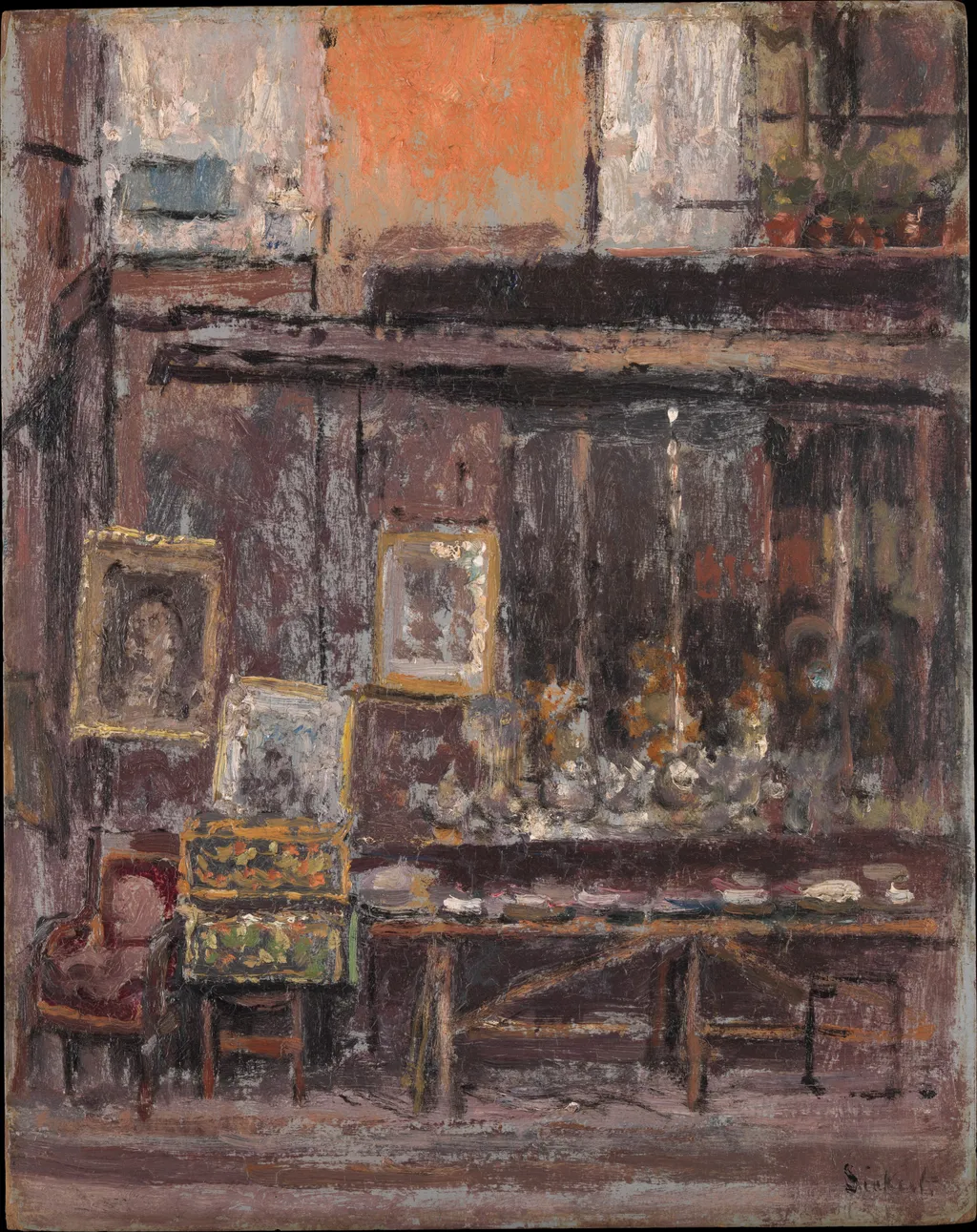
The Antique Shop is an oil painting by the Post-Impressionist artist Walter Richard Sickert. It dates from 1906 and is held in the collection of the Metropolitan Museum of Art.
About this work
Subject & Meaning
Walter Sickert's 1906 oil painting, The Antique Shop, depicts the interior of a shop.
Walter Sickert's 1906 oil painting, The Antique Shop, depicts the interior of a shop. The work focuses on the commercial space itself, presenting a scene centered on the retail environment rather than specific narrative figures or allegorical events. As an urban genre scene, the piece captures the atmosphere of a London antique dealer's premises, reflecting Sickert's broader interest in the daily life and architectural settings of the city.
Technique & Style
Executed in 1906, The Antique Shop is an oil painting by Walter Sickert. Unusually, the artist applied the oil paint onto a cardboard support rather than a traditional canvas or wood panel. The work measures 24.1 cm in height and 19.1 cm in width.
As a painting, it utilizes the opaque and blendable qualities of oil media to render its subject, a shop interior, though specific details regarding its current surface condition or handling history are not provided in the available records.
History & Provenance
Walter Sickert painted The Antique Shop in 1906, an oil on cardboard work depicting a shop interior. The painting entered the collection of the Metropolitan Museum of Art, where it remains on view.
The work was created during Sickert’s early London period, reflecting his interest in everyday urban scenes and commercial interiors.
The Antique Shop, an oil painting by Walter Sickert from 1906, is held in the collection of the Metropolitan Museum of Art. According to Wikidata records, the work is catalogued as part of that institution's holdings, with its location listed as the Metropolitan Museum of Art. The painting measures 24.1 cm in height by 19.1 cm in width and is executed in oil paint on cardboard.
No specific accession number is recorded in the available sources, and no exhibition history is documented beyond its current placement in the museum's collection.
Legacy
The Antique Shop (1906) by Walter Sickert contributed to the development of early 20th-century British art through its psychological realism and focus on urban interiors. Its inclusion in the Metropolitan Museum of Art's collection has ensured continued scholarly attention to Sickert's role in the transition from the Camden Town Group to broader modernist tendencies. The work is frequently cited in studies of interwar British art as an example of narrative depth in modestly scaled genre scenes.
Overview
Walter Sickert’s 1906 oil on canvas titled The Antique Shop captures a modest interior space with a focus on everyday detail. Executed in the early twentieth‑century, the work belongs to the artist’s extensive series of urban scenes and is part of the permanent collection of the Metropolitan Museum of Art.
Own this work as a print
Artist & collection

Artist
Walter Richard Sickert (31 May 1860 – 22 January 1942) was a German-born British painter and printmaker who was a member of the Camden Town Group of Post-Impressionist artists in early 20th-century London.

- Bouquet and Mirror
 În atelierul pictorului
 Fountain in the khan’s palace in Bakhchisaray. From the journey to Crimea
 Interior cu fotolii
 Interior of the khan’s palace in Bakhchisaray. From the journey to Crimea
 Still Life
 Natură statică cu roșuri
 Cârciuma pescarului
 Interiorul artistului
 Study of the Interior of the Artist’s Studio in Krakow
 Sisäkuva Jaatsista
 Natură moartă cu fructieră