Artwork
Regime Change
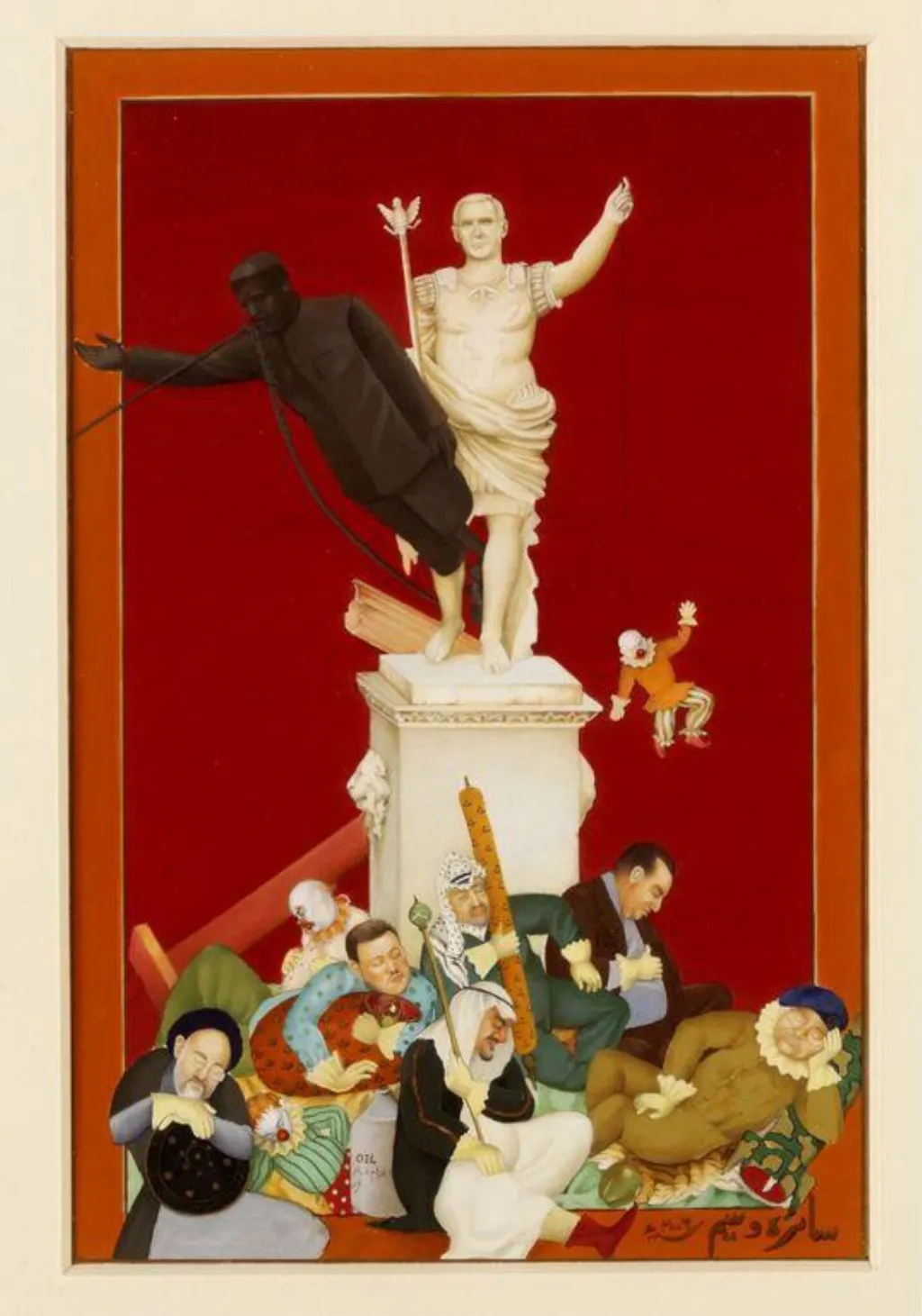
Regime Change is a paint painting by the Contemporary Realist artist Saira Wasim. It dates from 2004 and is held in the collection of the Victoria and Albert Museum.
About this work
The fallen dictator’s head is shown twice: once on the ground, once as a ghostly echo in the sky, like a memory that won’t fade.
You see a crowd swarming a toppled bronze statue, its head severed and dragged through the dust.
This painting reworks the famous photo from Baghdad’s Firdos Square in 2003. The artist strips away the media’s celebratory tone, no flags, no cheering faces. Instead, the scene feels heavy, almost quiet.
The fallen dictator’s head is shown twice: once on the ground, once as a ghostly echo in the sky, like a memory that won’t fade. The colors are muted, as if the moment itself is already fading into history.
To see how other artists question war imagery, look up the technique impasto.
Overview
Saira Wasim’s painting reimagines the 2003 toppling of Saddam Hussein’s statue in Baghdad’s Firdos Square, a moment widely broadcast as a symbol of liberation. Rather than amplifying the media’s triumphant narrative, the work subverts it with somber symbolism and layered historical references, transforming a moment of public spectacle into a quiet meditation on power, illusion, and cultural memory.
Subject & Meaning
The painting replaces Saddam’s fallen bronze statue with a white marble figure of George W. Bush cast as Augustus Caesar, evoking imperial continuity rather than democratic renewal. At the base, sleeping Muslim leaders, Khamenei, Abdullah, Musharraf, suggest complicity or passivity. The doubled image of Saddam’s head, one on the ground and one faintly hovering above, implies the persistence of authoritarian legacies despite regime change.
Technique & Style
Wasim employs muted tones and soft, diffused edges to strip the scene of its original media-driven drama. The crowd is rendered without individual features or emotion, reducing collective celebration to a blurred mass. The ghostly afterimage of Saddam’s head is painted with translucent layers, creating a spectral presence that lingers beyond physical collapse, reinforcing themes of unresolved history.
History & Provenance
The work directly responds to widely circulated photographs and video footage from April 9, 2003, which were later questioned for selective framing and possible staging. Wasim draws from these contested images but removes their celebratory context, offering a counter-narrative that interrogates the role of Western media in shaping perceptions of war and liberation.
Context
Created in the years following the Iraq War, the painting engages with growing critical discourse around the justification and imagery of the U.S.-led invasion. It reflects broader artistic and intellectual skepticism toward narratives of democratic intervention, particularly as they intersect with cultural appropriation, imperial symbolism, and the erasure of local agency in wartime representation.
Legacy
The painting contributes to a broader artistic lineage that challenges dominant war imagery through reinterpretation and subversion. By replacing spectacle with silence and replacing triumph with ambiguity, Wasim invites viewers to consider how historical moments are constructed, consumed, and ultimately distorted, leaving behind not liberation, but lingering questions.
Artist & collection
Artist
Saira Wasim paints large miniatures in a style rooted in Mughal tradition but updated for today’s world.