Artwork
Two Ships at Anchor
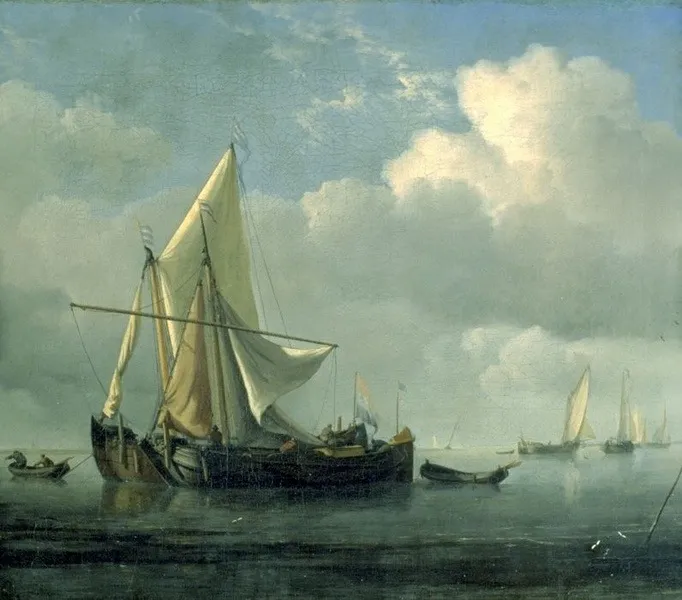
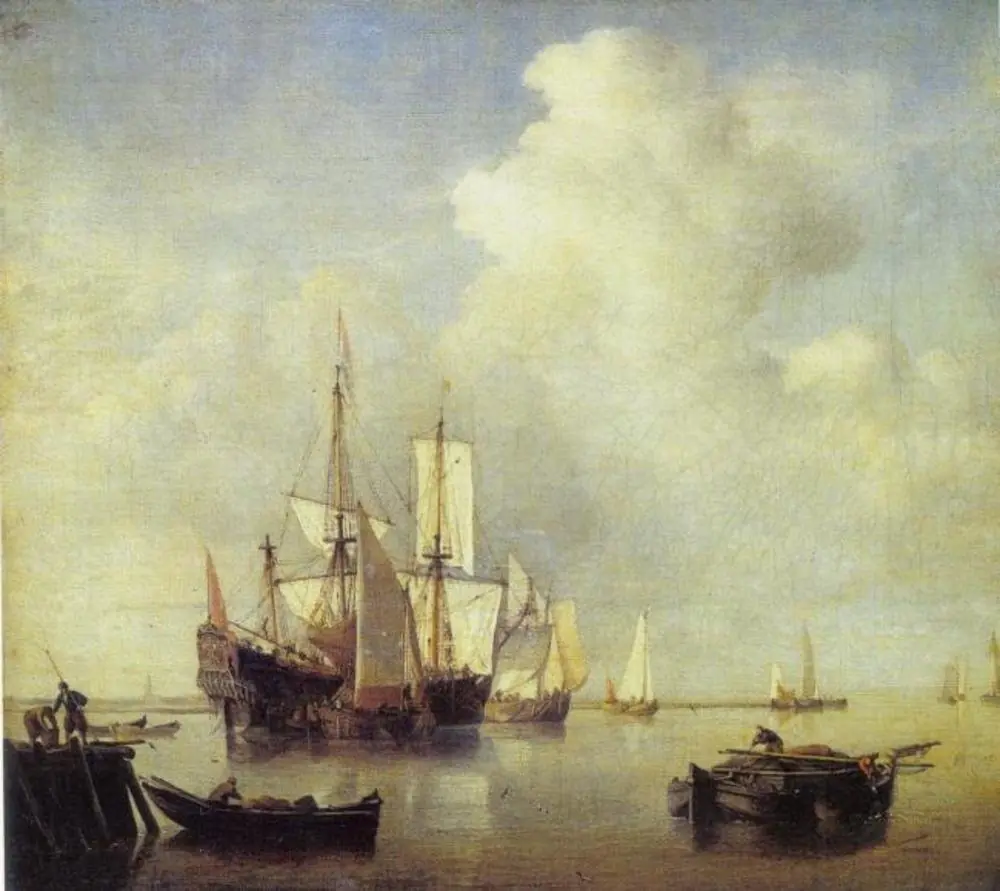
Two Ships at Anchor is an oil painting by the Dutch Golden Age artist Willem van de Velde the Younger. It dates from 1670 and is held in the collection of the Gemäldegalerie Berlin.
About this work
Overview
The work exemplifies the artist's mature ability to render maritime subjects with meticulous attention to the details of shipping and atmospheric conditions.
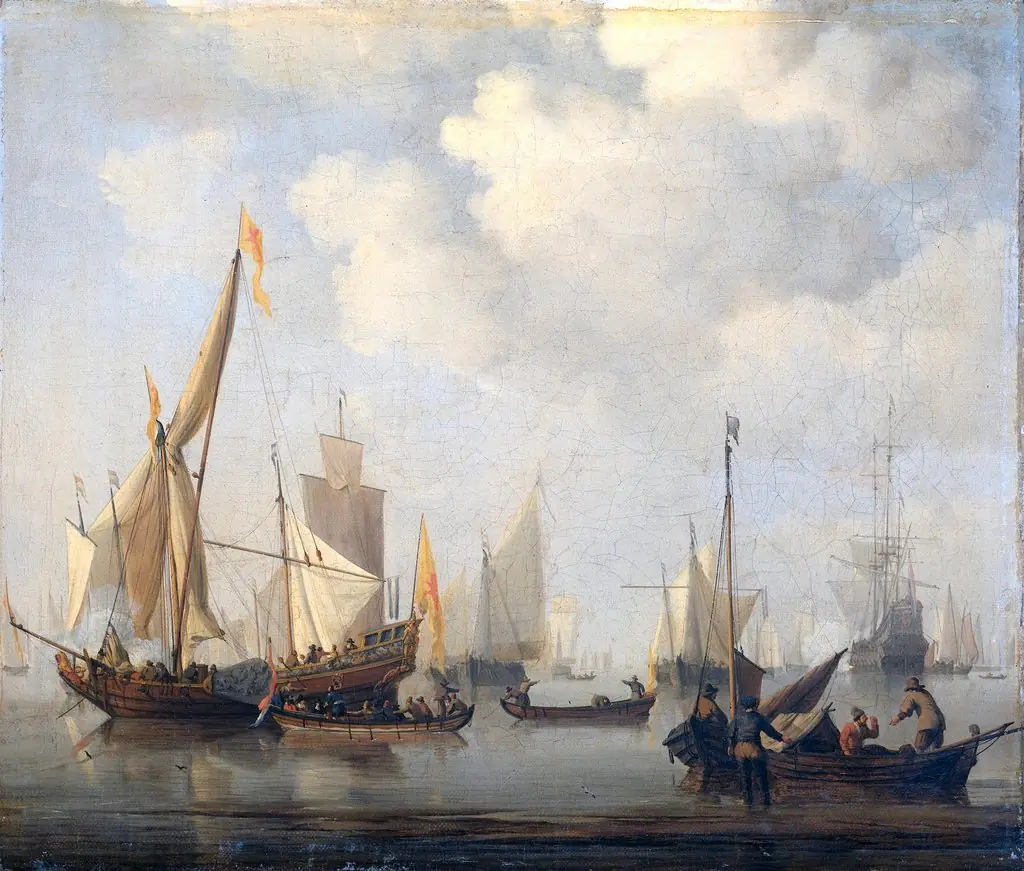
Two Ships at Anchor is an oil painting of 1670 by the Dutch marine artist Willem van de Velde the Younger (1633-1707), now held in the collection of the Gemäldegalerie Berlin. The work exemplifies the artist's mature ability to render maritime subjects with meticulous attention to the details of shipping and atmospheric conditions. Painted during a period when Van de Velde had established himself as the leading marine painter in Amsterdam, the canvas demonstrates the controlled brushwork and silvery tonalities that distinguished his finest productions. The painting occupies a significant place within the Dutch marine tradition, a genre that flourished in the maritime republic of the Netherlands during the seventeenth century and found in Van de Velde its most accomplished practitioner.
Subject & Meaning
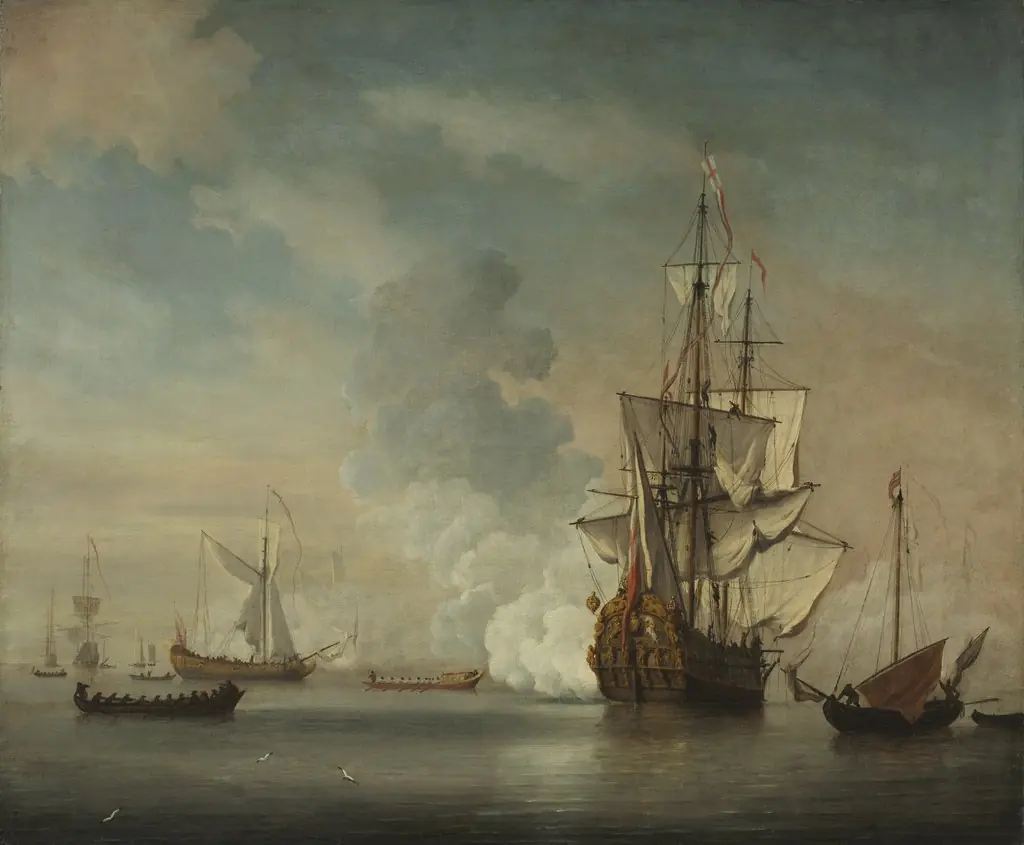
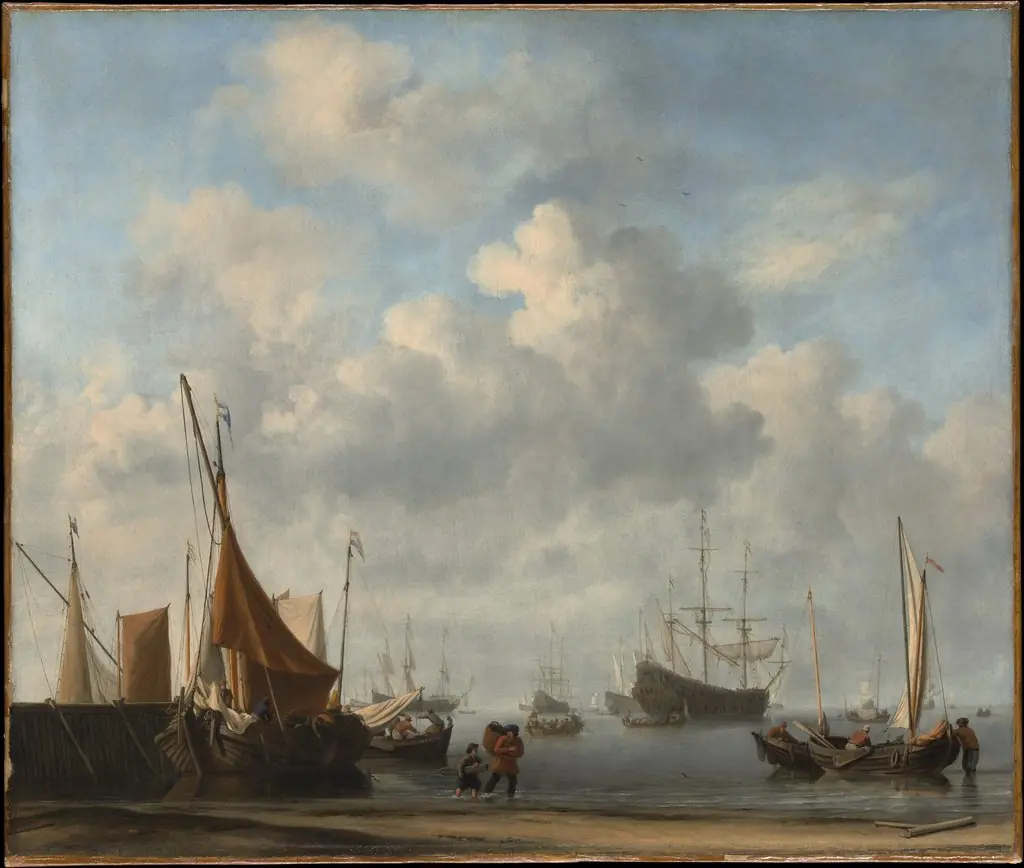
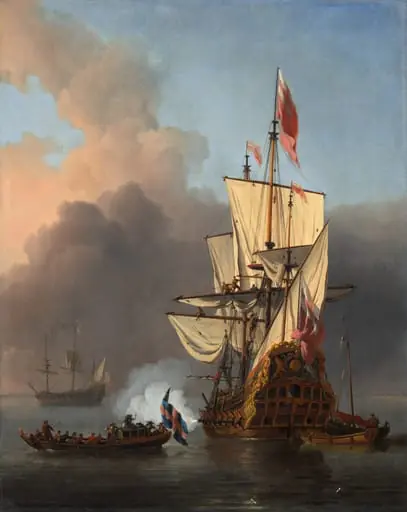
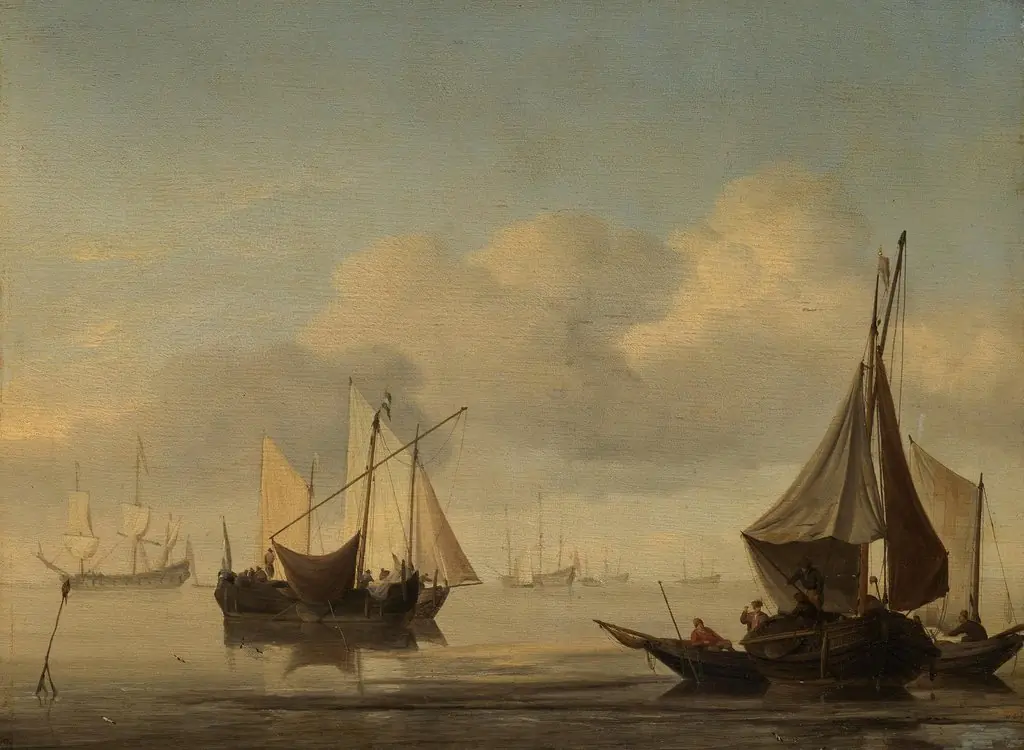
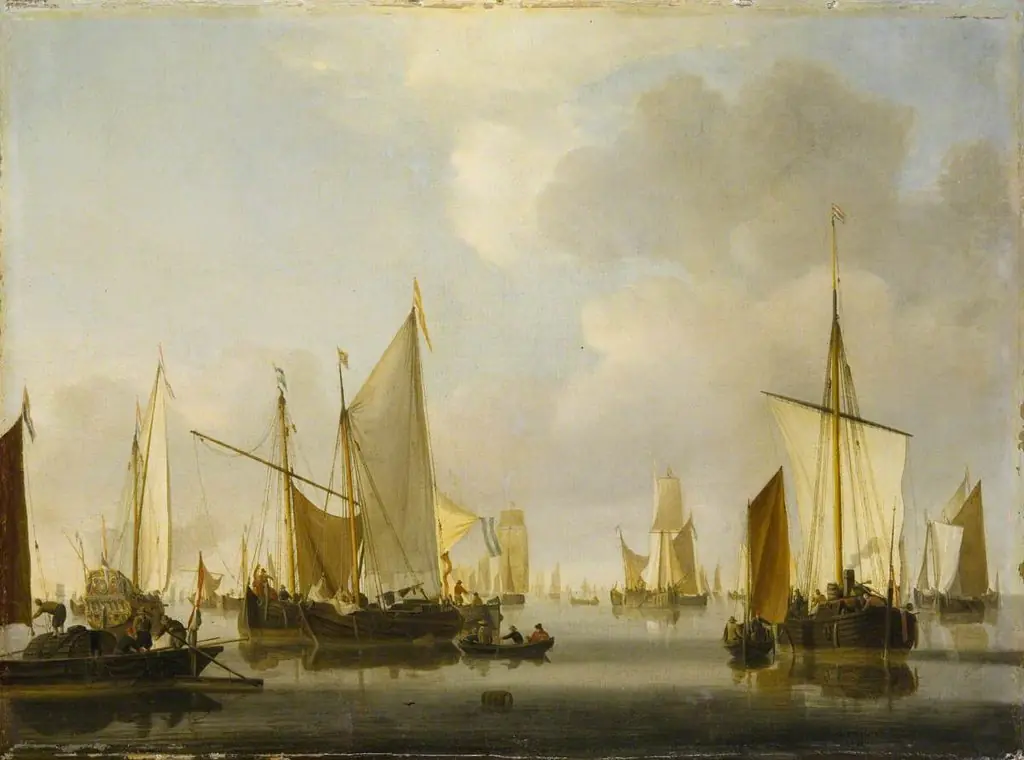
The painting depicts a large sailing vessel with cream-colored billowing sails dominating the left foreground, anchored on calm dark water. Several smaller boats with figures occupy the immediate vicinity, while multiple sailboats recede toward a low horizon line on the right. The sky fills most of the canvas, filled with towering white and gray cumulus clouds against patches of pale blue. A thin dark line, possibly a pole or marker, enters the frame at the lower right edge. The subject of ships at anchor held particular significance in Dutch marine painting, reflecting the maritime economy and naval power upon which the Dutch Republic depended. The calm waters and orderly arrangement of vessels suggest prosperity and control rather than the drama of storm or battle. The muted palette of blues, grays, whites, and deep browns, illuminated by soft diffused light from the upper right, creates an atmosphere of tranquil authority. The inclusion of figures in the smaller boats animates the scene with human activity without disturbing the overall serenity.
History & Provenance
The painting is dated to 1670, a period when Van de Velde was at the height of his career in Amsterdam. During the 1650s and 1660s, he and his father, Willem van de Velde the Elder, dominated the marine painting market in the city, receiving important commissions from the Admiralty and other patrons. The work is now in the collection of the Gemäldegalerie Berlin, though specific details of its acquisition and accession history are not provided in the available sources. No exhibition history is recorded in the sources consulted.
Context
Willem van de Velde the Younger was baptized in Leiden in 1633 and trained initially with his father, completing his studies under Simon de Vlieger in Weesp. By the 1660s he had surpassed his father in artistic reputation and was widely regarded as the most influential marine painter of the late seventeenth century. The Amsterdam period, during which Two Ships at Anchor was painted, represented the zenith of his production of calm water scenes with clusters of vessels. The political and economic conditions of the Dutch Republic, including four European naval wars between 1652 and 1674, created substantial demand for marine painting, though the market collapsed with the Disaster Year of 1672. Van de Velde's work from this period must be understood within a competitive artistic environment that included his father and other specialists, yet his technical refinement and accuracy in depicting shipping set him apart. The family studio operated under a single brand name, 'W.V.V.' or 'W.V.V.elde', until around 1680 when the younger artist began adding a 'J' to distinguish his individual authorship.
Legacy
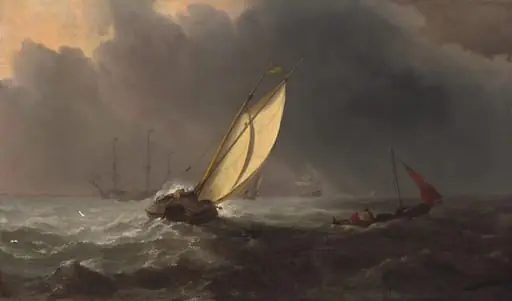
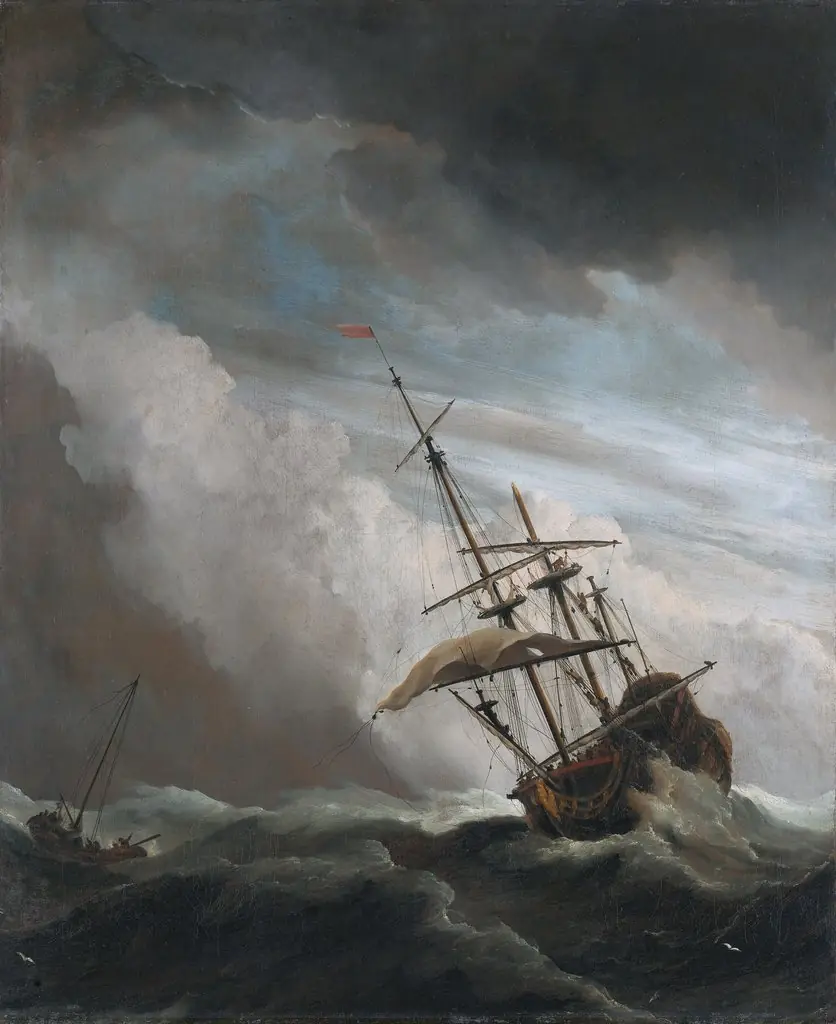
Van de Velde's influence extended far beyond his Dutch contemporaries. After emigrating to England in 1672-1674 with his father, he adapted his style to English patronage under King Charles II and the Duke of York, introducing more spectacular subjects including storm-tossed ships and specific vessels from the royal fleet. His studio in the Queen's House at Greenwich employed numerous assistants and apprentices, including his sons Willem III and Cornelis, Johan van der Hage, and Pieter Monamy. His principal imitators emerged among eighteenth-century English marine painters, who carried his conventions into a new national tradition. The precision of his ship depictions has made his works invaluable historical documents for naval historians. His paintings command significant attention in the art market; one of his works achieved a record auction price of $9,226,332 at Christie's London in 2011. Major collections of his paintings and drawings are held in the National Gallery and National Maritime Museum in London, the Rijksmuseum in Amsterdam, and the National Gallery of Art in Washington, D.C.
Artist & collection
Artist
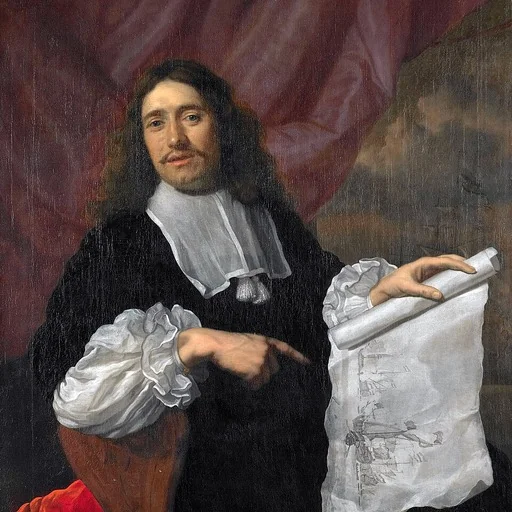
Willem van de Velde the Younger
Willem van de Velde the Younger (18 December 1633 (baptised) – 6 April 1707) was a Dutch painter who specialised in marine art.