Movement
American scene painting
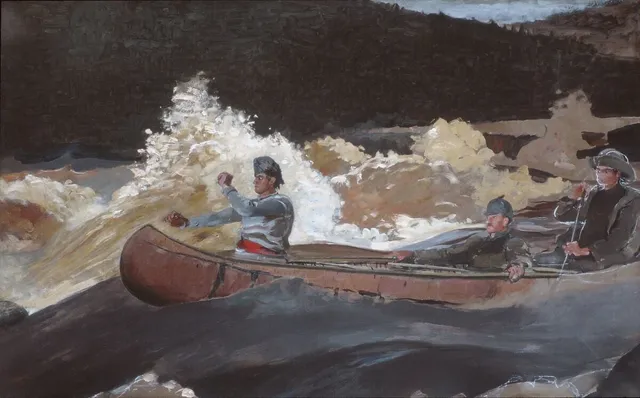
American scene painting is an art movement dating from 1920. The gallery holds 2 works in this movement, including works by Edward Hopper. Browse American scene painting paintings, portraits, pictures and artworks from the world's public-domain museum collections.
American Scene painting is the umbrella term for the broadly realist art that dominated the United States from the mid-1920s through the Second World War. It arose as the nation turned inward—first amid the prosperity and dislocation of the 1920s, then under the weight of the Great Depression—and as many artists rejected European modernism and abstraction in favor of recognizably American subjects. Conventionally the movement is split into two strands: Regionalism, which celebrated rural and small-town life, chiefly in the Midwest; and Social Realism (or Urban Realism), which depicted city life with a sharper political and social conscience. Federal patronage through New Deal programs such as the Public Works of Art Project and the WPA gave the style institutional momentum in the 1930s.
Visually, American Scene painting favored legible, figurative imagery over experiment: solid forms, narrative clarity, and ordinary American places—farms, main streets, diners, tenements. Regionalist canvases often used rolling, sculptural rhythms and heightened, almost stylized detail, while the urban realists leaned toward gritty observation. A recurring mood is stillness and isolation, the sense of modern life emptied of company.
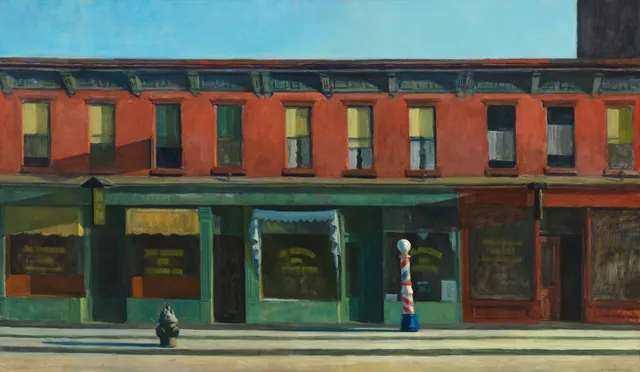
The Regionalist wing was anchored by a celebrated trio: Grant Wood, whose "American Gothic" (1930, Art Institute of Chicago) became one of the most parodied images in American art; Thomas Hart Benton, known for muscular, swirling murals of labor and community and featured on the cover of Time in 1934; and John Steuart Curry. Charles Burchfield brought a brooding lyricism to watercolors of vernacular houses and weather-charged landscapes. On the urban side, Edward Hopper stands apart—though he resisted the label, calling the American Scene a caricature of America. His "Early Sunday Morning" (1930, Whitney Museum) reduces a stretch of Seventh Avenue to silent storefronts and raking light, distilling Depression-era unease; "Nighthawks" (1942) remains his signature meditation on solitude.
Closely tied to Regionalism, American Scene painting offered a nationalist alternative to the imported avant-garde, and its populist accessibility made it the era's dominant idiom. After 1945 it was eclipsed by Abstract Expressionism and dismissed by some as provincial, yet its reckoning with American identity endured—most powerfully through Hopper, whose stark compositions continue to shape how the country pictures itself.
Key artists
Works
Frequently asked questions
What is American scene painting?
American scene painting is an art movement. A 1920s–1940s American movement that celebrated the country's everyday landscapes, small towns, and workers rather than European avant-garde abstraction.
Who are the key American scene painting artists?
Key American scene painting artists in the collection include Edward Hopper.
When did American scene painting take place?
American scene painting dates from around 1920.
Where can I see American scene painting works?
American scene painting works in the collection are held by Whitney Museum of American Art and Metropolitan Museum of Art.