Movement
Still life
Still life is an art movement. The gallery holds 1 work in this movement. Browse Still life paintings, portraits, pictures and artworks from the world's public-domain museum collections.
Still life is the genre devoted to the depiction of inanimate objects—fruit, flowers, vessels, food, books, musical instruments, and other commonplace things—arranged for contemplation rather than narrative. Its roots reach back to antiquity: Roman painters produced *xenia*, trompe-l'oeil frescoes and mosaics of food and drink that signalled a host's hospitality, and roughly three hundred such images survive in the Vesuvian cities of Pompeii and Herculaneum. The genre's modern name derives from the Dutch *stilleven*, coined in the mid-seventeenth century, when still life first flourished as an independent specialty.
It was in the Dutch Republic of the early 1600s that still life became a distinct professional discipline. The Protestant Reformed Church's prohibition of religious imagery redirected a prosperous, market-driven art world toward secular subjects, and painters developed sharply defined subtypes: floral pieces, the *banketje* or breakfast piece, the opulent *pronkstilleven* of imported luxuries, and the *vanitas*, in which skulls, guttering candles, and wilting blooms served as memento mori. Defining techniques included meticulous rendering of texture and reflective surface, controlled raking light, and—in masters such as Willem Claesz. Heda—near-monochrome tonal harmonies of grey and brown.
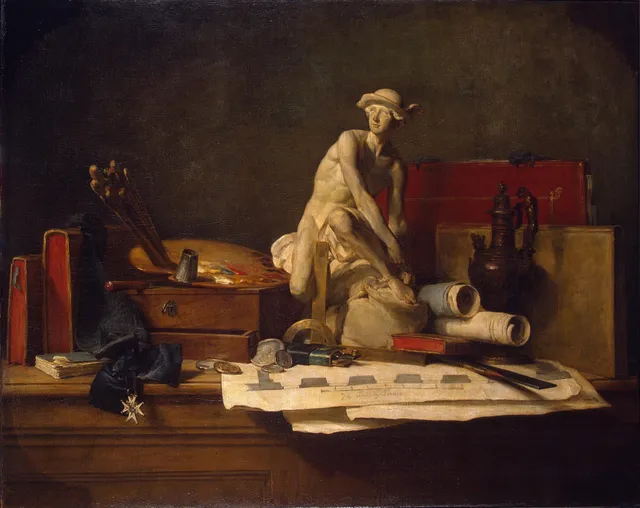
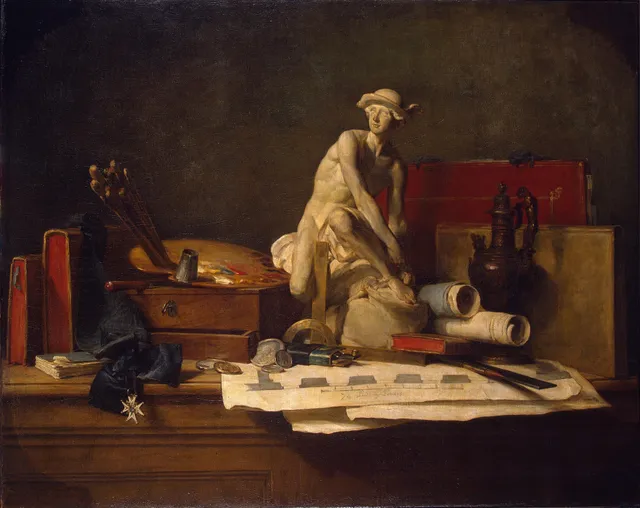
The canonical figures span centuries and nations. In Italy, Caravaggio's *Basket of Fruit* (c. 1599) demonstrated unprecedented realism. The Netherlands produced Heda, Willem Kalf, Jan Davidsz. de Heem, and the flower specialist Jan van Huysum. In eighteenth-century France, Jean-Baptiste-Siméon Chardin elevated humble domestic objects into images of quiet gravity; his *Still Life with Attributes of the Arts* (1766) was commissioned by Catherine the Great for the St. Petersburg Academy of Arts and is now in the Hermitage.
Despite this achievement, academic theory—following André Félibien's 1667 hierarchy of genres—ranked still life lowest, beneath history painting and portraiture, precisely because it required no invented action. That low status made the genre fertile ground for formal experiment. Paul Cézanne, who turned seriously to still life from the 1870s (partly inspired by Chardin works the Louvre acquired in 1869), used arrangements of apples to interrogate form and perception, laying groundwork for Cubism. Édouard Manet, Vincent van Gogh, and later Picasso, Braque, and Matisse all found in the motionless object a laboratory for modern painting.
Works
Frequently asked questions
What is Still life?
Still life is an art movement. One of the major Western genres, depicting arrangements of inanimate objects — food, flowers, vessels, and skulls.
Where can I see Still life works?
Still life works in the collection are held by Hermitage Museum.