Most surveys treat El Greco's elongated saints as a quirk of temperament, the work of a man who happened to see the world stretched and lit by a private fever. That reading is comfortable, and it is wrong. The distortions are a method. He built a deliberate visual language out of two inheritances that should never have fused, the flat gold-ground icon of his Cretan youth and the loaded, color-first oil paint of Venice, and he bent both toward one end: to make pigment describe a spiritual event rather than an optical one. The break he made was formal before it was anything else, and it shows up in three places at once. How he arranged a picture. How he lit it. How he loaded the brush.
The argument of this essay is narrow. His famous strangeness is not expressive excess leaking past his control. It is the control. The lengthening of a body, the acid green set hard against a sour rose, the white scumble dragged across a dark ground so a sleeve seems to phosphoresce: each is a decision pointed at the same target. Once you see the system, the late canvases stop looking like the output of an oddity and start to read as the most rigorous claim anyone in European painting ever made that paint owes nothing to appearances. I want to put that claim against the works, starting with one fairly early Spanish picture and ending under the storm light over Toledo.
Candia, Venice, Toledo: where the break happened
Domenikos Theotokopoulos was born on Crete in 1541, when the island was still the Venetian Kingdom of Candia, and he died in Toledo in 1614 (Wikipedia). The biography matters here only because his eye was assembled in stages, and each stage left a residue you can still find on the canvas. He trained first as a painter of Orthodox icons, a craft of fixed gestures, gold backgrounds, and figures that do not occupy real space because real space is beside the point. Then he went to Venice. The Metropolitan Museum's essay by Keith Christiansen places him there as a disciple of Titian, absorbing the Venetian habit of building form out of color and of letting the brush stay visibly present in the finished surface (The Met). Crete gave him the indifference to natural space. Venice gave him the means to paint anything he wanted instead.
The National Gallery of Art documents him in Venice in August 1568 and settled in Toledo by July 1577 (National Gallery of Art). He had ambitions toward the Spanish court. They failed early. His 1582 Martyrdom of Saint Maurice, painted for Philip II at El Escorial, displeased the king and closed the door on royal patronage. That rejection is usually told as a misfortune. I read it as the moment the break was free to widen. Cut loose from a court that wanted decorum, El Greco settled into Toledo's clerical and intellectual circle, took commissions for altarpieces and private devotion, and stopped negotiating with anyone's idea of how a body should sit in space. The pictures get stranger after 1582 because there was no longer a reason for them not to.
Composition: the picture plane refuses to recede
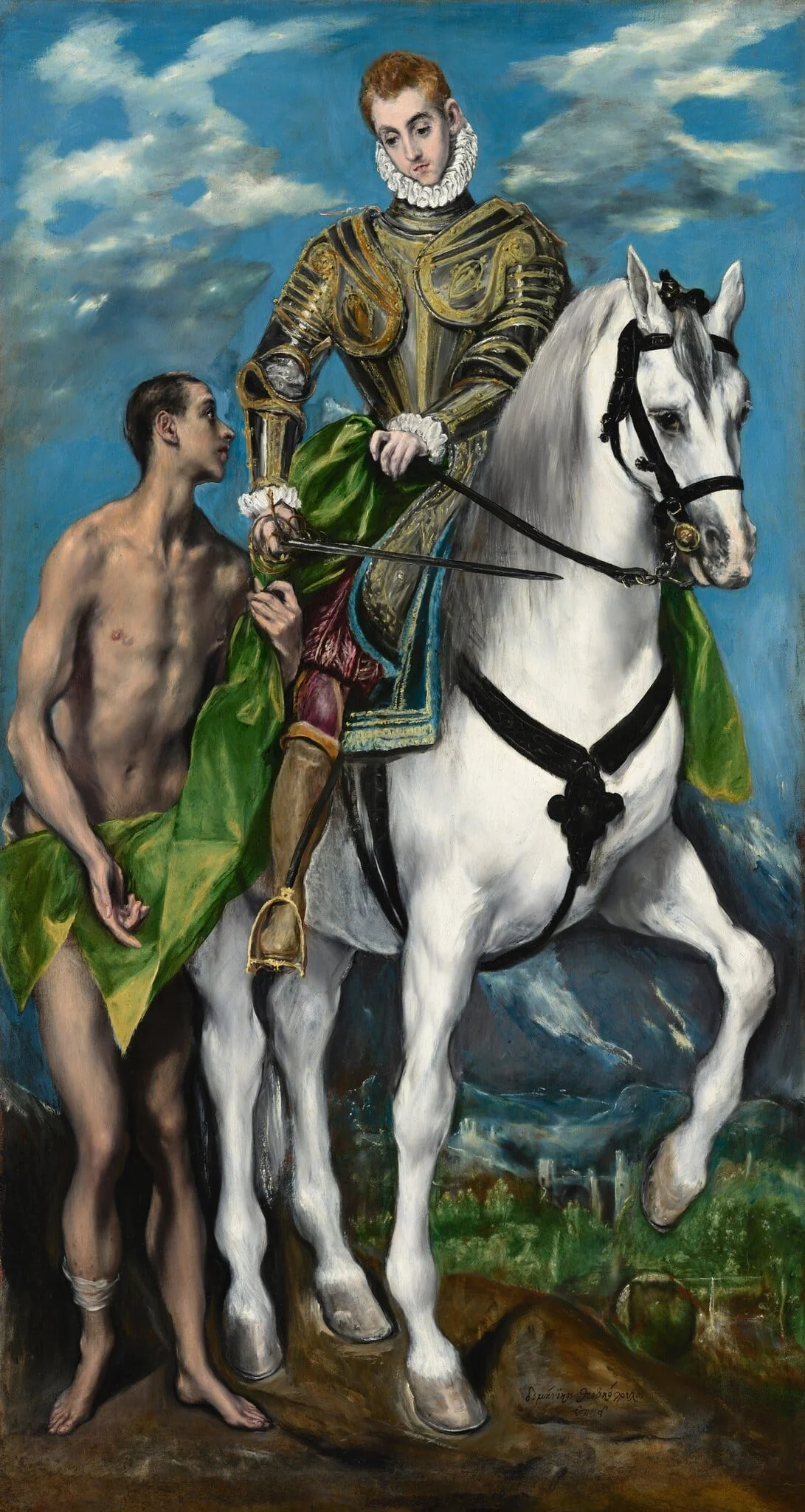
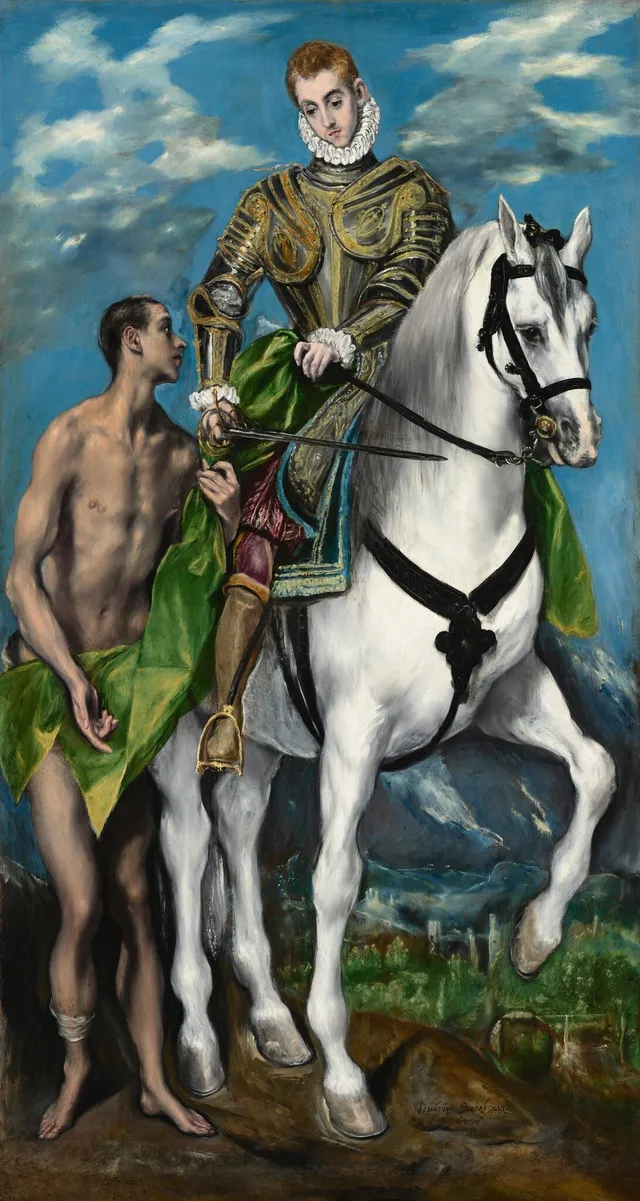
Look hard at Saint Martin and the Beggar. The canvas is tall and narrow, and El Greco fills almost all of it with one event pressed flat against the front of the frame. Saint Martin sits on a pale grey-white horse, half-armored, leaning down to cut his cloak for the near-naked beggar who stands at the lower right. There is a sliver of Toledo and a band of cold sky beneath them, but it never functions as ground the riders stand on. The horse's legs taper to thin points that do not bear weight. The two figures and the animal are stacked vertically, so the eye climbs the picture rather than walking back into it. This is the icon's logic running underneath the Venetian paint: the scene exists on the surface, not in a room.
Notice what the elongation does to the rhythm. The beggar's body is drawn out into a slow pale vertical, his weight given to one hip, and Martin's torso answers it with a longer, armored vertical above. The cut cloak swings between them like a curtain, the one warm note holding two cold figures together. A painter committed to anatomy would shorten the beggar and seat Martin properly on the horse. El Greco does the opposite, because the picture is not about a man on a road. It is about the transaction of charity made monumental, lifted off the ground and set against the sky where transactions of that kind are settled. The distortion is the meaning. Take it out and the subject collapses back into anecdote.
The same refusal of deep space governs the nocturnes. In The Adoration of the Shepherds, the kneeling shepherds, the Virgin, and the Child are wound into a single spiral that turns in the plane of the canvas rather than receding from it. There is no convincing floor, no measured architecture to anchor the scale. The figures interlock like flames, each one bending toward the source of light at the center. Set it beside the second Adoration of the Shepherds in the same collection and the constant becomes clear: the composition is a vortex, and the Christ Child is its still point. El Greco does not stage a Nativity in a stable. He organizes a column of bodies around a light.
Light: cold, sourceless, and on the wrong side of plausible
El Greco's light does not come from a window. It comes from inside the bodies it touches. This is the hardest part of his break to defend to a viewer trained on Caravaggio, whose light is brutally physical and always has a source you can locate. El Greco's illumination has no plausible origin. It flares on a knee, a forehead, the edge of a cloak, then dies in the next fold for no optical reason. The palette he uses to carry it is deliberately unnatural: steel blues, a bruised violet, lead white pulled up almost to electric pitch, and that signature acid green he sets against rose so the two colors vibrate at the seam. These are not the colors of a Toledo afternoon. They are the colors of a vision described to someone who has never seen it.
In Saint Ildefonso, the saint sits writing, and the white of his vestment is not lit so much as it is switched on. The fabric gives off more light than it could ever receive. The face above it is built from cool greys and a thin warmth at the cheek, the eyes turned up and away from the page in the inward look El Greco gives nearly all his devotional figures. The light here is a state of grace rendered as luminance. You can read the whole theology of the picture off the value scale alone, before you identify a single object in it. That is the test of his system: the lighting carries the argument independent of the subject.
The Holy Family pictures show the gentler register of the same instrument. The Holy Family with Saint Anne and the Infant John the Baptist warms the palette toward flesh and rose, but the light still pools where El Greco wants devotion to land, on the Child and on the Virgin's lowered face, and leaves Anne's features in a cooler, more worn key. He uses brightness as emphasis the way a writer uses italics. Nothing is lit because it stands near a candle. Everything is lit according to how much it matters.
The handling of paint: where the modern reputation comes from
If composition and light are where El Greco breaks with his contemporaries, the brushwork is where he reaches forward three hundred years. Venice taught him that the mark could stay visible, that you did not have to sand a painting down to an invisible enamel finish the way Florence preferred. He took that license and ran past where Titian would have stopped. In the late works the paint is built in long, loose, audible strokes. Highlights are dragged on dry, so a streak of lead white sits on top of a darker passage as a separate, physical event. Edges dissolve. A hand may be three confident swipes and nothing more. Stand close and a robe stops being cloth and becomes a record of the loaded brush moving fast.
This is why the nineteenth century could claim him as a forerunner and why painters from Manet to the early modernists studied him with a possessiveness they reserved for almost no other old master. The Getty's Christ on the Cross, an oil dated to about 1600 to 1610, shows the manner at full pitch, the body modeled in cold, broad sweeps against a turbulent sky (The J. Paul Getty Museum). The handling there is so free it reads as unfinished to an eye expecting High Renaissance polish. It is not unfinished. It is finished to a different standard, one that values the energy of the touch over the smoothness of the illusion. A century before anyone used the word, El Greco had decided that the trace of the making was part of the picture's content.
It is worth holding El Greco's surface against a later master of the visible stroke. Rembrandt also let the brush show, also dragged light across dark, but his end was the warmth and weight of a real face in a real gloom. El Greco's free handling drives the opposite way, toward dematerializing the body, thinning it into light and movement until the flesh seems ready to leave. Same technical freedom, contrary purpose. The mark in Rembrandt builds a person. The mark in El Greco releases one.
Works discussed in this article
View of Toledo: the proof in a landscape
The clearest evidence that El Greco's break was a deliberate program, not a tic, is the one subject where distortion serves no devotional purpose at all: the city itself. View of Toledo is one of only two surviving landscapes from his hand (Wikipedia). It would have been the natural place to be literal. A topographer's commission asks for accuracy, and El Greco refuses it on principle. Smarthistory points out that he placed the cathedral roughly where it belongs and then moved several other buildings to wherever the composition needed them, because matching the real skyline was never the assignment (Smarthistory).
What he paints instead is a weather of the soul. The hill is a hard, cold green, lit in patches the way his saints are lit, with the same sourceless flare picking out a wall here and a tower there. The sky is a bruised, electric storm, blue-black pressing down with breaks of unnatural pale light tearing through it. The river is a cold ribbon. The whole thing vibrates because the values are pushed past anything the eye would actually register on a Castilian evening. He treats a city the way he treats a martyr: stretch it, chill the color, light it from no plausible direction, and let it stand as a charged presence rather than a place. The painting is the argument made without a single figure to carry it.
This is where our own holdings sharpen the point. Across Artifact World Gallery, 120 works carry El Greco's name, spread over 38 separate venues and clustered across roughly four decades, from about 1570 to 1613. Set that figure beside the fact that only two of his landscapes survive at all, and the shape of his career snaps into focus. The output we can still see is overwhelmingly sacred, made for altars and private devotion across dozens of institutions, while the secular world of trees and rivers and accurate skylines he almost entirely declined to paint. The corpus is lopsided because the man was. He spent forty years building one instrument and pointing it almost exclusively at the spiritual.
What the break left behind
El Greco kept a workshop, and the most capable hand to come out of it was Luis Tristán, who carried the master's lighting into a more sober, grounded Spanish naturalism. The lineage is real but thin. El Greco had no school in the way Venice or Bologna had schools, and for two centuries after his death he was treated as a curiosity, an eccentric foreigner whose pictures were admired warily or not at all. The recovery came late and came hard. Manuel Bartolomé Cossío's monograph, the foundational modern study that reset his reputation, survives complete and freely readable today (Internet Archive). It was that book, and the generation of painters who came after it, that finally read the distortions as intent rather than incompetence.
The thing to carry away is mechanical, not mystical. El Greco took the icon's flat sacred space, fused it with Venice's free and color-driven brush, and aimed the result at a target no other painter of his century was even trying to hit. Composition that climbs the surface instead of receding into it. Light with no source and no obligation to nature. Paint that announces its own making. Three levers, pulled together, in service of one idea about what a picture is for. The proof that it was a system and not a symptom hangs in the storm over his Toledo, a city he could have copied faithfully and chose to electrify instead. Stand in front of it and you are not looking at a view. You are looking at the weather a man invented to hold a feeling that the real sky could not.
Sources & further reading
- El Greco (1541-1614) — The Metropolitan Museum of Art (Keith Christiansen)
- El Greco — National Gallery of Art
- El Greco, View of Toledo — Smarthistory
- View of Toledo — Wikipedia
- Christ on the Cross, about 1600-1610 — The J. Paul Getty Museum
- El Greco — Wikipedia
- El Greco (monograph) — Manuel B. Cossío, via Internet Archive