Artwork
Saint Martin and the Beggar
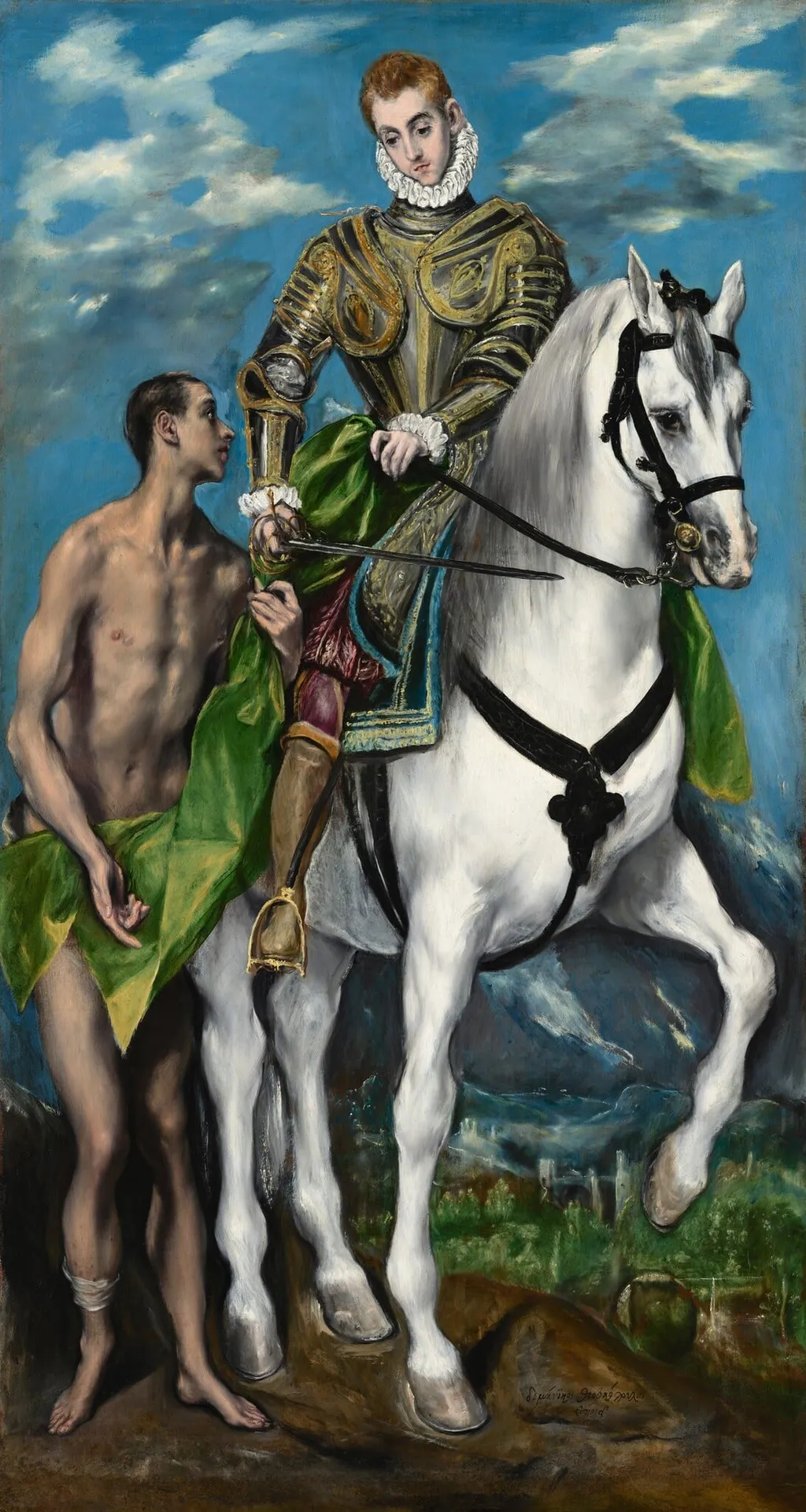
Saint Martin and the Beggar is an oil painting by the Mannerist artist El Greco. It dates from 1598 and is held in the collection of the National Gallery of Art.
- Inscription
- Inscribed:lower right in cursive Greek: doménikos theotokópoulos e'poíei (Domenicos Theotocopoulis made this)
About this work
From a low vantage point, a Roman soldier in gleaming Toledan armor sits astride a white Andalusian stallion, his sword raised to cut through a lime-green cloak for a naked beggar below. Behind them stretch the green Tagus valley and the city of Toledo. El Greco signed the canvas in cursive Greek and painted it in 1597 for the Chapel of Saint Joseph in that city.
Subject & Meaning
Through blue-grey tones and a low horizon, the work conveys a solemn, spiritual piety, transforming a historical narrative into a poignant symbol of compassion.
The painting depicts the Christian legend of Saint Martin of Tours, who, while still a Roman soldier, cut his cloak in half and gave it to a naked beggar. El Greco portrays Martin as a young Spanish nobleman in ornate armor atop a white Arabian horse, while the beggar, nearly nude and wounded on one leg, looks up gratefully. The background, showing Toledo and the Tagus River rather than the legendary setting of Amiens, grounds the scene in the artist's contemporary Spain.
The composition emphasizes the act of charity: the green cloak forms a diagonal band that visually separates the earthly realm from the heavenly, while the elongated, Mannerist proportions of the beggar lend him an otherworldly air, prefiguring the subsequent dream in which Christ appears to Martin. Through blue-grey tones and a low horizon, the work conveys a solemn, spiritual piety, transforming a historical narrative into a poignant symbol of compassion.
Technique & Style
El Greco executed Saint Martin and the Beggar in oil on canvas, a support that allowed the luminous layering characteristic of Mannerist painting. The work (193.5 × 103 cm) typifies his mature style: figures are dramatically elongated, the beggar’s body stretched beyond natural proportions, and the saint’s horse is shown in a refined, almost dancing pose. The composition employs a low horizon and a view from below, enhancing the monumental presence of the pair against an ice-blue, wintery sky.
Formal organization is starkly vertical, with the saint’s green cloak spanning the canvas’s center to separate earthly from celestial realms. Color is restrained yet powerful, dominated by cool blues, grays, and the vivid green of the cloak, while the gilded armor adds splendor. El Greco’s handling combines precise, naturalistic detail in the faces and armor with a looser, more expressive treatment of the landscape and sky, creating a spiritualized atmosphere.
The work embodies two canons: traditional proportion for the saint and a personal, distorted canon for the beggar, reinforcing the otherworldly nature of the charitable act.
History & Provenance
El Greco's Saint Martin and the Beggar was commissioned on 9 November 1597 by Martín Ramírez for the Capilla de San José (Chapel of Saint Joseph) in Toledo. The painting is dated to circa 1597–1599. It remained at the chapel until 1906, when the directors sold it to the Parisian firm Boussod, Valadon & Cie.
That same year, it was acquired by Philadelphia collector Peter A. B. Widener (1834–1915). Upon his death, the work passed to his son Joseph E. Widener (1860–1943) through a power of appointment, and it entered the National Gallery of Art, Washington, D.C., as part of the Widener Collection.
The painting is held at the National Gallery of Art in Washington, D.C., as part of the Widener Collection. It has been exhibited internationally: in the exhibition 'El Siglo de Oro. The Age of Velázquez' and at the Grand Palais in Paris from 16 October 2019 to 10 February 2020 during the retrospective 'Greco'.
Context
Saint Martin and the Beggar, commissioned in 1597 for Toledo's Capilla de San José, is a Mannerist work from El Greco's late period [1][2][4]. Scholarship on the painting is referenced in studies by Álvarez Lopera and Scholz-Hänsel [6]. Critical reception highlights the artist's personal canon and spiritualism, achieved through elongated figures and a cold, wintry sky that impart a pathos-filled expression of charity [5][6].
Art historically, the painting holds a distinctive place within the vast iconography of Saint Martin; French commentary contrasts its restrained, compassionate rendering with more dramatic depictions by Simone Martini, Van Dyck, and Kandinsky, underscoring El Greco's unique Mannerist interpretation [5].
Legacy
El Greco's composition of Saint Martin and the Beggar has been noted for its restraint and pathos compared to other artistic treatments of the same subject, an assessment that has helped cement its enduring reputation. The painting was featured in the major El Greco retrospective at the Grand Palais in Paris from October 2019 to February 2020, underscoring its continued curatorial significance. The existence of a smaller, autograph version in the Art Institute of Chicago further attests to the composition's importance and demand during the artist's own career.
Overview
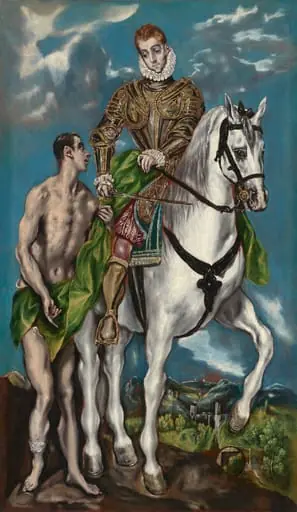
This oil on canvas painting, "Saint Martin and the Beggar," was created by the Greek Mannerist artist El Greco between 1597 and 1599. It portrays a significant episode from the life of Saint Martin of Tours, depicting his act of charity. The work is now held in the collection of The National Gallery of Art in Washington, DC.
Artist & collection
Artist
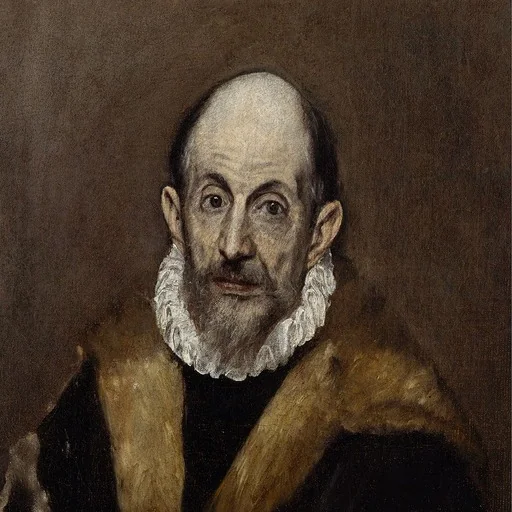
Doménikos Theotokópoulos was born in 1541 in Candia (modern Heraklion), the capital of Venetian-ruled Crete, where he was trained in the post-Byzantine tradition of icon painting.

 Compared in the Caravaggio & Baroque course