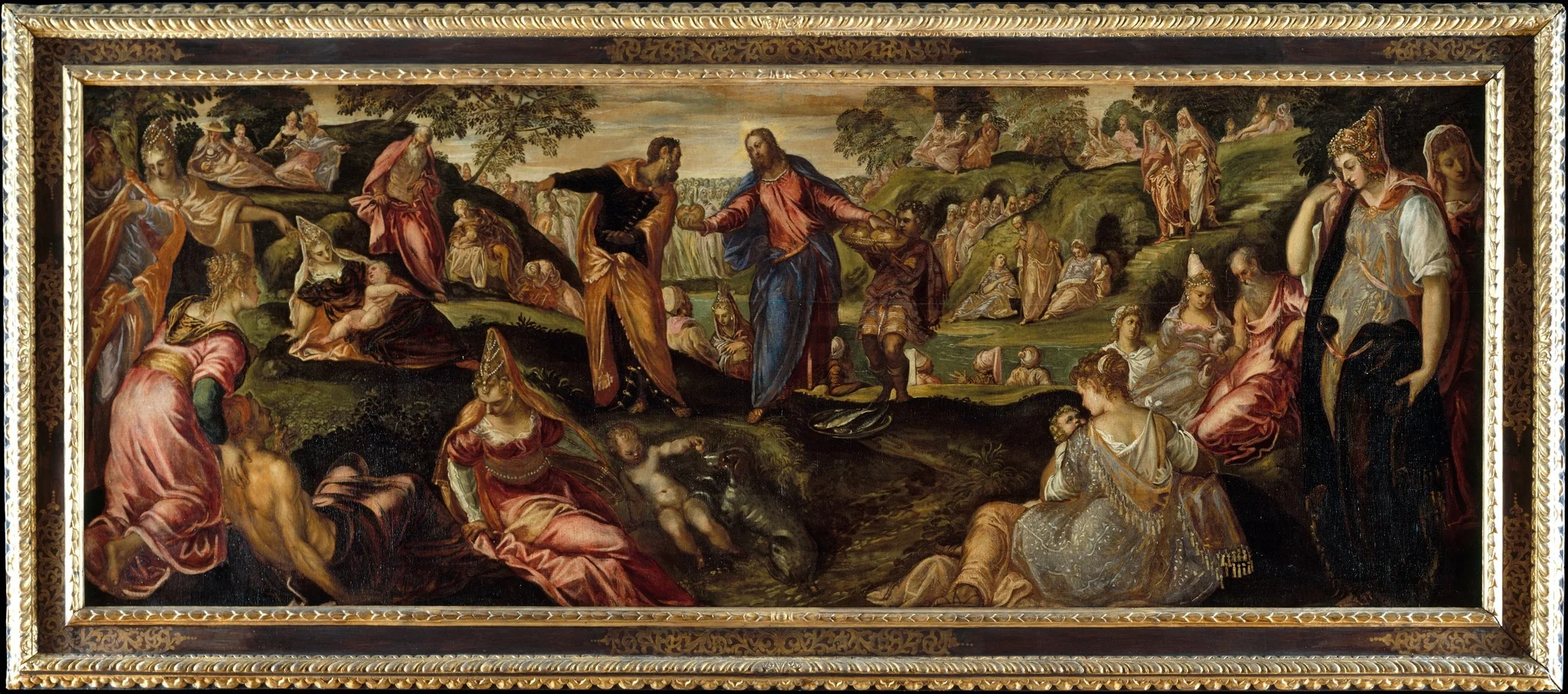
The fastest way to misread Jacopo Tintoretto, the Venetian painter, is to start with the catalogue. His output fills church walls, scuole, ducal halls, and private studies, and the sheer volume tempts the survey writer into a list of subjects and dates that explains nothing. I want to argue the opposite procedure. Tintoretto is best understood through the spatial logic of a single picture, because the same logic governs almost everything he made. He treats a painting as a stage seen from a specific seat, and he builds the seat into the composition. Once you have watched him do this in one canvas, the rest of the corpus stops being a pile and becomes a method.
That method has a thesis behind it, and the thesis is this: Tintoretto painted distance as a moral fact. Where his rivals offered beauty arranged for contemplation, he placed the viewer at an awkward remove from the event and made the gap itself the subject. A miracle happens over there, on a slope, behind a row of nearer figures who got there first. You crane to see it. The reaching, the crowding, the foreground bodies that block your line of sight, all of it is engineered so that grace arrives as something you have to work toward. The Miracle of the Loaves and Fishes is where I will make the case, because it stages exactly this problem and refuses to solve it the easy way.
The dyer's son who out-worked Venice
He was born Jacopo Robusti in the autumn of 1518, probably late September or early October, and he died in Venice on the last day of May 1594, which means his life runs almost exactly with the long sixteenth century of Venetian painting at its height (Wikipedia). The name everyone uses is a workshop joke that stuck. His father Battista was a dyer, a tintore in Italian, tintor in the Venetian dialect, so the boy became Tintoretto, the little dyer. The trade matters more than the anecdote suggests. A dyer thinks about saturation, about how a pigment sits in a ground and how strongly it reads at a distance, and the painter never lost that instinct for color carrying across a room.
Venetian painting in his lifetime was effectively the work of three hands. Tintoretto shared the city with Titian and Veronese, and the three of them divided the great commissions among them for half a century (The Met). What set Tintoretto apart was less his ambition than his rootedness. He was the one major artist of the period born in Venice who also spent his whole career there, painting for Venetian patrons and Venetian rooms, rarely traveling, rarely working for a foreign court (Smarthistory). Titian became Europe's painter. Tintoretto became the city's. That choice is the ground under everything else, including the way he frames his pictures for the people who would actually stand in front of them.
He set himself a program early, and tradition records it as a motto written up in his studio: the drawing of Michelangelo joined to the color of Titian. The phrase is the kind of thing that gets tidied by biographers, but it names a real tension in his work. Tintoretto wanted the sculptural, muscular figure of central-Italian disegno and the deep, breathing color of his own lagoon. The friction between those two ambitions, line that wants to be solid and color that wants to dissolve, is visible in nearly every large canvas, and it is the engine of his restlessness.
One picture, looked at slowly
Stand in front of The Miracle of the Loaves and Fishes and notice first where Tintoretto refuses to put Christ. The miracle does not occupy the center, lit and isolated, the way a more conventional painter would have placed it. Christ stands up and back, set into the slope of the hillside, his gesture of blessing folded into the press of the crowd rather than declared above it. The eye does not land on him. The eye has to find him, and the path it takes is the whole point.
The foreground belongs to the recipients, not the giver. A woman sits near the bottom edge with children gathered against her, her arms full, her back partly turned to us, so that we read the miracle through her receiving of it rather than through Christ's performing of it. Baskets of bread pass from hand to hand along a diagonal that climbs from this lower corner up into the throng. The loaves are the brightest small notes in the lower half, little struck highlights of warm pigment that keep the eye moving from one open hand to the next. The figures nearest us are large, solid, weighted, the Michelangelo side of the motto made flesh, and they sit close enough to the picture plane to crowd our view. To see the blessing we look over their shoulders. The composition seats us at the back of the crowd.
Then the landscape opens behind the figures and undoes any comfort that solidity offered. The hillside falls away to a distance painted in cooler, thinner color, water and far trees dissolving toward the horizon, the Titian side of the motto taking over exactly where the bodies stop. This is the friction I mentioned, and here it does narrative work. The near world is heavy and human and slow. The far world breathes and recedes. Grace sits at the seam between them, neither wholly here nor safely out there, and the diagonal of passed bread is the only bridge across. Tintoretto has turned a feeding miracle into a picture about reach. The crowd reaches, the baskets travel, and we, placed at the rear, lean in to follow them.
Compare this to the obvious alternative staging, the symmetrical, frontal miracle with the holy figure raised and radiant, and you can feel what Tintoretto gave up and what he gained. He gave up instant legibility. He gained participation. The viewer is not shown a miracle. The viewer is enrolled in a crowd that is having one, and made to do the small physical labor of finding the source. That enrollment is the recurring Tintoretto effect, and once you have named it here you start seeing it everywhere in his work.
The method behind the speed
The staging was not improvised on the canvas, even though the brushwork can look headlong. Tintoretto worked out his crowds and his light using small models. He built miniature figures in wax and clay, arranged them inside little boxes like a stage set, and lit them from chosen angles so he could study how the shadows fell across a group before he committed a stroke (The Met). The seat we sit in for the Loaves and Fishes was chosen with a light source and a viewing angle in mind. The crowded foreground that blocks our sightline is a deliberate piece of theatre, blocked out in a box before it was ever blocked out in paint.
The other half of his reputation runs the opposite direction. Contemporaries called him il Furioso for the violence of his application, the speed and aggression with which he laid paint down, and he carried into monumental commissions an economical, time-saving handling that he had learned doing decorative panel work on furniture (The J. Paul Getty Museum). The combination is unusual and worth holding onto. The compositions are calculated in advance with a model-maker's patience. The surfaces are then attacked with a speed that frightened slower painters. Cold planning, hot execution. It let him take on a quantity of work that no careful brush could have matched, and it is why his rivals accused him of underbidding and overproducing.
This is also why a Tintoretto rewards the close look more than a reproduction ever admits. In photographs the big religious canvases can read as dark and busy. In the room, the struck highlights, the loaves, a shoulder, the edge of a sleeve, do the same job the lit wax models did. They carry the eye along the intended path through the gloom. The dyer's instinct for what reads at distance and the model-maker's instinct for staged light are the same instinct, applied at two scales.
The same logic, turned on a single face
It would be easy to think the staging argument only applies to the multi-figure machines. The portraits prove otherwise, because Tintoretto runs the same problem of distance through a single sitter. Look at the Portrait of a Man with a Landscape View. The man is brought close, solid and frontal in the manner he owed to the central-Italian draftsmen, and then a landscape is opened behind him exactly as it was opened behind the crowd in the miracle. The near figure is dense and present. The far world thins and recedes. The sitter is given the same double address as Christ on the hillside, weighted in the foreground, set against a distance he does not belong to.
Set that beside the plainer Portrait of a Man, where the background is held back to near-darkness and the whole event is the head emerging from shadow into a raking light. Here there is no landscape to recede into, so the recession becomes tonal. The face advances out of black. The viewer again does the small work of finding the lit thing in a dark field, the same labor the loaves demanded, compressed now into a single portrait. Tintoretto does not change his grammar when the subject shrinks. He keeps placing the viewer at a calculated remove and lighting the path back in.
His portraits of patrons could also carry an argument, not only a likeness. Return to the man set against his landscape. The distance behind him reads as a measure of what he commands and what lies past his reach, the sitter weighted in the near world while the far one slips away. The face is the occasion. The composition is the meaning. That is the portrait equivalent of seating us behind the crowd, a likeness staged so that we read the man through what he reaches for and what he is set against.
The Doge, the state, and the politics of the seat
Because he was the city's painter, Tintoretto spent his career staging the Venetian state to itself, and the same compositional politics show up in the official commissions. The two Mocenigo pictures are a clean pair to read against each other. In Doge Alvise Mocenigo and Family before the Madonna and Child, the ruling family is arranged in devotion before the holy figures, the human party weighted and near, the sacred party set apart, with the gap between earthly office and heavenly grace built into the spacing exactly as it was in the miracle. The Doge is shown reaching toward grace, not possessing it.
In Doge Alvise Mocenigo Presented to the Redeemer, the same ruler is brought forward toward Christ by an intercessor, the act of presentation made literal. Both pictures do public theology. They show the head of a republic as a supplicant, carefully placed below and apart from the divine, which is precisely the message a merchant republic wanted on its walls. Power here is staged as distance honored, not distance abolished. Tintoretto's habit of seating the viewer behind the event turns out to be ideally suited to a state that liked to picture its own rulers as humble before heaven.
The narrative canvases carry the city's appetite for spectacle rather than its piety. The Finding of Moses takes a biblical rescue and dresses it as a courtly outing by the water, the infant lifted from the reeds amid attendants and rich cloth, the riverbank used the way the hillside was used in the miracle, as a stage that recedes from a crowded near edge into open distance. The subject is deliverance. The staging is, again, a near party of figures and a far world they are pulled between. Whether the event is a feeding, a rescue, a coronation of the Virgin, or a Doge at prayer, the seat Tintoretto builds for us barely moves.
Works discussed in this article
What the spread of the work tells you
There is an information-gain here that only a large catalogue can offer, and it sharpens the close-looking. Across Artifact World Gallery our own holdings run to 163 works attributed to Tintoretto, scattered across thirty-nine venues, with catalogue dates clustering roughly between 1501 and 1594. The early end of that span reaches before his own birth in 1518, which is the honest fingerprint of a busy workshop and centuries of attribution, since a productive Venetian studio and the dealers who came after rarely drew a clean line between the master's hand and the shop's. The 2019 retrospective at the National Gallery of Art, the first Tintoretto show ever mounted in North America and timed to the 500th anniversary of his birth, had to make those same hard calls about hand and workshop when it assembled its loans (National Gallery of Art). A thirty-nine-venue spread is itself a portrait of his career. The man who almost never left Venice is now everywhere, dispersed by exactly the export market he personally declined to chase.
The spread also makes a quieter point about attribution that the single-picture method helps you adjudicate. If you have internalized how Tintoretto seats a viewer, how he weights a near figure and thins a far distance and lights one path through a dark field, you have a working test for the borderline canvases. A picture that merely copies his subjects without staging the viewer's remove is a shop product or a follower's. A picture that puts you behind the crowd and makes you reach is more likely the man himself. The thesis is not only a way of reading the masterpieces. It is a tool for sorting the 163.
Why the seat outlasted him
Tintoretto's near contemporaries felt the friction in his work as roughness, and not everyone admired it. The smooth Bolognese reform that followed, led by painters such as Ludovico Carracci, aimed at a more legible, more centered sacred drama, the kind of clarity Tintoretto had deliberately refused. Even within Venice, the steadier altarpieces of a painter like Bonifazio Veronese show how unusual it was to make the viewer work this hard for the holy event. Set against them, Tintoretto looks less like a sloppy genius and more like a man who knew exactly what legibility he was trading away and what he bought with it.
What he bought was a viewer with a body. The Baroque would spend the next century learning to do this on purpose, pulling the worshipper into the drama, lighting a path through darkness, staging holiness as something you lean toward rather than something handed to you. Tintoretto got there first, and he got there not through theory but through a dyer's eye for what carries, a model-maker's box of lit wax, and a furious brush. Go back to the loaves passing up that diagonal, brightest thing in the lower canvas, and you are watching the whole later history of staged devotion being invented in a single corner of a single picture. That is why one work is enough to hold the man. The seat he builds for you in the Loaves and Fishes is the seat he builds everywhere, and once you have sat in it you can never again read him as a list.
Sources & further reading
- Tintoretto — Wikipedia
- Sixteenth-Century Painting in Venice and the Veneto — The Met (Heilbrunn Timeline of Art History)
- Jacopo Tintoretto — Smarthistory
- Jacopo Tintoretto — The J. Paul Getty Museum
- Tintoretto: Artist of Renaissance Venice (2019) — National Gallery of Art
- Carlo Ridolfi, Vita di Giacopo Robusti detto il Tintoretto (Venice, 1642) — Internet Archive