One question, several answers
Every patron who hired the painter Paolo Veronese asked a version of the same question. Give us a sacred event. A Last Supper for the refectory wall, an Annunciation for the altar, a virgin martyr alone in her cell. Veronese answered each commission with the thing he always painted: a wide, sunlit, overpopulated Venice that would not shrink to fit the doctrine it was hired to illustrate. The question stayed constant across forty years of work. The answers multiplied, and they all came back in the same register, the same even light, the same crowd half-turned away from the miracle at the center. You can move from a chapel altarpiece to a fifty-foot banquet and never leave his weather.
Here is the claim this essay defends. Veronese never solved the problem of a religious subject by subordinating his world to it. He solved it the other way around, by absorbing the subject into the world. The holy moment happens inside a banquet, under a marble colonnade, among dogs and servants and figured silk. That habit can read as mere decoration until you notice how stubborn it is. When the Venetian Inquisition told him to repaint a picture, he kept every offending figure and changed only the title. A decorator obeys. Veronese had a conviction about what a painting was for, and he would not surrender it to a tribunal. The conviction is visible long before the trial, in pictures that had no doctrine to defend at all.
Verona made him before Venice did
He was born Paolo Caliari in Verona in 1528, which is why posterity dropped the surname and kept the city (Wikipedia). The mainland, not the lagoon, formed his eye first. By 1541 he was apprenticed to the Verona painter Antonio Badile, a steady local master who would later become his father-in-law. From Badile he took a clear, daylit palette and a taste for architecture drawn with a surveyor's confidence, the floors that recede in honest perspective and the columns that actually carry weight. A boy who learns to build space that way does not later let a figure float in gold. The training shows up decades afterward in every banquet hall he ever staged, in the way a checkered pavement keeps a hundred figures pinned to a measurable floor.
He grew up among a whole generation of Verona painters working the same churches and the same villa walls. Two of them sit in our archive beside him: Paolo Farinati, a busy and inventive contemporary, and Giovanni Battista Zelotti, with whom Veronese shared scaffolding on fresco cycles across the Veneto countryside. Those collaborations matter for more than biography. They mean that from the start his idiom was a shared workshop language, a way of laying out figures against stone that several hands could speak at once. Verona taught him to build a picture out of stone and measured light. Venice, when he moved there, taught him to flood that structure with color until the architecture became a stage for spectacle. The combination is the whole of him: a Veronese painting is a rigorous building filled with a careless-looking party, the discipline hidden under the pageantry so well that viewers mistake the rigor for ease.
The portraits give the plainest answer
Start with the case where the world and the subject are already the same thing. In portraiture the commission asks only for a likeness, and Veronese has nowhere to hide behind narrative. There is no gospel to stage, no martyr to light, only a person who must be made to occupy the canvas. What he does instead is build the sitter out of cloth, light, and bearing, treating a Venetian gentleman with the gravity another painter would reserve for a saint. The portrait, in his hands, becomes a small theater of presence.
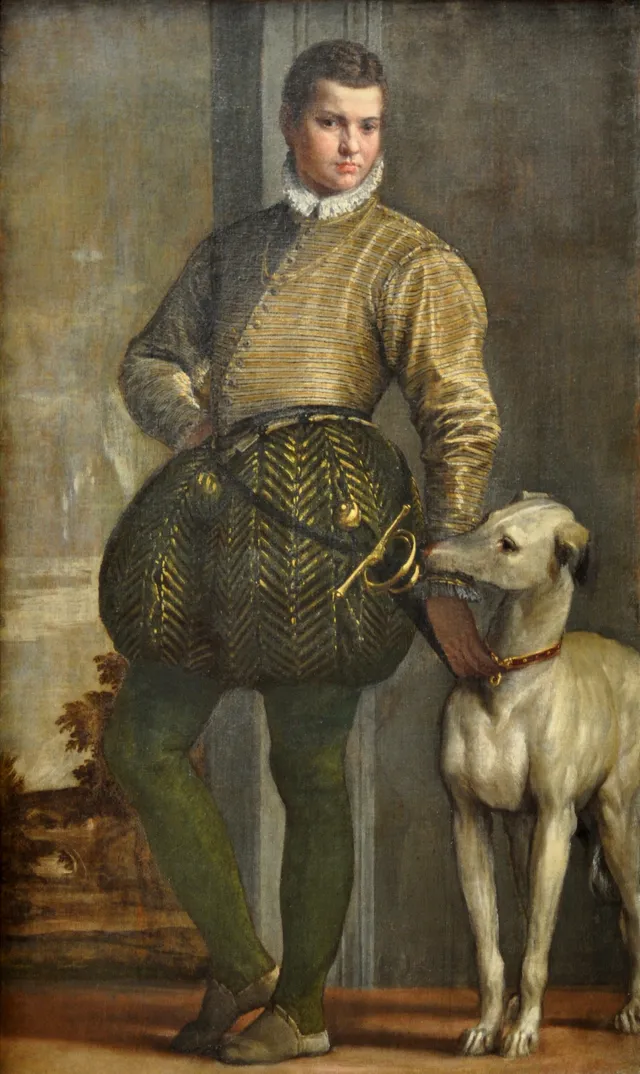
Look at Boy with a Greyhound. A young boy stands toward the left of a stone setting, one hand dropped onto the head of a tall greyhound that presses its full weight against his legs. The dog's body cuts a long diagonal across the lower canvas, and the boy absorbs that lean without flinching, his stance easy, his expression composed past his years. Behind the pair a heavy column and a low ledge open onto a cool band of sky, the architecture doing what Badile taught it to do, holding the figures in real space rather than floating them. Veronese paints the boy's costume with the patience a history painter spends on drapery, the fabric catching a silvered light, the folds sitting with real heft. Nothing here is doing symbolic work you must decode. The greyhound is a greyhound. The child is somebody's son. The picture is about presence, about a body holding its place in space while a large animal trusts it, and Veronese decides that is subject enough. That confidence, the willingness to make a whole painting out of plain being-there, is the same nerve he will carry into the gospel scenes.
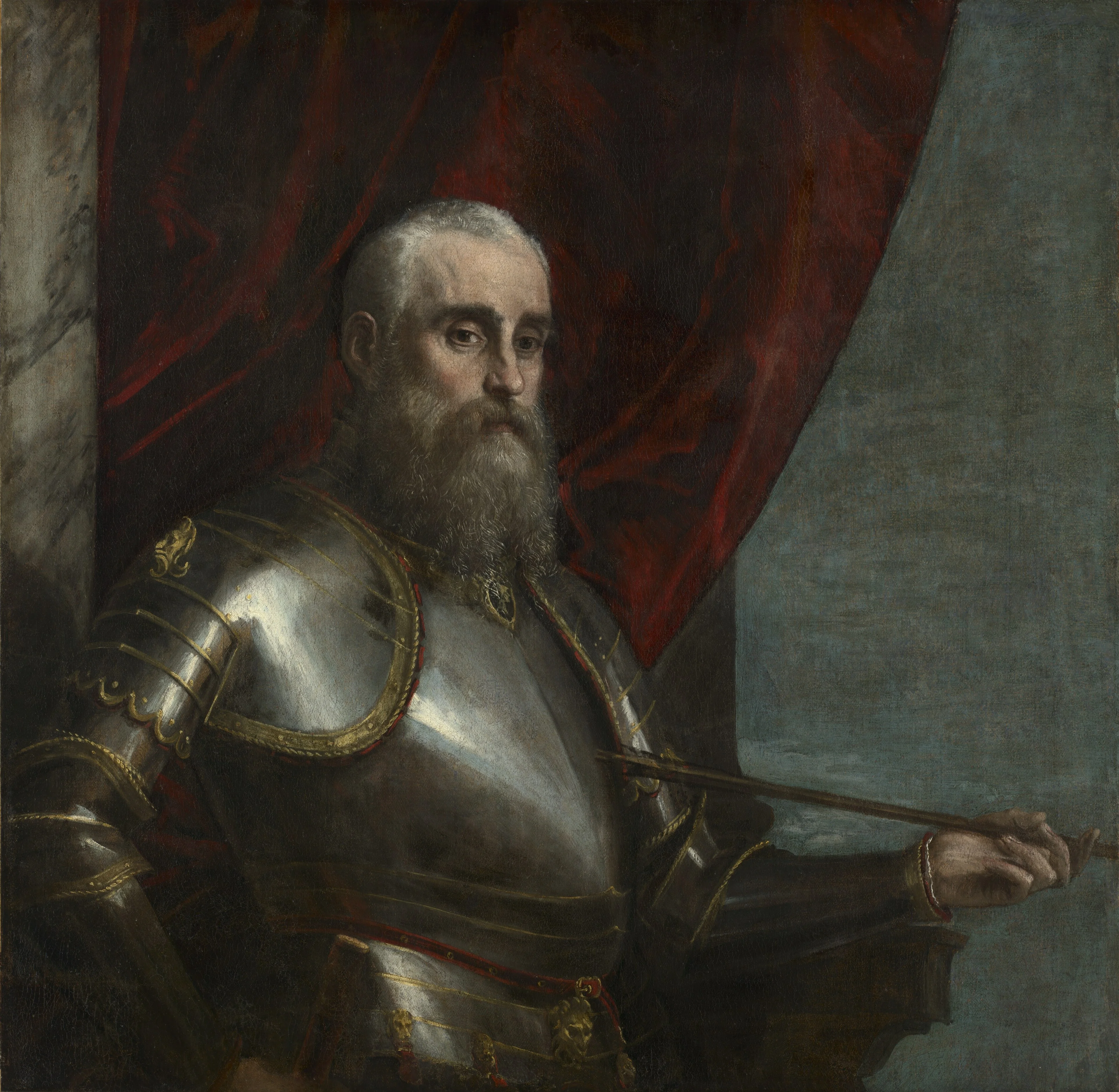
Move to the adults and the social charge sharpens. Portrait of Agostino Barbarigo sets a Venetian patrician against a dark, near-featureless ground so that the light has only the man to fall on. It rakes across armor and fabric, finding the cold sheen of metal and the warmth of skin, and the sitter returns the viewer's look without performing for it. The face is alert, a little guarded, the look of a man used to being watched. The restraint is the point. Veronese, who could fill a fifty-foot canvas with a hundred guests, knows exactly when to empty the field and let one steady face carry everything. The same painter who loves a crowd understands the power of subtracting it.
The same instinct shapes his portrait of the sculptor Alessandro Vittoria, now in the Metropolitan Museum of Art, where Veronese shows the artist holding a small model for his statue of Saint Sebastian, a maker caught with the thing he makes (The Met). It is a portrait about work, about the dignity of a hand that shapes marble, and it flatters the sitter not by idealizing his face but by taking his craft seriously. Vittoria turns the little figure as if checking its silhouette against the light, and the gesture tells you more about him than any heraldry could. The Getty's Portrait of a Man, dated to about 1576 through 1578, belongs to this same line of grave, upright Venetians, men painted as if their bearing were itself a kind of architecture. Put these faces in a row and the consistency is the lesson: every sitter gets the weight Veronese would give a sacred protagonist.
The sacred subjects answer in the same voice
Now watch what happens when the question turns explicitly holy. In The Annunciation, Veronese does not abstract the miracle into a gold field or a blank chamber. He houses it. Gabriel arrives from one side across a run of columns, the Virgin receives him at the other, and the swept, empty paving between them carries the perspective into depth while light pours down the corridor. The angel's drapery still streams with the speed of his arrival, and the Virgin's body turns with a startled courtesy, as if a great visitor had been announced at the door. The annunciation becomes an event in a real building, witnessed the way a Venetian would witness an arrival in a grand palazzo. The supernatural is not denied. It is simply given an address.
Even confinement gets the full treatment. Saint Catherine of Alexandria in Prison takes a cell, the bleakest setting a hagiography can offer, and floods it with the painter's habitual light. Catherine kneels as brightness breaks into her darkness, her robes painted with the richness Veronese would lavish on any noblewoman, the gloom of the prison handled as carefully as the radiance that interrupts it. He will not let the walls go dull just because the story is grim. The lesson is consistent. A martyr's prison, in his hands, is still a place where silk catches the sun. He refuses to let the subject's misery dictate a poorer palette, and the refusal becomes its own kind of theology: grace arrives as light on good cloth.
His Lucretia carries the same conviction into secular tragedy. The Roman matron, ruined and resolved, is shown close to the picture plane in heavy, costly dress, the blade present and the face set. Veronese gives her sorrow the same material dignity he gives a wedding feast, the grief rendered as a Venetian portrait of state rather than a study in pathos. Across portrait, gospel, martyrdom, and Roman legend, the answers differ in subject and never in voice. That sameness of voice is not a limitation. It is the argument, and the trial that nearly cost him a commission proved it in public.
The trial that proved the point
The clearest evidence sits in a single year. In 1573 Veronese delivered an enormous canvas for the refectory of Santi Giovanni e Paolo, a Last Supper meant to replace a Titian that fire had destroyed in 1571. He filled it the way he filled everything, with servants, a steward, foreign soldiers, a jester, dogs underfoot, dwarfs at the margins. The sacred table sat at the heart of a roaring household. That July the Holy Tribunal summoned him to explain the buffoons, the drunken Germans, the dwarfs and other such scurrilities he had set around the table of Christ (Smarthistory). By the surviving record of the interrogation, he defended himself by claiming the same license poets and madmen are granted: a painter ornaments the empty spaces of a picture as his invention prompts him. It was less an apology than a description of his entire practice.
The tribunal ordered him to correct the painting at his own expense. He corrected almost nothing. He renamed it The Feast in the House of Levi, a different gospel meal where mixed and disreputable company was the entire moral point, and left the canvas otherwise intact. The doctrine bent to the painting rather than the painting to the doctrine. This is the thesis made literal. He did not win by repainting and he did not win by argument. He won by relabeling, which was possible only because the world he had painted, the crowded and worldly and luminous world, was the one true subject he ever had. The gospel story was a frame the world had already overflowed, and a frame can be re-cut without disturbing the picture inside it.
One hand, many walls
A painter who works at this scale cannot work alone, and Veronese did not. He ran a large and disciplined workshop that kept producing in his manner well past his lifetime, the firm eventually signing itself as the heirs of Paolo. His brother Benedetto Caliari was part of that machine, as were the collaborators from the Verona years who helped cover villa walls in fresco. The studio was an instrument tuned to a single idiom, capable of carrying his light into rooms he never set foot in. The consequence for us, four centuries on, is a body of work scattered across an improbable number of rooms, and a stubborn difficulty in saying where the master's hand ends.
Our own holdings register that diffusion plainly. Artifact World Gallery gathers 144 works under Veronese's name, spread across 37 separate venues, their catalog dates ranging across most of the sixteenth century. Set that against an external benchmark and the scale of his enterprise comes into focus: when the National Gallery of Art marked the painter's fourth centenary, it assembled fifty paintings and fifty-five drawings drawn from collections on two continents to do it (National Gallery of Art). The exhibition needed two continents to be representative. Our 37-venue spread is the everyday version of that same fact, the long modern afterlife of a studio that worked at architectural scale and shipped its output to churches, refectories, and palaces that have since become museums from Verona to North America.
Works discussed in this article
That scale is also why attribution stays hard. Where Veronese's own hand stops and a capable assistant's begins is a question scholars still negotiate canvas by canvas, especially in the fresco cycles where he worked beside Zelotti and others who had learned the same Verona grammar. A shared idiom is wonderful for output and merciless for connoisseurship. The Anglophone world came to this sorting late. Percy Osmond's monograph, the first sustained study of the painter in English, opened by claiming to be the first adequate account of his career and work in the language at all (Osmond, Internet Archive), which tells you how long the English-reading public treated Veronese as Titian's and Tintoretto's gorgeous third rather than a mind worth its own book.
Why the answers still hold
Stand in front of any of these pictures and the original question quietly reverses. You stop asking what doctrine the image serves and start asking who all these people are, why the marble is so cool and the silk so warm, why the light is distributed with such even generosity that no single face is privileged by shadow. Veronese's wager, held from the portraits through the gospel scenes to the canvas the Inquisition could not make him touch, was that a sacred story loses nothing by being crowded with the fully living. The miracle does not need a hush. It can happen at a party and still be a miracle.
Four hundred years on, the crowd is still there. The boy still steadies his greyhound, the sculptor still cradles his small Sebastian, the steward at Levi's feast still turns to the kitchen with a guest's drink in hand, half-attending to the holy man down the table. Veronese gave one answer to every commission, in a hundred variations, and the answer was the visible world rendered without apology. The Tribunal asked him to make it smaller. He changed a title and let the world stay exactly as large as he had painted it.
Sources & further reading
- Paolo Veronese — Wikipedia
- The Feast in the House of Levi — Wikipedia
- Paolo Veronese, Feast in the House of Levi — Smarthistory
- Alessandro Vittoria (1524/25-1608) — The Metropolitan Museum of Art
- The Art of Paolo Veronese, 1528-1588 — National Gallery of Art
- Portrait of a Man (about 1576-1578) — The J. Paul Getty Museum
- Paolo Veronese: His Career and Work — Percy H. Osmond (Internet Archive)