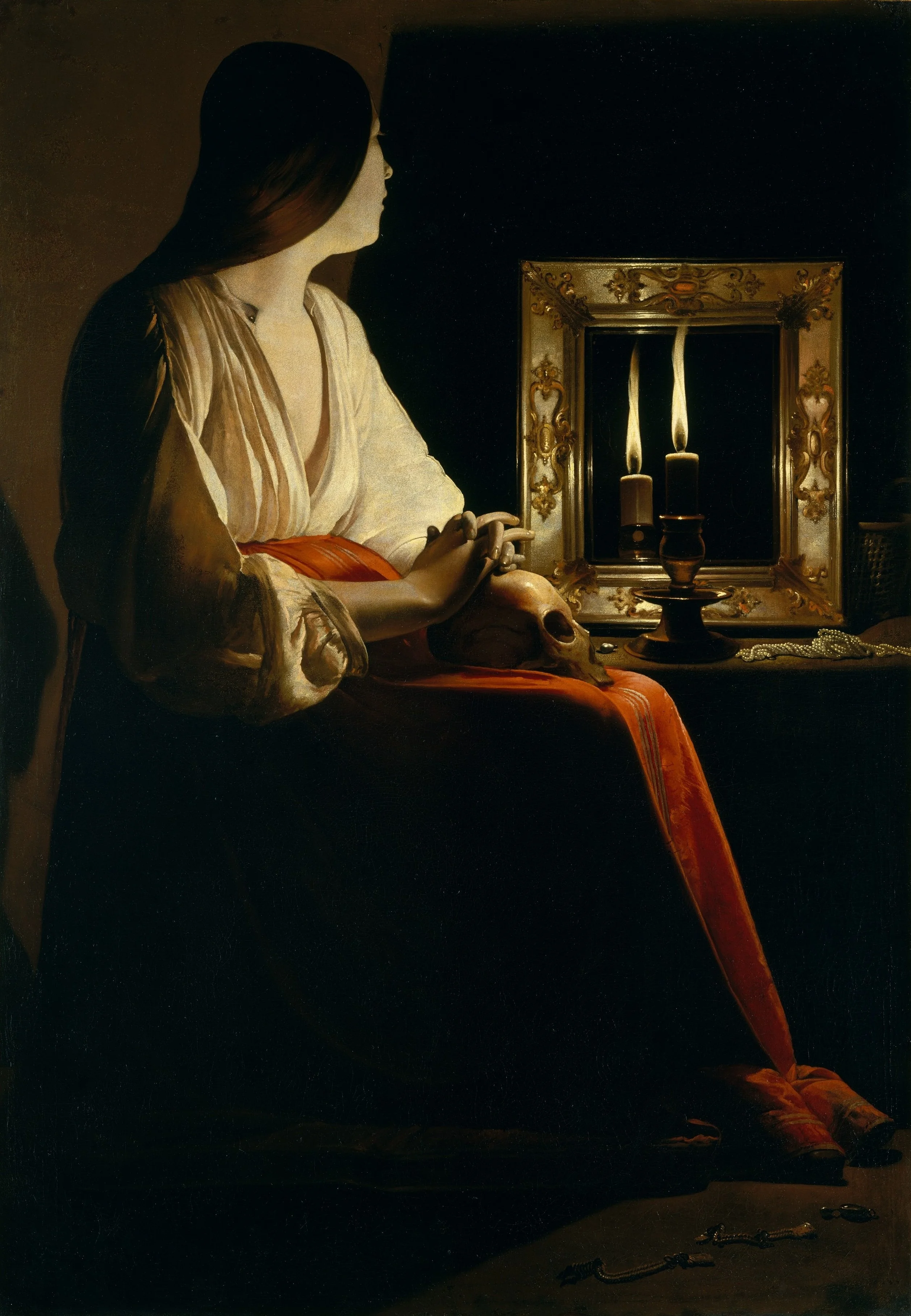
The temptation with Georges de La Tour is to file him under candlelight and move on, as if the flame were a mood he happened to like. It was not a mood. It was a method. La Tour built a repeatable system out of one decision, the choice to admit a single source of light into an otherwise sealed room, and then he engineered everything else around the consequences of that choice: the geometry of the figures, the suppression of detail, the way a hand becomes a translucent screen when a candle sits behind it. This essay argues that his style can be reverse-engineered from the surviving pictures, that you can watch the rules being applied, and that the famous stillness is not piety leaking onto canvas but the by-product of a working procedure.
Put differently, the night scenes that made his reputation are the output of a craftsman who had figured out what light does to form and then refused to let anything distract from it. The thesis matters because it changes how we read the calm. Critics reach for words like contemplative and spiritual, and the pictures earn them, but the calm is downstream of technique. Take away the incident, fix the light at one point, simplify the bodies into clean volumes, and the result reads as devotion whether or not the subject is sacred. La Tour discovered that, and he ran the same procedure across penitent saints, fortune-tellers, and brawling musicians. The room changes. The method holds.
A painter rebuilt from almost nothing
We know less about La Tour than the work deserves. He was born on 13 March 1593 in Vic-sur-Seille and died on 30 January 1652 in Lunéville, both towns in the duchy of Lorraine, a contested borderland that the wars of the period repeatedly ground down (Wikipedia). He worked for the Dukes of Lorraine and, in 1638, received the title of Painter to the King of France, so the patronage ran from the regional court up to the crown. Then he was forgotten. For the better part of three centuries the name carried almost nothing, and his pictures drifted under other attributions, sometimes Spanish, sometimes anonymous. The recovery began in 1915, when the German art historian Hermann Voss reassembled a coherent hand out of scattered canvases and gave the work back its author.
That late rediscovery shapes everything about how we encounter him. There is no studio archive of letters, no run of dated commissions to map a tidy development. What we have is the paintings, and they have to do the explaining themselves. Our own holdings give a sense of the scale of the surviving body. Artifact World Gallery carries 21 works under La Tour's name, spread across 16 venues and clustered roughly between 1620 and 1650, which is most of his working life compressed into a single generation of pictures. That spread, many institutions each holding a few, is the signature of an oeuvre rebuilt by connoisseurship rather than inherited intact. Each museum acquired its La Tour separately, often before everyone agreed it was a La Tour at all.
The single flame as a working tool
Start with the light, because La Tour did. In the mature night pictures the source is almost always a candle or an oil lamp inside the frame, and it is usually doing real optical work rather than sitting there as a symbol. A candle behind a hand turns the fingers coral and lets you read the bone through the flesh. A flame partly hidden by a cupped palm throws a hard rim of brightness around the edge of the hand and drops everything behind it into flat dark. La Tour studied these effects and reused them like a vocabulary. The same translucent-finger motif recurs across pictures because it works, and because it advertises that the painter understands the physics the viewer is also seeing.
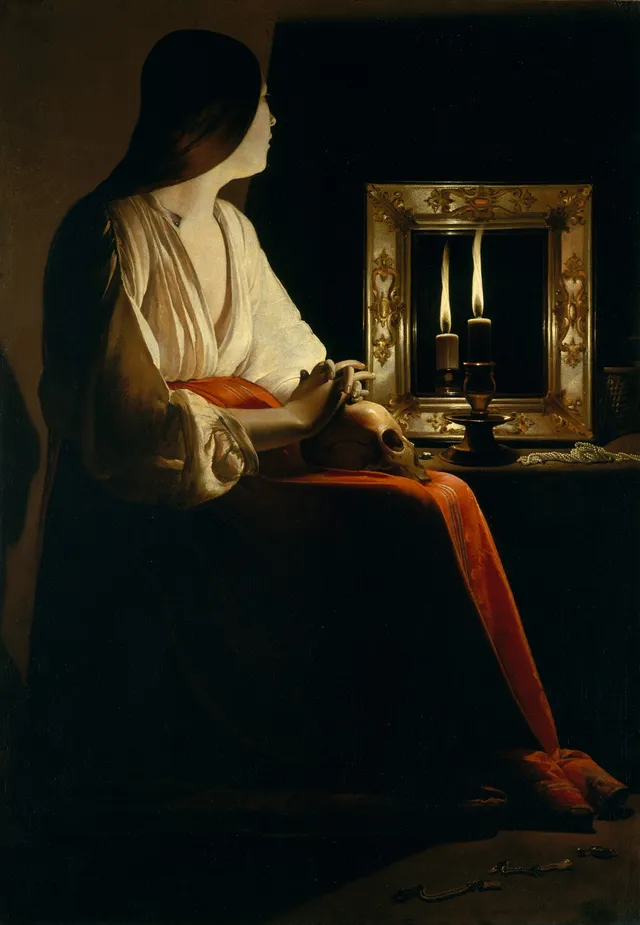
The discipline is in what he leaves out. A real candle in a real room scatters light off ceilings, catches dust, glints on a dozen surfaces. La Tour suppresses nearly all of it. He lets the flame define a small theater of illuminated faces and hands, then lets the surrounding dark swallow the architecture whole. There is no background to speak of in the strongest night scenes, no furniture beyond the few objects that carry meaning. This is a choice with a cost, and he paid it deliberately. The Metropolitan Museum, describing its Penitent Magdalen of around 1640, frames exactly this: extreme contrasts of candlelight and shadow and a pared-down geometry that ran counter to the pomp of mainstream Baroque painting (The Metropolitan Museum of Art).
Looking hard at The Penitent Magdalen
Stand in front of The Penitent Magdalen and notice first how few things are in it. A young woman sits in profile. One hand rests on a skull in her lap. A candle burns on a table beside her, and behind the candle stands a mirror that returns the flame as a second, softer point of light. That is almost the entire inventory. The mirror is the cleverest object in the room. It gives La Tour two light sources for the price of one, the bright original and its dimmer reflection, and it lets him stage the picture's whole argument about vanity and mortality without a single explanatory gesture. The flame is doubled; the skull is single and final.
Look at the modeling of the face and you see the method at work. The light rakes across the cheek and forehead from the candle's height, so the lit planes are broad and unbroken and the shadowed side of the face simply disappears. There is no fussy transition, no scatter of half-tones to soften the turn from light to dark. The edge where illumination stops is firm, almost architectural. The same logic governs the hand on the skull. The fingers are long, simplified, set down as clear cylinders rather than knuckled and veined, and they catch the warm light cleanly along their upper surfaces. The skull itself is barely described, a pale dome with two pools of shadow for sockets, because La Tour trusts the light to do the work that a more anxious painter would do with detail.
Then there is the vertical fall of the woman's shift and skirt, a long quiet passage of cloth that the candle catches in a few broad facets. Compare this to the agitated drapery a Roman Baroque painter would have piled up here, and the restraint reads as a position, not a limitation. The picture holds still because La Tour has removed every element that might move. He gives you a flame, a reflection, a skull, a downturned gaze, and he calculates the rest out of the frame. The result is a portrait of attention, and it is engineered.
Method, not mood
Once you see the system in one picture, it surfaces everywhere. La Tour's figures tend toward simple solids. A torso becomes a smooth cylinder, a sleeve a clean cone, a head an egg with the features kept low and undramatic. This geometric reduction is not naivety. It is the only way the single-source light can read legibly, because complex surfaces would break the broad lit planes he depends on into noise. The simplification and the lighting are one decision seen from two sides. He cannot have the calm illumination without the simplified forms, and he would not bother with the simplified forms if the light were diffuse.
His variations on the penitent saint let us watch him tune the same machine. The Repentant Magdalen, the Magdalen with the Smoking Flame, and the Penitent Magdalen are close cousins, each a seated woman with a skull and a flame, each lit from inside the frame. Set them beside one another and the differences are adjustments to a fixed apparatus. In one the flame is bare and smoking, a thin black thread of soot rising off the wick, so the light is harsher and the shadows more absolute. In another the candle sits behind a screening hand and the glow is filtered, warmer, more enclosed. La Tour is not reinventing the picture each time. He is moving the dial.
The same control governs his male penitents. Saint Peter Repentant and Saint Jerome reading a letter take the apparatus into different rooms, an aged apostle weeping, a scholar squinting at a page, but the rules survive the change of subject. The light comes from one place. The forms are simplified to hold it. The background is suppressed to nothing. What changes is the human content the system is asked to carry, and that portability is the point. A method that works on a Magdalen and on a brawl is a method, not a feeling.
Daylight and the other La Tour
The night scenes get the attention, but La Tour also painted a body of brightly lit daytime pictures, and they prove the discipline is general rather than tied to candles. The clearest case is The Fortune Teller, an exercise in tenebrism datable to about 1632 to 1635, uncovered around 1960 and bought that year by the Metropolitan Museum (The Metropolitan Museum of Art). Here the light is even and frontal, the costumes are crisp, and the drama is social rather than spiritual. A young dandy has his palm read by an old woman while her accomplices quietly relieve him of a coin and a chain. The faces are sharply individuated, almost caricatured, and the surfaces are described with a precision the night pictures refuse.
Yet the underlying instinct is the same. The figures are pressed close to the picture plane, the background is a flat neutral field, and nothing competes with the human transaction at the center. La Tour clears the stage in daylight exactly as he does at night. The earlier daytime work can be rowdier still. The Getty's Musicians' Brawl, an oil on canvas of about 1625, shows hired street players coming to blows, and the museum's record fixes its acquisition at Christie's in London on 8 December 1972 (The J. Paul Getty Museum). The brawl is loud, comic, full of grasping hands and bared teeth, and it tells you La Tour did not arrive at stillness by temperament. He chose it, picture by picture, once he found the method that made it pay.
Works discussed in this article
What he took from Caravaggio, and what he refused
The shorthand is that La Tour was a northern Caravaggist, and there is truth in it. The dark grounds, the cropped close staging, the refusal to prettify ordinary faces all descend from the revolution Caravaggio set off in Rome, probably reaching Lorraine through Dutch intermediaries in Utrecht who had seen the Italian work firsthand. But the inheritance is partial, and the refusals are as telling as the debts. Caravaggio's light is theatrical and external, a hard raking beam from somewhere off-frame that strikes like a spotlight and leaves the source a mystery. La Tour brings the source into the room and makes it a candle you can point to. That single move domesticates the drama. The violence of Caravaggio's chiaroscuro becomes something quieter and more explicable, a person sitting near a flame.
He also refused Caravaggio's restlessness. The Italian crowds his canvases with diagonal thrusts, foreshortened limbs, and the snapshot energy of a moment caught at its peak. La Tour drains the motion out. His figures have settled, his compositions square up to the picture plane, and his geometry is calm where Caravaggio's is explosive. The Lorraine painter took the dark and the honesty and left the turbulence behind. There is a local inheritance too. The Mannerist printmaker Jacques Bellange had worked the same Nancy court a generation earlier, and the elongated, stylized elegance of that school sits somewhere behind La Tour's tapering hands and smoothed faces, pulling him away from raw naturalism toward something more designed.
This places La Tour inside a wider seventeenth-century current that historians now describe as a sacred Baroque, painters who served Catholic devotion with restrained emotion and stark contrasts of light and dark rather than with spectacle. Smarthistory situates him there and points to his 1640s canvas The New-born in Rennes as a case in point (Smarthistory). The category fits, but it should not flatten him into a type. Plenty of devotional painters used dark grounds. Few turned the lighting of a room into a reproducible engineering problem and then solved it the same way for thirty years.
The afterlife of a forgotten method
There is a hard question buried in the rediscovery. If La Tour's procedure was so coherent, why did three centuries lose him? Part of the answer is that the method was almost too quiet to leave a school. He trained few followers we can name, his Lorraine was repeatedly devastated by war and plague, and the calm that we now read as sophistication could look, to later eyes raised on Rococo glitter and academic finish, merely plain. The simplified forms that hold his light so beautifully can be mistaken for crudeness if you are not looking for the system. It took the twentieth century's taste for geometric reduction, the same taste that valued Cézanne and the early Cubists, to make La Tour's economy legible again as a virtue.
Once recovered, he traveled fast. The National Gallery of Art, with the Kimbell Art Museum, mounted Georges de La Tour and His World, gathering 43 paintings and 3 engravings and setting him among contemporaries including Caravaggio, Bellange, Simon Vouet, and Hendrick ter Brugghen (National Gallery of Art). An exhibition on that scale, staged around a painter almost no one had heard of in 1900, measures how completely the recovery succeeded. The pictures that museums had bought blind, under wrong names and uncertain dates, turned out to belong together and to belong to one of the period's most disciplined imaginations.
What survives best is the lesson the method teaches about looking. La Tour proved that you can produce overwhelming feeling by subtraction, that a candle, a skull, a simplified hand, and a great deal of removed detail will carry more weight than a crowded altarpiece. The next time a museum places one of his night scenes in a dim room and the visitors fall silent in front of it, the silence is the painter's design returning his investment. He calculated it. He took the noise out so that one flame could be heard.
Sources & further reading
- Georges de La Tour — Wikipedia
- The Penitent Magdalen — The Metropolitan Museum of Art
- The Fortune-Teller — The Metropolitan Museum of Art
- The Musicians' Brawl — The J. Paul Getty Museum
- Georges de La Tour and His World — National Gallery of Art
- The Sacred Baroque in the Catholic World — Smarthistory
- Georges de la Tour (Pascal Quignard, Flohic, 1991) — Internet Archive