Artwork
The Repentant Magdalen
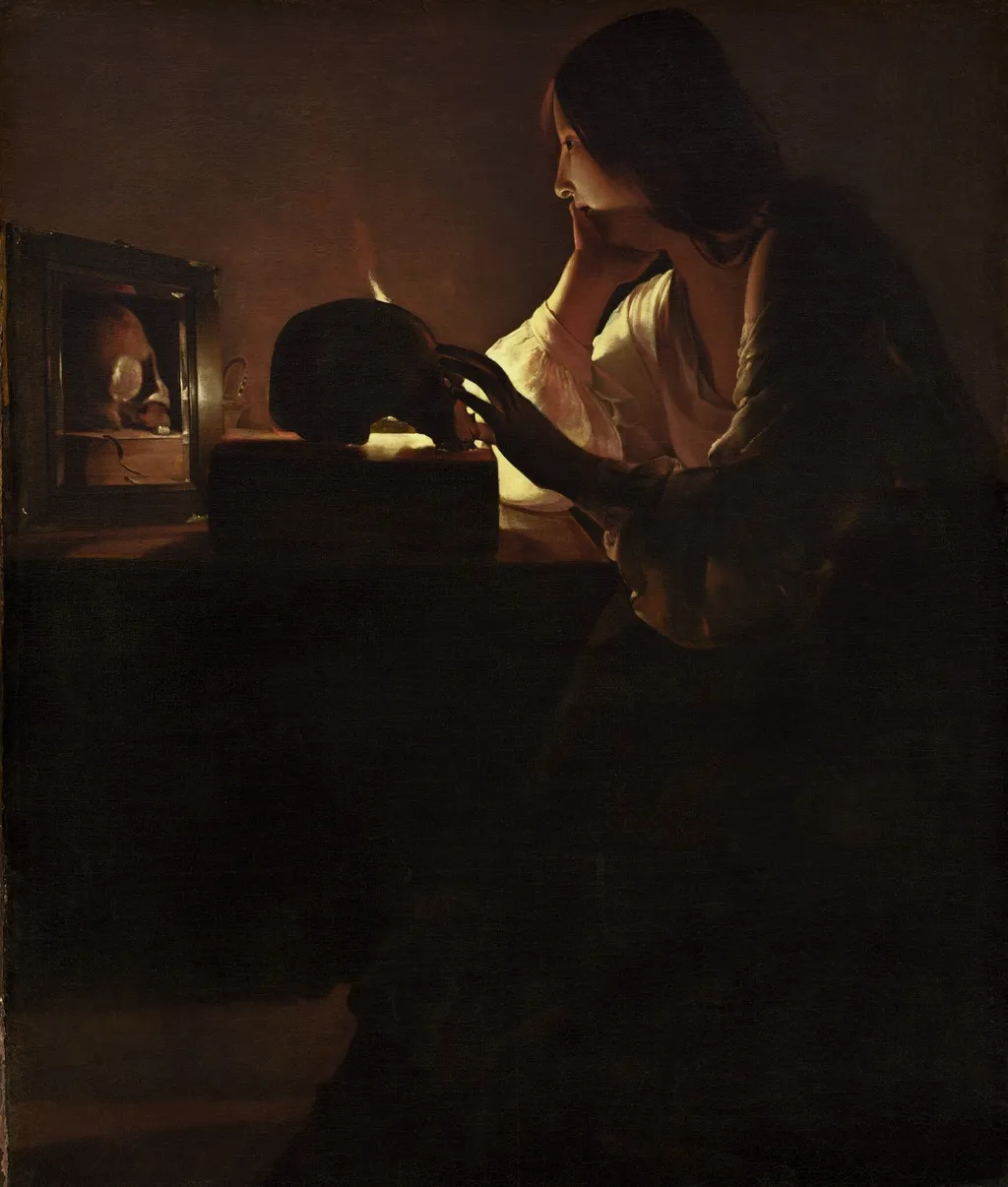
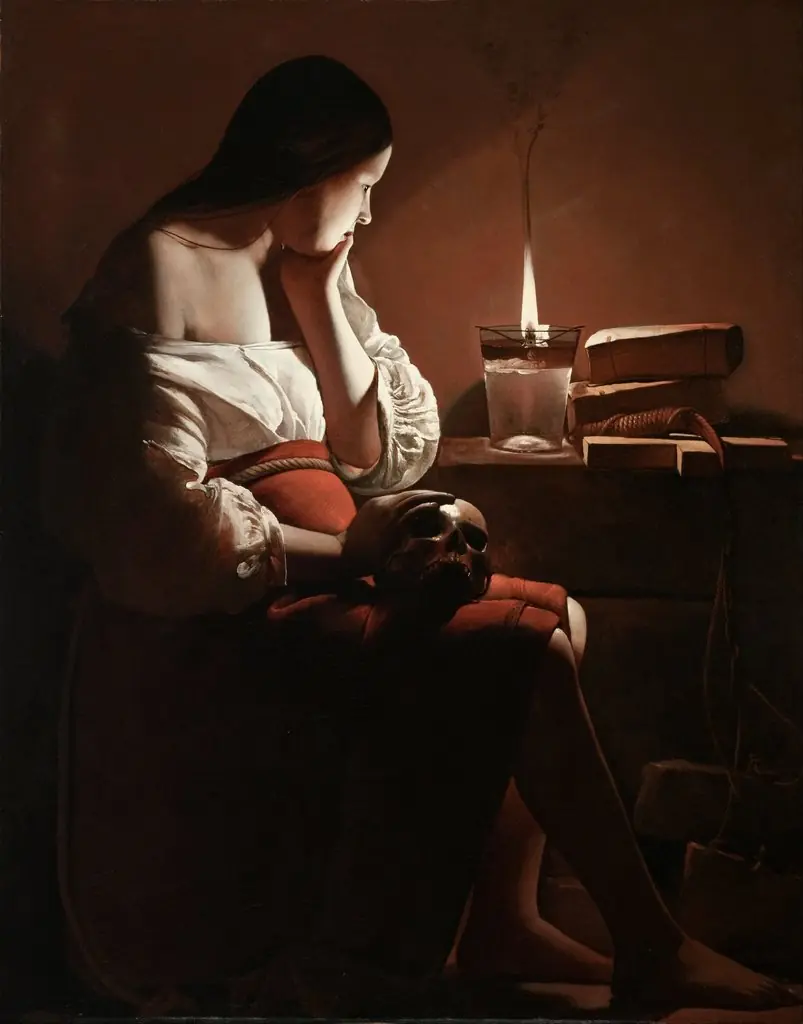
The Repentant Magdalen is an oil painting by the Baroque artist Georges de La Tour. It dates from 1638 and is held in the collection of the National Gallery of Art.
About this work
In a darkened room a single candle washes gold across Mary Magdalene's face as she studies a skull reflected in an ebony mirror. Georges de La Tour pares Baroque drama down to essentials: flame, bone, and glass. The National Gallery of Art acquired the canvas in 1974; it once belonged to André Fabius in Paris, who lent it to a 1937 exhibition at the Palais National des Arts.
Subject & Meaning
The dramatic contre-jour lighting, with the candle hidden behind her hand, emphasizes the moment of inner revelation and the transcendent power of grace.
The painting depicts Mary Magdalene as a penitent hermit, a common post-Tridentine subject. Iconographic symbols, a skull (memento mori), a mirror (past vanity, rejected), an open book (scripture), and a single candle flame (divine illumination), underscore her repentance and spiritual conversion. The dramatic contre-jour lighting, with the candle hidden behind her hand, emphasizes the moment of inner revelation and the transcendent power of grace.
Mary’s simple shirt, uncovered shoulders, and long unbound hair recall her former life of luxury while signaling her new humility. The work thus represents the triumph of penitence over sin, a central Counter-Reformation theme.
Technique & Style
Georges de La Tour painted The Repentant Magdalen in oil on canvas around 1637, a medium and support characteristic of his mature work. The canvas measures 113 by 92.7 cm. Stylistically, the painting exemplifies La Tour's tenebrist approach, with a single candle flame as the sole light source, creating stark contre-jour effects and deep shadows. The composition focuses on Mary Magdalene in pensive solitude, with her brown hair, a skull, and a mirror, all rendered through broad, smooth handling that minimizes visible brushstrokes.
The careful modulation of light and shadow conveys both physical volume and spiritual introspection, hallmarks of La Tour's nocturnal religious scenes.
History & Provenance
The painting was created in 1637, as indicated by both institutional records and the Wikidata entry. Its early provenance begins with the Marquise de Caulaincourt, who owned it by 1877; a stencil from the Parisian restorers Étienne-François and Henri Haro on the stretcher and an entry in their account book for 9 October 1877 confirm this. The work passed by inheritance to the Marquise's sister, the comtesse de Andigné, by 1911.
It subsequently entered the Paris art market and was acquired by André Fabius in 1936 (or slightly earlier, according to differing accounts). The National Gallery of Art purchased the painting from Fabius in 1974. No specific commission or creation history beyond the date is documented.
Overview
Georges de La Tour's oil on canvas, titled The Repentant Magdalen, was created between approximately 1635 and 1640. The painting depicts Mary Magdalene in a moment of profound introspection, illuminated by a single candle as she meditates before a mirror. This work is a significant example of de La Tour's distinctive style, characterized by its dramatic use of light and symbolic elements. It is currently held in the collection of the National Gallery of Art in Washington.
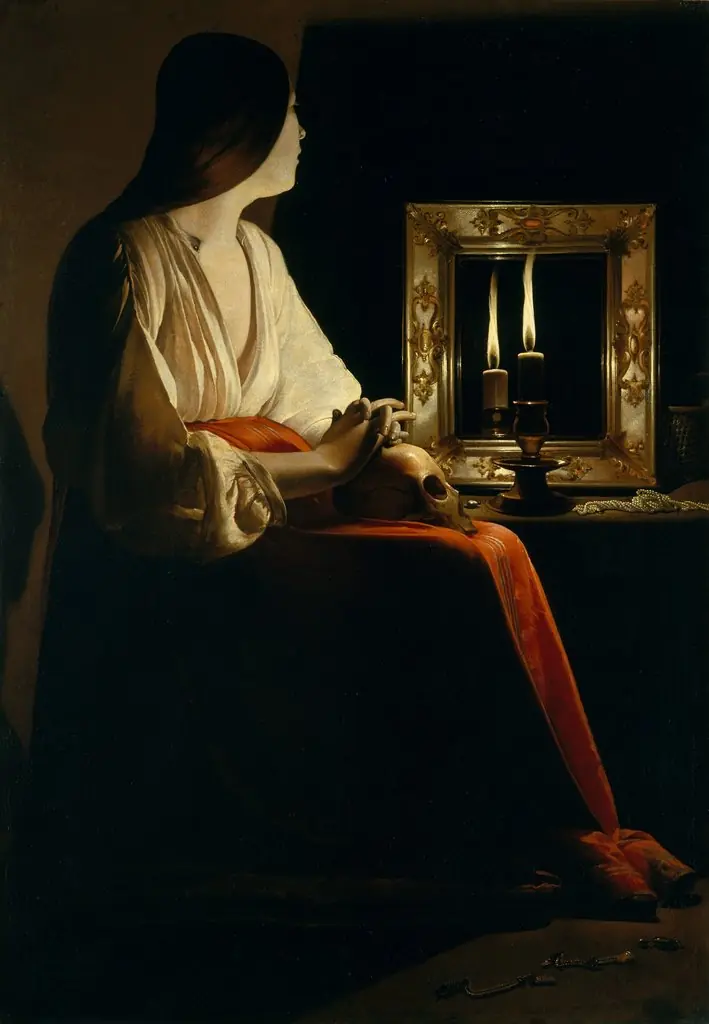
Own this work as a print
Artist & collection
Artist
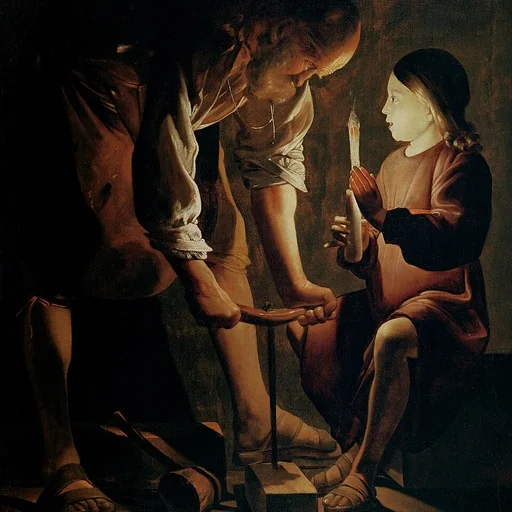
Georges de La Tour (French pronunciation:; 13 March 1593 – 30 January 1652) was a French Baroque painter, who spent most of his working life in the Duchy of Lorraine, which was temporarily absorbed into France between 1641 and 1648.

 Studied in the How to Look at a Painting course
  Studied in the Caravaggio & Baroque course