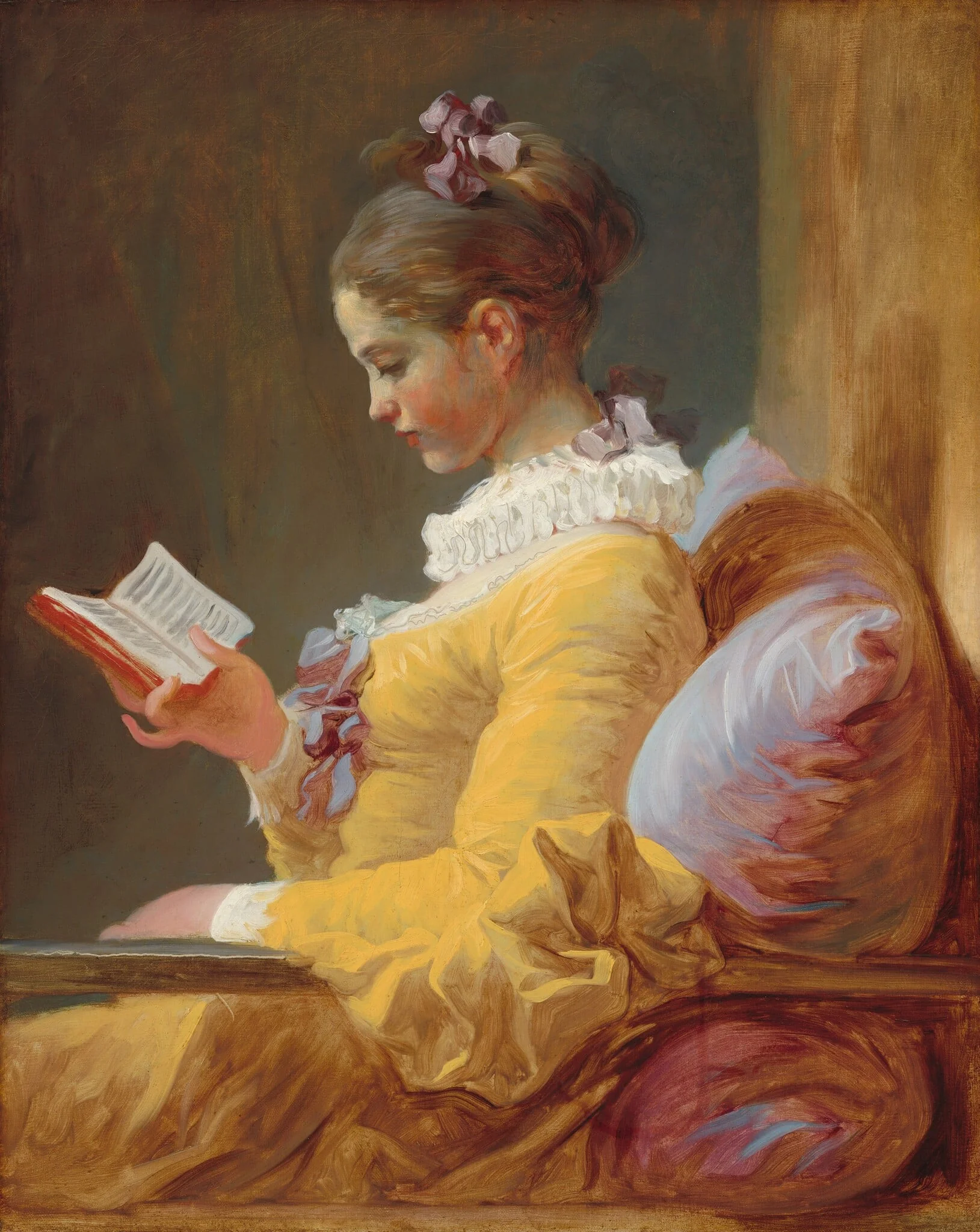
Jean Honoré Fragonard is usually praised for a feeling: the warm hush around a girl with a book, the giddy upward arc of a swing, the flushed half-second before a stolen kiss. The feeling is genuine. It is also the symptom, not the cause. The argument of this essay is narrower and more mechanical. Fragonard's manner was built, decision by decision, out of support and ground, out of medium and speed, and out of a market that let him stop a picture wherever he chose. His brushwork looks spontaneous because it was fast, and it was permitted to stay fast because the people who paid for it were not the Academy.
Fragonard lived from 1732 to 1806, and early on he stepped off the conventional career path the Royal Academy laid out, working instead largely for private patrons in an elaboration of the Rococo line running from Watteau through Boucher, as the Metropolitan Museum's account of his life makes plain (Heilbrunn Timeline). That biographical fact is also a technical one. Salon painting demanded a high, sealed finish that buried the trace of the brush under glaze and blending. Private cabinets demanded no such thing. Released from the obligation to hide his hand, Fragonard made the sketch his destination, and the abbreviated touch became his real subject, as much as the women and gardens it described. To understand the style, watch how the paint was laid down.
The market that made the manner
Fragonard trained in the orbit of François Boucher, the most fluent decorator of the age, and the lesson he took from that studio was less about subject than about tempo. Boucher could cover a wall fast and keep it charming. Fragonard learned the speed and then pushed it past charm into something more nervous and alert. The crucial move came when he chose his clientele. Tax farmers, dancers, financiers, courtesans, and a handful of grand amateurs wanted pictures for rooms, not for juried walls. They wanted wit, intimacy, and surface energy. They did not require the labored polish a Salon jury used to measure seriousness.
This is why his oeuvre is so heavy with cabinet pictures, decorative panels, overdoors, and quick figural fantasies rather than the large mythological set-pieces that earned reputations at the Louvre. The economics rewarded the gesture. A patron buying for a boudoir could be delighted by a head sketched in an hour. A jury could not. Once you see the manner as a response to who was paying, the so-called incompleteness of a Fragonard stops looking like haste and starts looking like a calibrated product, tuned to a buyer who prized verve over labor.
Support, ground, and the loaded brush
The look begins under the paint. Fragonard favored warm, mid-toned grounds, ochres and pinkish browns, and he let them do work that other painters covered up. Where a Salon machine would build flesh through many thin, blended layers until the ground vanished, Fragonard often left the ground breathing through the picture, using it as the middle value so that he only had to state the lights and the darks. That single decision halves the labor and doubles the apparent speed. The eye reads the bare warm tone between strokes as atmosphere, as the air in a room, when it is really just the unpainted preparation showing through.
On top of that ground he worked wet into wet, with a brush carried full. A highlight on a satin sleeve is one confident drag of thick, light paint, not a passage built up and smoothed. A curl of hair is a flicked comma. He used the oil sketch tradition, the premier coup or first-strike picture meant to be done in a sitting, and he treated it as a finished category rather than a preparatory stage. The medium itself encouraged this. Oil stays open long enough to be pushed, scraped, and re-touched while wet, and Fragonard exploited that window ruthlessly, dragging a dry-ish brush over a still-tacky underlayer to get broken, scumbled edges that shimmer instead of locking into contour.
Compare this with Jean-Baptiste-Siméon Chardin, his great contemporary, who also loved a frank, granular touch but built it slowly, tile by tile, into dense matter that sits and holds. Chardin's surface is patient. Fragonard's is impatient by design. Both reject the invisible brush of academic finish, and they reject it from opposite ends: one through accumulation, the other through abbreviation. Knowing which lever Fragonard pulled tells you most of what you need to know about why his pictures move the way they do.
Close looking: Young Girl Reading
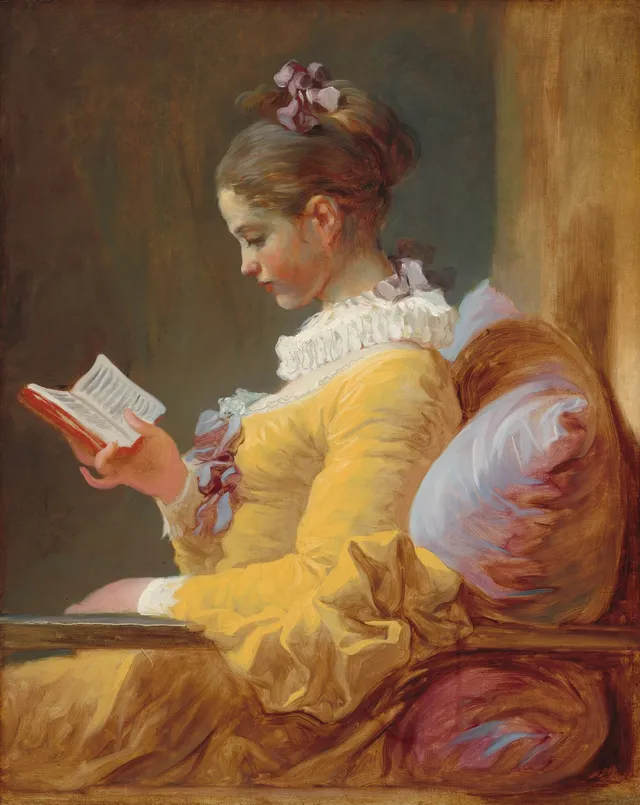
Stand in front of Young Girl Reading and the method is visible to the naked eye. The girl sits in pure profile against a warm, almost weightless wall of ground that Fragonard barely touches. Her dress is a single saturated citron yellow, and he models it not with gradual shading but with broad parallel strokes that change direction at the folds, so the satin seems to catch light in bands. Look at the ruff and cuff. They are not drawn. They are scribbled in thick white over the yellow, a few loaded twists of the brush that resolve into starched lace only at viewing distance. The small book in her hand is held by fingertips described in three or four touches. The purple cushion behind her back carries the boldest move in the picture, a raised crest of impasto along its top edge where the paint stands proud of the canvas and catches real light in the room.
What makes the picture more than a bravura demonstration is what conservators found beneath it. When the National Gallery of Art studied the panel between 2013 and 2015, imaging revealed an earlier composition in which the model originally faced the viewer, her gaze turned out toward us, before Fragonard painted her over into the absorbed reader we now see (National Gallery of Art). The discovery is decisive for the argument here. The serene inwardness we admire was not found in one inspired pass. It was edited. He chose, mid-picture, to turn the head away and convert a portrait-like confrontation into a private act of reading. The fast brush did not preclude revision. It absorbed it, because wet oil over a warm ground forgives second thoughts, and the final surface keeps no obvious scar.
The picture he could have repeated and didn't
Fragonard was perfectly able to make the grand machine the Academy wanted. He proved it once. His large history painting Coresus Sacrificing Himself to Save Callirhoe was shown at the Salon of 1765, won him admission to the Académie royale de peinture et de sculpture, and drew warm praise from Denis Diderot, the period's most influential critic (Wikipedia). The path to an official career was open. He declined to walk it. After that triumph he turned almost entirely to the private cabinet work that did not require the same finish, the same scale, or the same submission to a jury.
Diderot's running commentary on that Salon survives, and you can read his assessment of the works Fragonard exhibited in the digitized text of the Salon de 1765. The point is not that Fragonard failed at high art. The point is that he weighed the official ladder against the freedom of the marketplace and picked freedom. That choice is the hinge of the whole career. A painter who keeps climbing the Academy must keep finishing to a standard. A painter who sells to amateurs can let the brush stay loose, and over the next two decades Fragonard built an entire idiom on exactly that permission.
The Swing as a working method
The most famous result of this freedom is The Swing of 1767, now in the Wallace Collection in London, where a young woman in billowing pink kicks her slipper into the air toward a statue of Cupid while a hidden admirer gazes up from the bushes (Smarthistory). The picture is usually read for its naughtiness. Read it instead for its making. The foliage is not painted leaf by leaf. It is a dense, feathery weather of touches, lighter at the edges where the brush lifts off, so the whole garden vibrates and the figure floats inside a soft green haze. The flying slipper is a single bright dab. The rose and cream of the dress are dragged on in long ribbons of paint that describe the swing of the fabric by the swing of the hand. Method and subject become one thing. A picture about motion is built out of visibly mobile strokes.
This is the engine behind the seduction pictures the corpus holds in number. In The Stolen Kiss the satin is rendered with a cooler, glassier finish than usual, a reminder that Fragonard could tighten the brush when a commission asked for porcelain smoothness. In The Love Letter the little spaniel, the flowers, and the note are flicked in with the shorthand he reserved for accessories, while the sitter's face gets the careful attention. He rationed finish. The eye goes where he spent the labor, and the rest is left as suggestion.
Works discussed in this article
What the archive shows about range
Artifact World Gallery holds 132 works under Fragonard's name, scattered across 27 venues and clustering roughly between 1750 and 1800, and that spread is itself an argument about his method. Tate's reference entry files him with Boucher and Watteau as a defining hand of the Rococo (Tate), and the label is fair, but the corpus shows a painter who refused to stay inside one register. The garden fantasies sit beside tender domestic scenes and pure landscape, which is exactly what you would expect from a man who sold to many small buyers rather than one institution. The number of separate holding venues matters too. A career built on cabinet pictures disperses. The works went into private rooms, then into many later collections, instead of accumulating in a single official deposit.
The domestic pictures are where the method turns warm rather than flirtatious. The Happy Mother uses the same loaded, broken touch to describe a nursery instead of a tryst, the figures dissolved into a soft domestic glow. A Woman with a Dog carries the same economy into a single half-length, the animal's fur a blur of quick strokes against a smoothed face. And in the pure landscapes such as A Shaded Avenue, the broken brush comes into its own, since dappled light through trees is precisely the effect his scumbled, atmospheric handling was made to deliver. The subject changes. The toolkit does not.
Drawing, late allegory, and the same hand
The brush economy had a sibling in the chalk. Fragonard was a prolific draftsman, and his red-chalk sheets share the painted manner's logic: state the structure with a few decisive lines, let the white of the paper carry the light, and stop. Draftsmanship was the discipline that made the speed possible. You cannot abbreviate a figure convincingly unless you know exactly which marks can be dropped, and that knowledge comes from drawing constantly. His contemporaries understood this premium on the graphic line. The engraver Augustin de Saint-Aubin built a whole practice on the precision of the chronicling line, and the architectural fantasist Louis Jean Desprez pushed wash and contour toward theatrical effect. Fragonard sits among them as the one who carried that draftsman's confidence directly into oil.
Even when he softened his manner in later years, the underlying method held. The Fountain of Love of about 1785, one of his Allegories of Love now in the J. Paul Getty Museum, trades the early sparkle for a smokier, more vaporous handling suited to its dreamlike pair of lovers rushing toward a basin (The J. Paul Getty Museum). The palette cools and the edges blur further, partly in response to the rising Neoclassical taste that was turning against Rococo lightness. Yet the basic procedure is unchanged. He still works on a toned ground, still lets it carry the middle values, still builds the figures from broad, fluid passes. The mood is graver. The machinery is the same one he assembled decades earlier.
Why the unfinished look outlived the Rococo
Fragonard's reputation fell hard after the Revolution. The aristocratic world that bought his pictures was gone, and the new severity had no use for a painter of swings and kisses. He died in relative obscurity in 1806. The recovery came in the nineteenth century, and it is worth asking what the later age recognized that his own had begun to dismiss. It was the touch. Once painters started to treat the visible brushstroke as a value rather than a defect, Fragonard looked less like a frivolous decorator and more like an ancestor. The very thing the Academy would have corrected, the open, unblended mark that admits its own making, became central to modern painting.
His British contemporaries make a useful measure of the distance he traveled. Joshua Reynolds theorized a grand manner and lectured on the dignity of high finish, while John Hamilton Mortimer worked a more linear, illustrative vein. Set beside them, Fragonard's commitment to the loaded, mobile brush looks almost programmatic. Where they argued for the finished idea, he argued, in paint, for the live hand. An early monograph by Pierre de Nolhac, available in full on the Internet Archive, already traced this rehabilitation a century ago and helped fix the modern view of him as a virtuoso of execution rather than a mere purveyor of charm (Nolhac, Fragonard).
So the feeling people reach for first, the warmth and the wit, turns out to rest on cold decisions: a toned ground left showing, a brush kept full, a market that paid for speed, a refusal of the Academy ladder, and a draftsman's certainty about which marks to drop. The next time a Fragonard surface seems to flicker on its own, look closer at the citron sleeve or the crest of impasto on a cushion. The shimmer is not magic. It is a method you can read, stroke by stroke, in the paint he never bothered to smooth away.
Sources & further reading
- Jean Honoré Fragonard — The Metropolitan Museum of Art (Heilbrunn Timeline)
- Fragonard, A Young Girl Reading: a mysterious fantasy — National Gallery of Art
- Jean-Honoré Fragonard, The Swing — Smarthistory
- Coresus Sacrificing Himself to Save Callirhoe — Wikipedia
- Diderot, Salon de 1765 — Internet Archive
- Rococo (art term) — Tate
- The Fountain of Love — The J. Paul Getty Museum
- Pierre de Nolhac, Fragonard, 1732-1806 — Internet Archive