Artwork
A Woman with a Dog
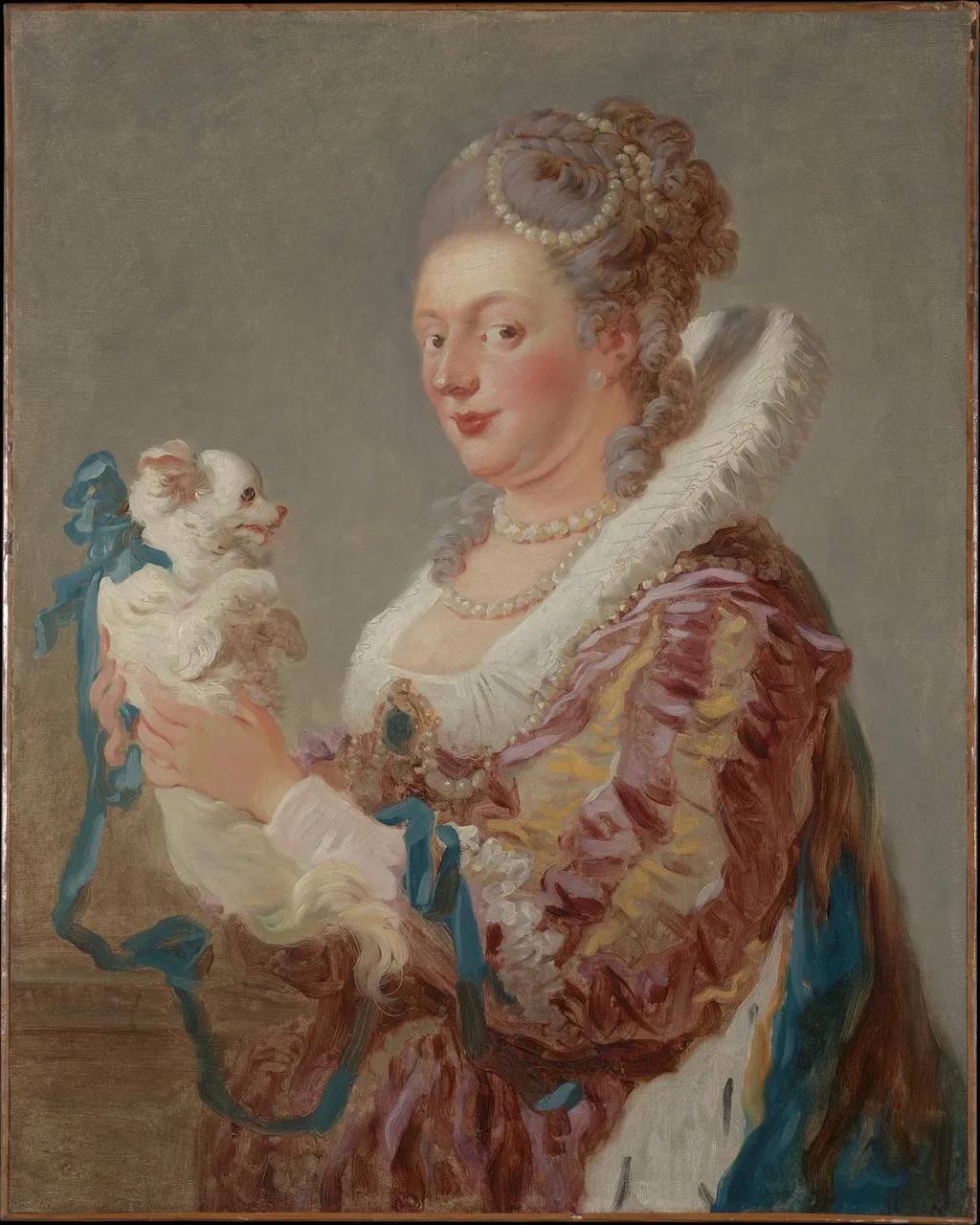
A Woman with a Dog is an oil painting by the Rococo painting artist Jean Honoré Fragonard. It dates from 1769 and is held in the collection of the Metropolitan Museum of Art.
About this work
Subject & Meaning
The model was identified as Marie Emilie Coignet de Courson, and the woman’s flushed cheeks and direct gaze suggest a cheeky, engaging demeanor.
The subject of A Woman with a Dog (1769) by Jean-Honoré Fragonard is a portrait from his Figures de Fantaisie series, characterized by playful, spontaneous execution. The woman’s attire, a dress styled after 16th–17th-century portraits, such as those of Marie de Médici or Anne of Austria by Rubens, contrasts with Rococo elements like her pearls and the palette of blue and pink. The dog, sharing curly features with the woman, is humorously juxtaposed in size, creating a whimsical dynamic.
The model was identified as Marie Emilie Coignet de Courson, and the woman’s flushed cheeks and direct gaze suggest a cheeky, engaging demeanor. The painting’s lighthearted yet refined qualities reflect Fragonard’s exploration of character through expressive detail.
Technique & Style
Created in 1769, A Woman with a Dog is an oil-on-canvas painting executed by Jean-Honoré Fragonard as part of his Figures de Fantaisie series. Characterized by the rapid execution typical of this group, often completed within an hour, the work demonstrates the artist's technical virtuosity. Stylistically, the composition blends Rococo elements, such as the subject's hairstyle, pearls, and a palette of blue and pink, with a dress rendered in a 16th- or 17th-century fashion reminiscent of Rubens' portraits.
The handling of paint creates a humorous juxtaposition between the woman and the dog, who share similar curly features despite their size difference. The figure's flushed cheeks and direct, cheeky gaze toward the viewer further define the portrait's lively formal qualities.
History & Provenance
The painting A Woman with a Dog was created by Jean Honoré Fragonard in 1769 as part of his Figures de Fantaisie series, a group of works executed rapidly to showcase his technical skill. The work’s subject was initially believed to depict Fragonard’s sister or aunt but has since been identified as Marie Emilie Coignet de Courson. The composition blends Rococo stylistic elements, such as the hairstyle, pearls, and color palette, with a dress evoking 16th- and 17th-century portraits, notably reminiscent of Rubens’ depictions of Marie de Médici or Anne of Austria.
The painting has remained in the collection of the Metropolitan Museum of Art, New York, since its creation.
Jean-Honoré Fragonard's 1769 oil painting, A Woman with a Dog, is held in the permanent collection of the Metropolitan Museum of Art in New York. While the provided sources confirm the museum's custody and the work's creation date, they do not specify an accession or inventory number. The painting belongs to the artist's Figures de Fantaisie series.
Regarding exhibition history, the available texts identify the work's current location and its inclusion in the museum's holdings but do not list specific past exhibitions, dates, or loan records. Consequently, while the repository is clearly established, detailed exhibition chronology remains unrecorded in the referenced materials.
Context
A Woman with a Dog (1769) is part of Fragonard’s Figures de Fantaisie series, known for its rapid execution and Rococo stylistic elements such as elaborate hairstyles, pearls, and pastel colors. The work’s juxtaposition of a woman and a small dog with similarly curly features, despite their disproportionate sizes, has been interpreted as a playful, humorous contrast, reflecting the artist’s Rococo sensibility. The sitter was initially thought to be Fragonard’s relative but is now identified as Marie Emilie Coignet de Courson.
The painting’s blend of 16th–17th century costume references, particularly to Rubens’ portraits of Marie de Médici or Anne of Austria, situates it within Fragonard’s engagement with historical portraiture. Housed at the Metropolitan Museum of Art, the work exemplifies the Rococo’s theatricality and informality, contributing to Fragonard’s reputation for capturing fleeting, expressive moments in portraiture.
Overview
A Woman with a Dog is an oil painting by Jean-Honoré Fragonard, executed in 1769. It belongs to the artist's celebrated series known as Figures de Fantaisie, a group of four half-length portraits created during his second trip to Italy. Unlike traditional commissioned portraits, these works depict idealized, anonymous figures representing distinct social types or characters rather than specific individuals.
In this composition, Fragonard portrays a young woman in a blue dress holding a small dog, rendered with the loose, fluid brushwork and vibrant color palette characteristic of the Rococo style. The series demonstrates Fragonard's mastery in capturing movement and psychological presence through rapid, confident strokes, moving away from the formal rigidity of academic portraiture. These paintings were likely intended as demonstrations of the artist's virtuosity and imagination, showcasing his ability to invent compelling scenes without a specific patron or narrative constraint.
The work stands as a significant example of Fragonard's transition toward a more expressive and painterly approach that would influence later Romantic artists.
Own this work as a print
Artist & collection

Artist
Jean-Honoré Fragonard was born on 5 April 1732 in Grasse, the son of a glover, and moved with his family to Paris in 1738.





 Portrait of a Woman as Astrea, Probably Mary Josephine Drummond, Condesa de Castelblanco
 Portrait of Maria Anna Sophia of Saxony, Electress of Bavaria (1728-1797)
 Portrait of a Woman
 Magdaleine Pinceloup de la Grange, née de Parseval
 Portrait of the Marquise d'Aguirandes
 Young Woman with Flowers in Her Hair
 Rouva Werner
 Anna Johanna Grill
 Françoise-Marie de Bourbon, Mademoiselle de Blois, Duchess of Orleans