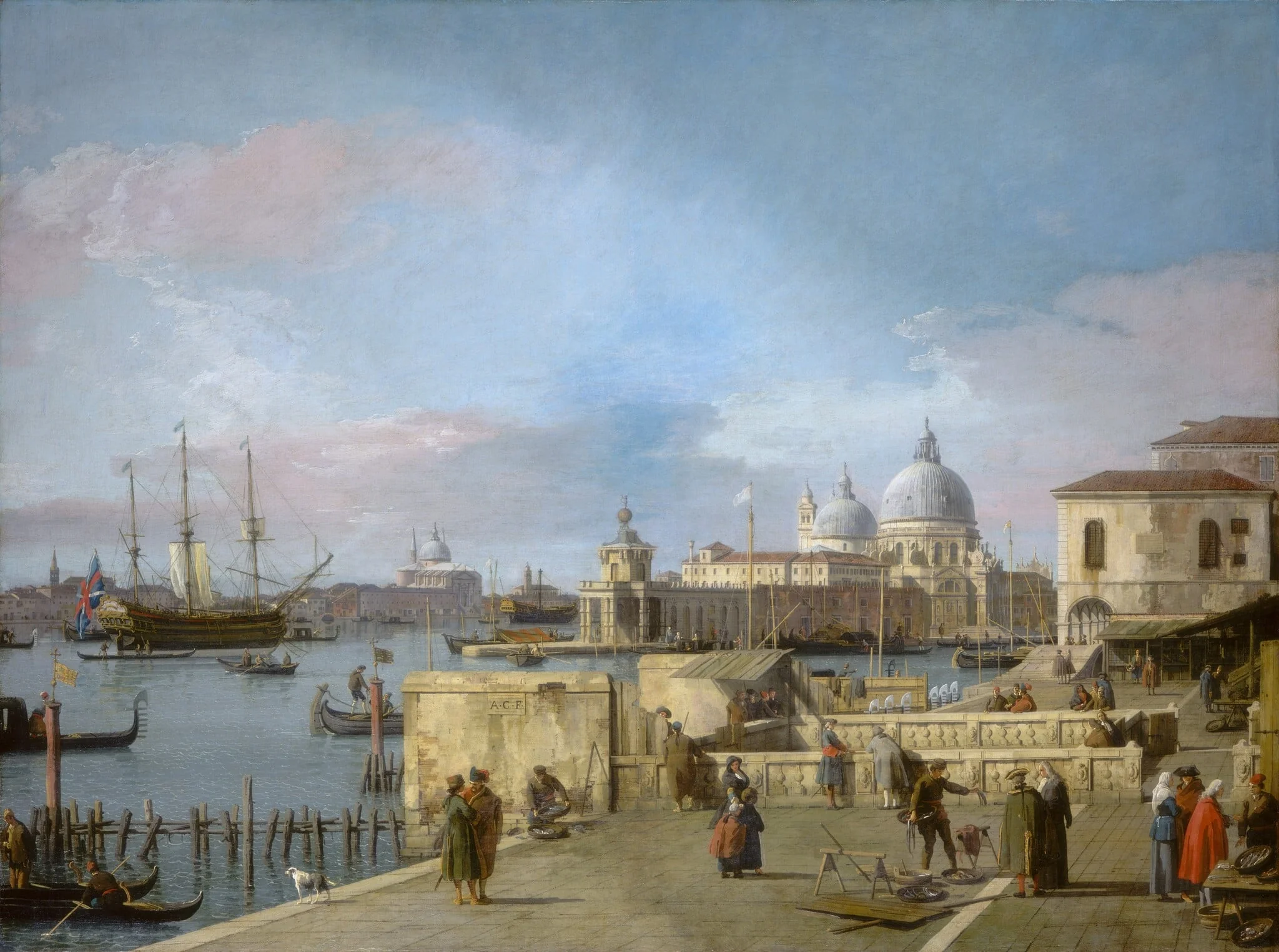
The fastest way to misread Canaletto's Venice is to treat it as a record of Venice. The pictures were made to leave. A young Englishman on the Grand Tour bought a view of the Bacino the way a later traveler buys a postcard, and the painter built each canvas to satisfy that buyer before it satisfied the city. He knew the wall it would hang on before he knew the weather he would paint. That is the argument here: his art is a study in transit, shaped at every stage by the distance between where it was painted and where it would finally hang. Once you see the destination inside the picture, the picture stops being a window and becomes a piece of freight.
And when the painter himself traveled, the formula went with him and bent under the strain. He crossed to England in 1746 and stayed most of a decade, and the Venice he had perfected under a lagoon sky did not survive the move intact. The light changed, the architecture changed, the buyers changed, and the work registers all of it. Read his career as a map of movement and the famous consistency starts to look like a long sequence of careful adjustments, each one made to keep a Venetian product selling in a place that was not Venice. The constancy people praise is really a discipline of small corrections.
A view built for export
The Venetian veduta, the topographical city view, was still a young business when Canaletto entered it. He was born Giovanni Antonio Canal in October 1697, the son of a theatrical scene painter, and he learned perspective in his father's workshop painting backdrops for the opera (Tate). That training matters more than the biographies usually allow. A stage set is a view engineered for an audience in fixed seats, legible from the back row, exaggerated wherever exaggeration reads better than truth. It teaches you to build a place out of cues rather than to copy one. Canaletto never fully left the theater. His Venice is staged, lit for an audience, arranged so the important things land where the eye expects them.
By the 1720s the city had become the climactic stop on the Grand Tour, and a generation of wealthy northern Europeans, the British above all, wanted to carry a piece of it home. The Met's survey of eighteenth-century Venice places Canaletto inside exactly this trade, supplying view paintings to foreign visitors who treated the canvas as proof of passage (The Met). The appetite was enormous, and he organized his studio to feed it. He repeated his best motifs, kept ready compositions of the Bacino and the Piazza, and treated a successful design less as a one-off than as a model he could issue again for the next buyer off the boat.
His great enabler was an Englishman. Joseph Smith, a merchant in Venice who later became British consul, served as Canaletto's agent and dealer, routing his output to British buyers while assembling a vast personal collection. In 1762 Smith sold that collection to King George III (Wikipedia), which is why the largest single trove of Canaletto on earth hangs in the British Royal Collection rather than on the lagoon. The fact names the direction of travel. The paintings were always headed north, and Smith was the funnel through which they went. A dealer who is also a collector keeps the best for himself and sends the rest abroad, and the result is a body of work scattered by design across a country the painter would not see until middle age.
Our own archive carries the same northward gravity. Artifact World Gallery holds 188 works under Canaletto's name, spread across 35 separate institutions and dated roughly between 1701 and 1756, and the venue list reads like a ledger of where the Grand Tour deposited its purchases: London and Washington far more than Venice itself. That spread is the point. A painter of one city, scattered across three dozen houses of art in countries that are not that city, is a painter whose subject and whose audience never shared a room. Lionello Puppi's catalogue of the complete paintings worked to fix the oeuvre in place (Internet Archive); the geography of where those paintings came to rest is a second catalogue, and it points abroad.
Reading the hero: Entrance to the Grand Canal
Look at the Entrance to the Grand Canal from the Molo. Canaletto sets you at the water's edge by the Molo, the ceremonial threshold where the sea meets the city, and swings the composition open like a pair of doors. On the right the domes of Santa Maria della Salute rise, heavy and pale, Longhena's votive church raised in thanks after plague. The Grand Canal slips away between the Salute and the palaces opposite, and the perspective is too generous, the angle wider than any single eye could hold at once. He has bent the geometry so the mouth of the canal yawns toward you and both banks stay in view, a thing no standing observer could actually see. Gondolas notch the foreground, their black hulls the darkest notes in the picture, and the figures aboard are quick calligraphic marks, a few strokes apiece.
The sky fills the upper third and does most of the emotional work, a high even Adriatic light that clarifies every cornice. The stone reads warm. The water carries the buildings back as broken reflection, the ripples scratched in with a loaded brush so the surface stays busy without ever going soft. Nothing dissolves, nothing blurs, because he wants the buyer to be able to name each campanile from memory. The eye is led down the right-hand palaces, across the throat of the canal, and out to the pale far bank, a path laid as deliberately as a stage direction. Every passage is built to be read, not felt for.
That legibility is the product, not a side effect. An Impressionist would later let exactly this scene melt into shimmer and trust the eye to reassemble it. Canaletto does the opposite. He hardens the view into an inventory, every landmark accounted for, every roofline kept crisp to its last tile, so that the man unrolling it in a damp English library can point and say he stood there. The painting answers a question the buyer will be asked at home, and it answers it in full sentences.
The mechanics of the souvenir
Canaletto almost certainly worked with a camera obscura, an optical box that threw the scene onto a surface he could trace. Scholars argue over how much he leaned on it, but the paintings settle the question of method: his perspective is mechanically exact in some passages and freely edited in others. He widens a campo, suppresses an inconvenient building, nudges a bell tower a few degrees to improve the balance. The instrument gave him accuracy; his judgment told him when to throw it away. The Square of Saint Mark's, Venice, now at the National Gallery of Art in Washington (NGA), is the method laid bare. He lifts the viewpoint, stretches the piazza wider than it stands, and squares the basilica's facade to the picture plane so its mosaics and five domes deliver maximum information. The pigeons, the strolling visitors, the market stalls, the stray dogs are staffage, populating a set. Stand where he says you stand and the square would never fan out so obligingly; he has opened it for you.
The Campo Sant'Angelo shows the quieter face of the same discipline. It is a lesser square, off the tourist spine, and Canaletto gives it the forensic patience he spends on the Salute. The wellhead, the bell-mouthed Venetian chimneys, the hanging laundry, the figures about their ordinary errands all get recorded, but recorded the way a stage designer records a street, each element placed for clarity and rhythm rather than transcribed where it stood. The shadows fall in a clean diagonal that organizes the pavement into legible bands. He sold the spectacular and the ordinary with equal conviction, because both were merchandise bound for a wall in Yorkshire or Norfolk. A back square handled with this much care is a painter telling you no view was beneath the system.
Across the Alps
The War of the Austrian Succession choked off the Grand Tour traffic in the 1740s, and Canaletto did the logical thing: he followed his market back to its source. He arrived in England in 1746 and stayed, with one return trip to Venice, until about 1755. He painted the Thames, London's new bridges, and the country seats of his patrons, fitting the Venetian system to a kingdom that had never owned a lagoon. The man whose whole trade was selling Venice to Britain simply moved to Britain when Britain stopped coming to him. It was a sound commercial instinct and a real artistic gamble, because the thing he sold best was the one thing England could not supply: Venetian water and Venetian light.
Warwick Castle is where you can watch the formula strain. He fits his Venetian apparatus to a medieval English pile: the same wide stage, the same crisp tally of every crenellation and window, the same scatter of small bright figures on the lawn. The subject resists. The castle's stone is grey, the English sky sits lower and softer, and the even lagoon light he had spent thirty years perfecting is simply not available outside the Adriatic. He brightens it anyway, pushing a clarity the climate withholds, and the picture takes on a slightly enameled, lit-from-everywhere quality that the Venetian pictures earn from real sun. Some English viewers felt the difference and complained that his work here looked harder and more mechanical than the Venice they remembered, and the doubt grew loud enough that he took to painting in public to prove the hand was still his.
The capriccio is where England loosened him. A capriccio is an architectural fantasy, a view of buildings that never stood together, and the English Landscape Capriccio with a Column lets him stop transcribing and start inventing. A lone classical column rises over countryside he made up, ruins assembled for mood rather than accuracy, the whole thing balanced on a fiction. With no real place to be checked against, his hand eases and the brush moves with a freedom the topographies never permit. The capricci may be the most personal pictures he produced on English soil, because they were the one product no patron could hold up against the view from his own window. Released from the duty of accuracy, the showman finally gets to compose for himself.
What travels, what stays
The Porta Portello, Padua belongs to an earlier and shorter journey, a trip up the Brenta to Padua around 1740, when the tourist drought was already setting in and Canaletto, perhaps reading the weather, turned toward printmaking and toward subjects beyond Venice. The Porta Portello is a working city gate on the water, and he handles it with a new looseness, the topographer relaxing into a place no Grand Tourist demanded he flatter. The brick is allowed to look used, the gate to look like a job rather than a monument. These same years produced his etchings. A 1912 volume reproduced them from the original plates held in the British Museum (Internet Archive), a reminder that the man we file as a painter was also a serious printmaker, and that a print, by design, is made to travel and to multiply. A plate is the export instinct made literal: one matrix, many copies, each one ready to be carried off.
The clearest proof that this art was about transit is that the name itself traveled without the man. His nephew and pupil Bernardo Bellotto trained in the workshop, absorbed the method whole, then carried it across the German and Polish courts, signing himself "Canaletto" in Dresden and Warsaw. Bellotto's northern views run colder, more silvered, sharper at the documentary edge, the lagoon warmth swapped for a continental grey. His Warsaw scenes were precise enough that the city leaned on them to rebuild its old town after the Second World War, the souvenir turned back into architecture. The uncle's formula proved portable enough to survive translation into another country, another climate, and another temperament, which is exactly what a system built for export should do.
Canaletto neither invented the view nor sold Italy to the north alone. In Rome, Giovanni Paolo Panini was doing parallel work, packaging the ruins and ceremonies of the papal city for the same Grand Tour purses, often assembling whole galleries of Roman sights into a single imaginary room. The Venetian figure painter Sebastiano Ricci, who had worked in England himself earlier in the century, belonged to the same outward current of Venetian talent flowing toward foreign patrons. What set Canaletto apart was the rigor of his system and the completeness with which he turned a city into a reproducible good. Others sold views; he industrialized one.
He came back to Venice for good around 1755. The city had grown poorer and quieter, the tourist flood reduced to a trickle, and his manner now struck the younger generation as old-fashioned, a style perfected for a market that no longer arrived by boat. The Venetian Academy was slow to take him and finally elected him in 1763 (Wikipedia), late honor for a painter whose canvases had hung in British country houses for decades before his own city's institution would claim him. He died in Venice in 1768, at home, in a market that had long since moved on without ever quite having him to begin with.
Works discussed in this article
What survives is a paradox worth keeping. The most faithful-seeming painter of Venice spent his life making a Venice tuned for elsewhere, edited for legibility, brightened for export, and the truest thing his record tells us about the city may be that almost none of it stayed there. To face a Canaletto today, in Washington or London, is to see the lagoon through the eyes of the man who shipped it. The campanile leans a degree it never leaned, the canal opens wider than the stone allows, and the light is a little too clean for the latitude. Call that the record itself, packed for travel and never fully unpacked.
Sources & further reading
- Canaletto — Tate
- Canaletto — Wikipedia
- The Square of Saint Mark's, Venice — National Gallery of Art
- The Etchings of Canaletto, reproduced from the originals in the British Museum — Internet Archive
- Venice in the Eighteenth Century (Heilbrunn Timeline of Art History) — The Met
- The Complete Paintings of Canaletto (Lionello Puppi) — Internet Archive
- Giovanni Antonio Canal (Canaletto) — The J. Paul Getty Museum