The career of the painter George Bellows is usually told as a story of subjects: the boxing ring lit from above, the tenement block, the East River clotted with barges and steam. Follow the money instead and a sharper figure comes into focus. The same hand that staged an illegal prizefight in oil also painted the wives of America's richest collectors, and it was that second clientele, the portrait sitters and the museum trustees, who bankrolled the first. Bellows was never the starving radical the boxing pictures imply. He was a salaried instructor, a magazine illustrator, and a man whose work entered a great public museum before he turned thirty. To read him only by his subjects is to miss who was standing behind the easel paying for the room.
That is the argument this essay defends, work by work. The popular Bellows is a chronicler of the gutter. The actual Bellows ran two ledgers at once: one of subjects that made his name notorious, and one of patrons who kept him solvent and respectable. The fame and the funding came from opposite ends of the social ladder, and Bellows worked both with an ease that should complicate any tidy account of him as an outsider. He died young, on January 8, 1925, at forty-two, of peritonitis after a ruptured appendix went untreated (Wikipedia). The brevity of the run is part of why the two ledgers stayed so visibly side by side. He never had time to resolve into a single brand. What looks like contradiction in him is really method. He kept the door open to every buyer the period offered, and the period offered a great deal to a fast, technically fearless hand.
Henri's pupil, and a school named after a Bellows drawing
Bellows arrived in New York from Ohio in 1904 and fell almost immediately under the teaching of Robert Henri at the New York School of Art (Wikipedia). Henri was the gravitational center of what would later be called the Ashcan School, an informal band of painters who treated the unglamorous city as subject matter worthy of a large canvas and a thick, dark palette. Henri preached speed, directness, and a refusal to prettify. His students learned to load a brush and commit. Bellows learned the lesson better than most. He absorbed Henri's economy and pushed it harder, until a whole figure could be carried by four or five loaded strokes and still read as a body in motion.
The name of the movement is itself a Bellows artifact. The term traces to one of his drawings, captioned "Disappointments of the Ash Can," which ran in the Philadelphia Record in April 1915 (The Metropolitan Museum of Art). The label stuck to the whole circle, a group Smarthistory describes as led by Henri and bound together by gritty urban realism and the muddy color that gave the school its informal nickname (Smarthistory). Worth registering the irony. The movement got its name from a man who was, within a few years, painting society portraits in clean light. The Ashcan brand was an accident of a caption, and Bellows wore it loosely. The muddy palette that the school is remembered for was, for him, a phase rather than a creed. He could go dark and grimed when the subject asked for it, and he could go bright and even when a sitter was paying.
The fights nobody was supposed to be selling
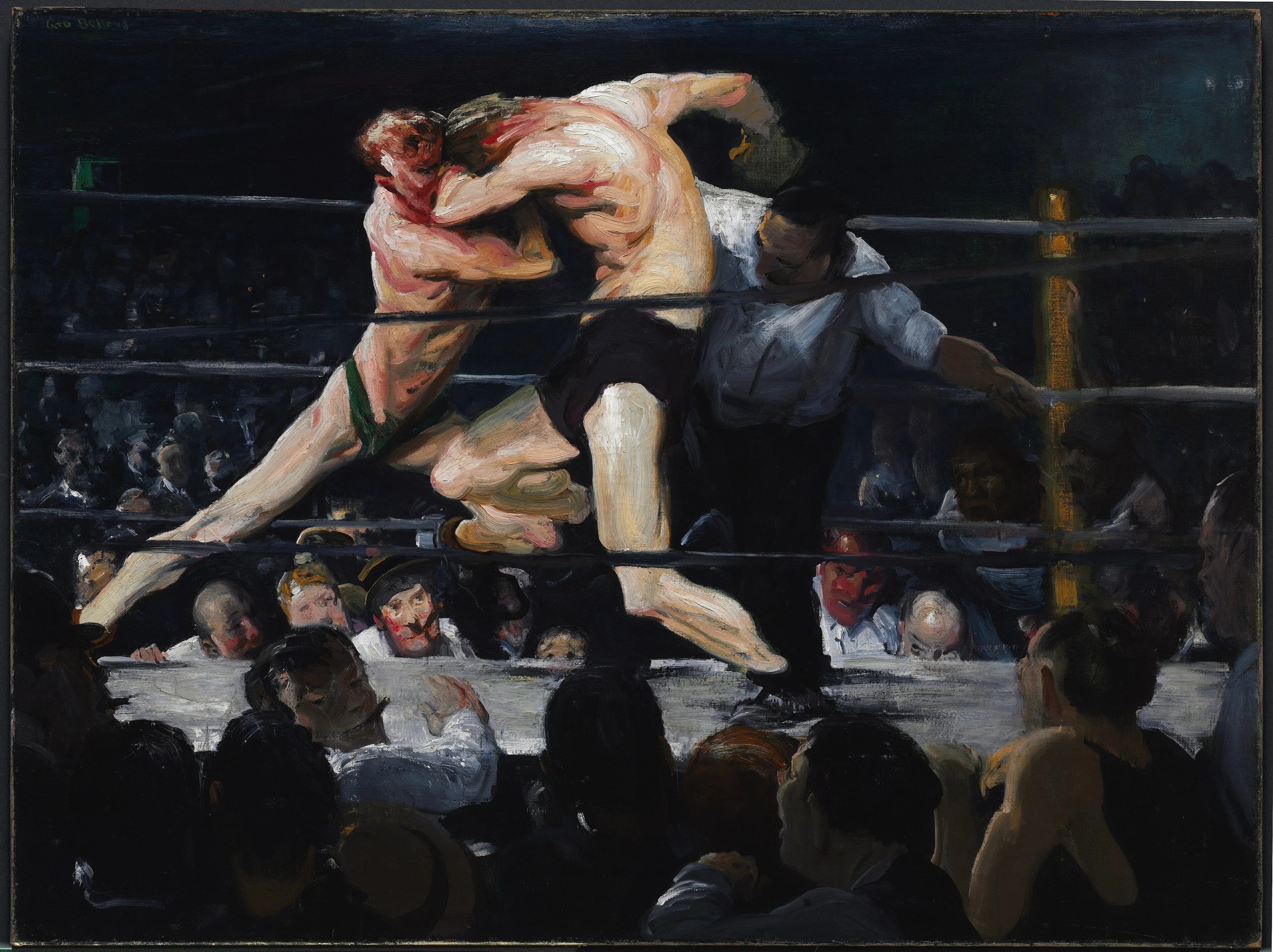
Stand in front of Stag at Sharkey's and the first thing the picture does is fuse its two fighters into a single shape. Their heads come together at the top, skull against skull, so that the two bodies read as one dark arch of strained muscle thrown across the center of the canvas. Bellows lights them from above with a hard ring lamp, and the light slides down their backs in greasy ribbons of white and pink laid wet into wet, so the paint itself looks sweated. The floor of the ring is the brightest plane in the picture, a scrubbed pale field that shoves the figures forward at us. Below them the crowd dissolves: a row of pink smears for faces, black coats, a hat, an open shouting mouth, painted so loosely they barely hold as people. The referee crouches at the right, smaller, almost an afterthought against the two men he cannot separate. Nothing here is finished in the academic sense. The brush is moving too fast to describe a knuckle. What it describes instead is force, the instant before a body gives.
Look longer and the cruelty of the design becomes clear. Bellows gives the fighters no faces worth the name, only the wedge where two heads meet, while the audience is reduced to appetite, a smear of pink and open mouths along the dark lip of the ring. The picture is about watching as much as fighting. We are placed where a paying spectator stood, low and close, looking up into the worst of it. The composition implicates the viewer in the transaction it depicts, which is one reason the painting still unsettles a museum wall a century after the men in it stopped throwing punches.
Sharkey's was a private athletic club directly across the street from Bellows's studio. Prizefighting was illegal in the New York of 1909, and the "club" arrangement was the legal fiction that let it happen: pay a membership and the bout was private, not a public match. Bellows painted the picture in 1909, and since 1922 it has belonged to the Cleveland Museum of Art (Wikipedia). The same autumn produced the largest of his early ring pictures, Both Members of This Club, painted in October 1909 and likely alluding to the Black heavyweight champion Jack Johnson. That canvas became the first Bellows the National Gallery of Art ever owned, given to the museum by the collector Chester Dale in 1945 (National Gallery of Art). Hold that last fact. A picture of an underground fight, charged with the racial politics of the Johnson era, entered the national collection as the gift of a Wall Street financier. The subject came from the bottom of the city. The path into the museum ran through the top. That route is the whole argument in miniature. The men in the ring had nothing. The man whose name now sits on the wall label ran money downtown. Between them stood the painter, taking both as material.
Who paid: the Met, the dealers, and the portrait sitters
The first institution to put real weight behind Bellows was the Met. When the museum bought Up the Hudson, a 1908 river landscape, in 1911 as its first Ashcan painting, Bellows became one of the youngest artists represented anywhere in the collection. He was not yet thirty. Compare the timeline of his European contemporaries to feel how unusual that is. Ernst Ludwig Kirchner and Umberto Boccioni were fighting for wall space in secessionist and Futurist breakaway shows in those same years, well outside the official museums of their countries. Bellows, the supposed gutter realist, was already inside America's largest one. The radical subject and the establishment patronage arrived together. The purchase did something a private sale could not. It put a public, permanent stamp on a young realist and signaled to every other collector in New York that this work was safe to own.
And the steady income, the money that paid the studio rent between the headline pictures, came increasingly from portraits. Look at who sat for him. Maud Murray Dale (Mrs. Chester Dale) is the wife of the very collector who would later hand Both Members of This Club to the nation. The Dales were among the most important American collectors of their generation, and a Bellows portrait of Maud put the painter inside that household as more than a name on a label. Florence Sittenham Davey (Mrs. Randall Davey) ties him to another artist's circle: Randall Davey was a fellow Henri pupil and a close friend. The portraits did two jobs at once. They paid, and they bound Bellows into the network of collectors, friends, and patrons who would carry his pictures into permanent collections after his death. A boxing canvas earns a reputation. A flattering likeness of a collector's wife earns a relationship. Notice the economy of it. One sitting could cover weeks of the work that made no money, and it could also place a Bellows on the wall of a house where the next sale would be negotiated. The boxing pictures were advertisements. The portraits were the business.
The corpus view: one name, many hands of patronage
There is a way to see the two-ledger life in aggregate. Artifact World Gallery holds 323 works under the Bellows name, drawn from twelve separate venues and clustered between about 1904 and 1924, which is to say across essentially his entire mature working life. The Getty Union List of Artist Names fixes the man himself precisely, an American painter, lithographer, printmaker, landscapist, illustrator, and draftsman, 1882 to 1925 (Getty Research Institute). Set the corpus against that authority and the spread tells the story. Twelve venues for a man dead at forty-two means his output did not pool in one or two collections. It scattered, because the funding was plural from the start: a museum purchase here, a collector's gift there, a portrait that stayed in a family before passing to a public institution. The Getty record lists six occupations because Bellows monetized six skills. The painter who made the boxing pictures was also, on the same days, an illustrator filing drawings to newspapers and a lithographer pulling editions. He was a working professional in the most literal sense, and the corpus's twelve-venue dispersion is what that professionalism looks like a century later.
There is a second thing the spread shows. A career funded from one source pools; a career funded from many scatters. Bellows scattered, which is the visible trace of a man who never let any single buyer define him. The twelve venues are not an accident of survival. They are the shape his hustle left behind, and they line up against the Getty's six occupations almost too neatly. A man who sold a museum a landscape, a financier a fight, a family a portrait, and a newspaper a drawing was never going to end up concentrated in one room.
Works discussed in this article
Maine, the family, and the quieter late market
The last years bend the story toward home. Bellows spent summers in Maine, and The Red Vine, Matinicus Island, Maine is the landscape painter the Getty record names, working off the boxing reputation entirely. The picture trades the ring lamp for open coastal light and lets a single vine of red carry the heat across a cooler ground. There is no crowd, no patron, no transaction implied on the surface. The handling stays quick, but the violence is gone out of it. What had been a weapon in the ring becomes, on the Maine coast, a way of catching weather. These island canvases sold to a different appetite than the fights did, to buyers who wanted a Bellows without the brutality, and they widened his market precisely by softening his subject.
The family pictures push further in the same direction. Jean with Blue Book and Apple is his daughter, posed with the small props of childhood study, a book and a piece of fruit, painted with the patience he denied the boxers. The brush slows down. The light is even and domestic. A man known for the fastest, ugliest action in American painting could also sit a child still and render her with tenderness, and he did it partly because the late market rewarded it. It is the same technician underneath, the same refusal to fuss, turned now on something he loved instead of something he wanted to expose. The portraits of his daughters, like the portraits of collectors' wives, belong to the funding ledger as much as the fighting pictures belong to the fame ledger. The difference is that by the early 1920s the two ledgers had nearly merged. The gentleness was no longer a compromise. It had become the work.
When Bellows died in January 1925, the consolidation of his reputation passed into the hands of dealers, family, and publishers. Four years later Alfred A. Knopf issued Paintings of George Bellows, a handsome 1929 monograph that helped fix the canon of his major works and is now readable in full through the Internet Archive (Internet Archive). A monograph is a market act as much as a scholarly one. It tells collectors which pictures matter, and it did its job. The boxing canvases and the portraits both made the cut, side by side, the way they had been made side by side in the studio. By 1929 the verdict was in print, and the verdict was plural. No single Bellows won out, because there had never been a single Bellows to win.
- Who painted it: a Henri-trained Ohioan who could move a brush faster than almost anyone in American art, and who never specialized in a single subject because his living depended on not specializing.
- Who paid for it: the Met as early as 1911, collectors like Chester Dale, the portrait sitters who tied him into wealthy households, and the print and illustration markets that paid by the week.
- What the corpus shows: 323 works across twelve venues, scattered exactly because the funding was plural from the first canvas to the last.
Sources & further reading
- George Bellows — Wikipedia
- Stag at Sharkey's — Wikipedia
- The Ashcan School — The Metropolitan Museum of Art
- Both Members of This Club — National Gallery of Art
- The Ashcan School, an introduction — Smarthistory
- George Bellows (ULAN Full Display) — Getty Research Institute
- Paintings of George Bellows (Alfred A. Knopf, 1929) — Internet Archive