Artwork
Stag at Sharkey's
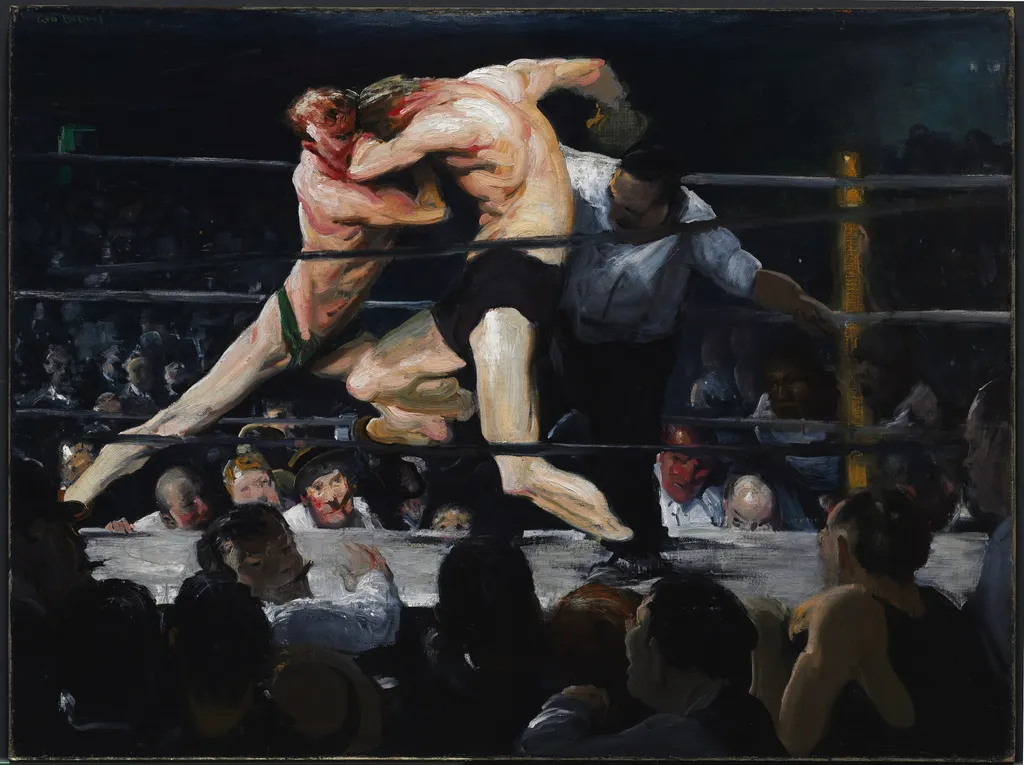
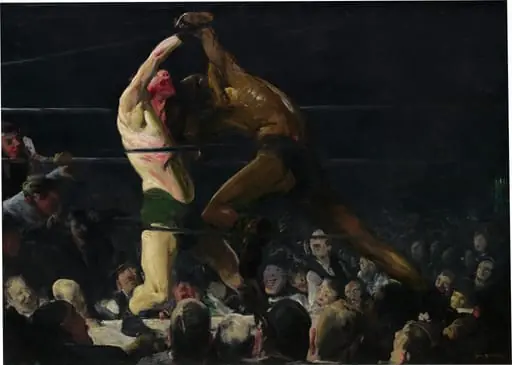
Stag at Sharkey's is an oil painting by the Ashcan School artist George Bellows. It dates from 1909 and is held in the collection of the Cleveland Museum of Art.
About this work
Two fighters lunge at each other in a backroom ring at Sharkey's Athletic Club, a rowdy saloon near George Bellows's New York studio where public boxing was illegal and outsiders fought as temporary members called 'stags.' Painted in August 1909 with quick, blurred strokes and a low vantage point, the canvas catches the raw physicality Theodore Roosevelt praised as healthy manliness. The Cleveland Museum of Art bought it in 1922.
Subject & Meaning
" The painting thus represents the raw, unregulated violence of lower-class boxing culture in early 20th-century New York.
The painting depicts two amateur boxers, called "stags" (non-professionals fighting with temporary club memberships), locked in a violent engagement at Sharkey's athletic club in New York City, while a referee attempts to intervene and a crowd watches. Bellows situates the viewer at ring level among the spectators, creating a sense of expressive involvement. As part of the Ashcan School movement, the work focuses on gritty, everyday urban life, often in poorer neighborhoods.
Bellows used expressionist brushwork, especially on the left boxer's face, to suggest speed and brutality, and he reportedly remarked, "I don't know anything about boxing, I'm just painting two men trying to kill each other." The painting thus represents the raw, unregulated violence of lower-class boxing culture in early 20th-century New York.
Technique & Style
Bellows executed Stag at Sharkey's in oil on canvas, using quick, visible brushstrokes to blur forms and simulate the boxers' rapid motion. The low viewpoint places the viewer among the crowd, intensifying the scene's visceral impact. The work exemplifies Ashcan School realism, but incorporates expressionist distortion, especially in the left boxer's contorted face, to emphasize violence and speed.
The composition is dynamic and tightly focused on the central figures. No specific condition issues are noted in the sources.
History & Provenance
George Bellows painted Stag at Sharkey's in August 1909 as part of a series of boxing scenes. The oil-on-canvas work depicts a match at a private athletic club in New York City. It entered the collection of the Cleveland Museum of Art in 1922, where it remains (accession number 1922.1133). No commission or earlier ownership details are documented in the available sources.
Since 1922, Stag at Sharkey's has been held in the permanent collection of the Cleveland Museum of Art (accession number 1922.1133), as documented by the institution's records. No further exhibition history is provided in the available sources.
Context
Stag at Sharkey's exemplifies the Ashcan School's focus on everyday life in early twentieth-century New York City's poorer neighborhoods. Bellows used quick brushstrokes and a low viewpoint to place viewers among the crowd, creating a sense of expressive involvement. The painting belongs to a boxing series Bellows produced in 1909.
Its style combines American realism with expressionistic distortion, evident in the left boxer's face, to suggest the speed and violence of the match. Acquired by the Cleveland Museum of Art in 1922, the work is recognized as a key achievement of the Ashcan School and a seminal sports image in American art.
Overview
George Bellows's 1909 oil painting, Stag at Sharkey's, vividly captures an illicit boxing match at a New York City athletic club. This work exemplifies the Ashcan School's focus on depicting the gritty realities of urban life in the early twentieth century. The scene immerses the viewer in the raw energy of the fight, a common but often hidden spectacle of the era, reflecting Bellows's interest in the city's less formal activities.
Own this work as a print
Artist & collection
Artist
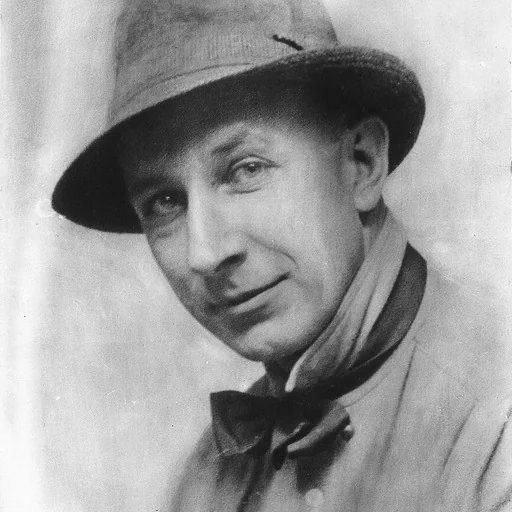
George Wesley Bellows (August 12 or August 19, 1882 – January 8, 1925) was an American realist painter, known for his bold depictions of urban life in New York City.