The Connecticut portraitist Ralph Earl learned to paint the way the English court painted, and then spent the rest of his working life arguing with what he had learned. He trained in London under Benjamin West, the American expatriate who supplied George III with grand history pictures, and he came home fluent in the metropolitan manner: the full-length figure, the columned interior, the heavy fall of curtain, the distant park glimpsed through a window. That idiom existed for one purpose, which was to make a sitter look like inherited power. Earl kept its grammar and threw out its purpose. In the hands of his Connecticut merchants and their wives, the grand manner stopped flattering rank and started counting goods.
That reversal is the argument worth following through his pictures. The first generation of painters working after the Revolution did not invent a new language. They took the imported English one and bent it toward a republic that had no court, no peerage, and no inherited estates to flatter. Earl is the clearest case in that cohort. His canvases keep the scale and confidence of the metropolitan portrait while swapping out its subject. Where the London manner asked you to admire blood, Earl asks you to read an account book. The predecessor sold atmosphere. Earl sold fact, and he did it without apology. A duke in paint was a closed argument about birth. Earl's merchants are open arguments about work, and the evidence is laid out in the frame for anyone to check.
A grand manner brought home
Earl's training is the root of the quarrel. The Getty Union List of Artist Names records him as American, born in Shrewsbury, Massachusetts, in 1751, a painter remembered for Revolutionary battle scenes and New England landscapes but working first and last as a portraitist, and a pupil of Benjamin West. West mattered here. He was the painter who had crossed the Atlantic, won a place at the English court, and turned out the large history canvases that defined ambition for any American holding a brush. To study in his London rooms was to absorb the imperial manner at its source: how to stage a body at full length and let a curtain fall so that the eye reads wealth before it reads a face. West had taught himself to make figures stand like statesmen, and his studio passed that lesson on in scale, in drapery, and in the careful management of where a sitter's eye should land.
The manner had a purpose, and the purpose was rank. A full-length portrait in that tradition was a claim about land and lineage, about the right to be looked up at. Earl absorbed the format completely, then carried it back to a society that had just fought a war to abolish the premise. Connecticut had no lords. Its leading men were merchants, lawyers, militia officers, and ministers, people whose standing rested on ledgers and elections rather than on birth. Earl did not soften the grand manner to suit them. He aimed it at them, and in doing so he changed what it was for.
This is the quiet radicalism in his work. He kept the whole apparatus of aristocratic portraiture and filled it with the evidence of labor. The window that once opened onto a nobleman's deer park now opens onto a town the sitter helped settle, or onto fields he farms and owns. The table that once held a letter of state now holds a stack of account books. The argument with the predecessor is never loud in Earl. It runs through the props.
The merchant who would not be flattered
Look at Elijah Boardman. The Metropolitan Museum, which holds the picture, describes Earl as an itinerant painter and Boardman as an elegantly dressed dry-goods merchant set inside his own shop in New Milford, Connecticut. Earl gives him the full-length treatment a duke would expect. Boardman stands tall on the canvas, weight settled on one leg, a hand easy at his hip, dressed in a dark coat with a high collar and bright buttons. So far this is London grammar. Then the room asserts itself. Beside him a slant-front desk carries a stack of bound account books, the working paper of a credit economy. To his right an open door reveals the shop proper: shelves loaded with bolts of imported cloth, packed tight, each roll a counted unit of inventory. A small shelf of books sits above, spines legible, the reading of a man who wants you to know he reads.
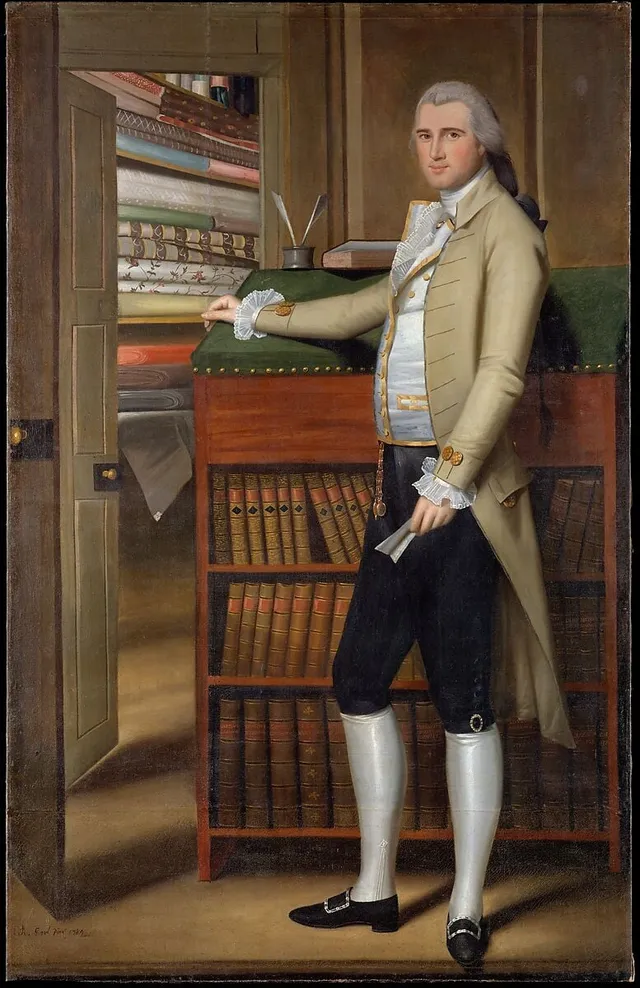
Earl lets Boardman meet the viewer head on. The merchant's gaze is direct and faintly amused, the face of a man who has counted the room and likes the total. His stance is wide and settled, the buckled shoes planted on a floor Earl tilts up just enough to keep both the man and his merchandise in view at once. There is no haze, no borrowed grandeur of sky. The light is the plain daylight of a working shop, and it falls on the cloth as evenly as it falls on the man, which is the whole point: in this room the goods and their owner are lit by the same sun.
Nothing here is accidental. A court portrait hides the source of a sitter's money behind a haze of leisure. Earl puts the source in the frame and labels it. The cloth is not decoration. It is Boardman's stock, the thing he sells, the reason he can afford to be painted at full length at all. The picture argues that in this republic a man's dignity is made rather than given, and that the making is worth showing. The bolts of fabric do the work a coat of arms would do in the older manner. They state who he is and how he rose.
Earl's handling backs the claim. His paint is plainer than the metropolitan ideal, the surfaces crisp rather than dissolved, edges held firm where a fashionable London brush would have blurred them into atmosphere. He draws like a man who trusts the object more than the mood. That literalism, often dismissed as provincial stiffness, is exactly the point. He wants the ledger readable and the cloth countable, and he keeps the light even and frank so that there is little flattering shadow to hide behind. What a softer painter would have called a flaw, Earl treats as the argument.
- Account books and writing desks, standing in for letters of state
- Bolts of imported cloth, doing the work of a coat of arms
- The local New England landscape, replacing the aristocrat's park
- The family itself, composed with dynastic seriousness
Seventeen pictures, seven rooms
The pattern holds across his surviving output. Artifact World Gallery holds seventeen works by Ralph Earl, spread across seven institutions, all from the single hand, clustered between roughly 1783 and 1800, the span of his American maturity after London. That distribution says something the individual labels do not. These are not court commissions gathered under one palace roof. They are scattered the way their sitters were scattered, through New England towns and the museums that later collected from them, a portrait economy assembled one merchant parlor at a time. The grand manner in Europe pooled around centers of power. Earl's version followed the road, because he followed the road himself.
Set those seventeen canvases beside the European pattern and the contrast becomes the whole argument in miniature. The grand-manner portrait in London or Paris was a court product, painted near the throne and hung where power gathered. Our seven rooms hold a different kind of record: a museum in New York, a national collection in Washington, and the rest dispersed through the institutions that inherited New England's merchant estates. The works did not survive because a dynasty protected them. They survived one parlor, one bequest, one town at a time, which is exactly how their sitters built the fortunes the pictures set out to record.
He was, in the Met's plain word, itinerant. He traveled for commissions, painting one family in one town and moving on to the next, carrying the London format in his head and fitting it to whatever room and whatever fortune he found. That mobility is itself part of the argument. The court painter waited for the world to come to him in the capital. Earl went to the world, and the world he found was built out of shopkeepers, officers, and their wives.
A republic of families
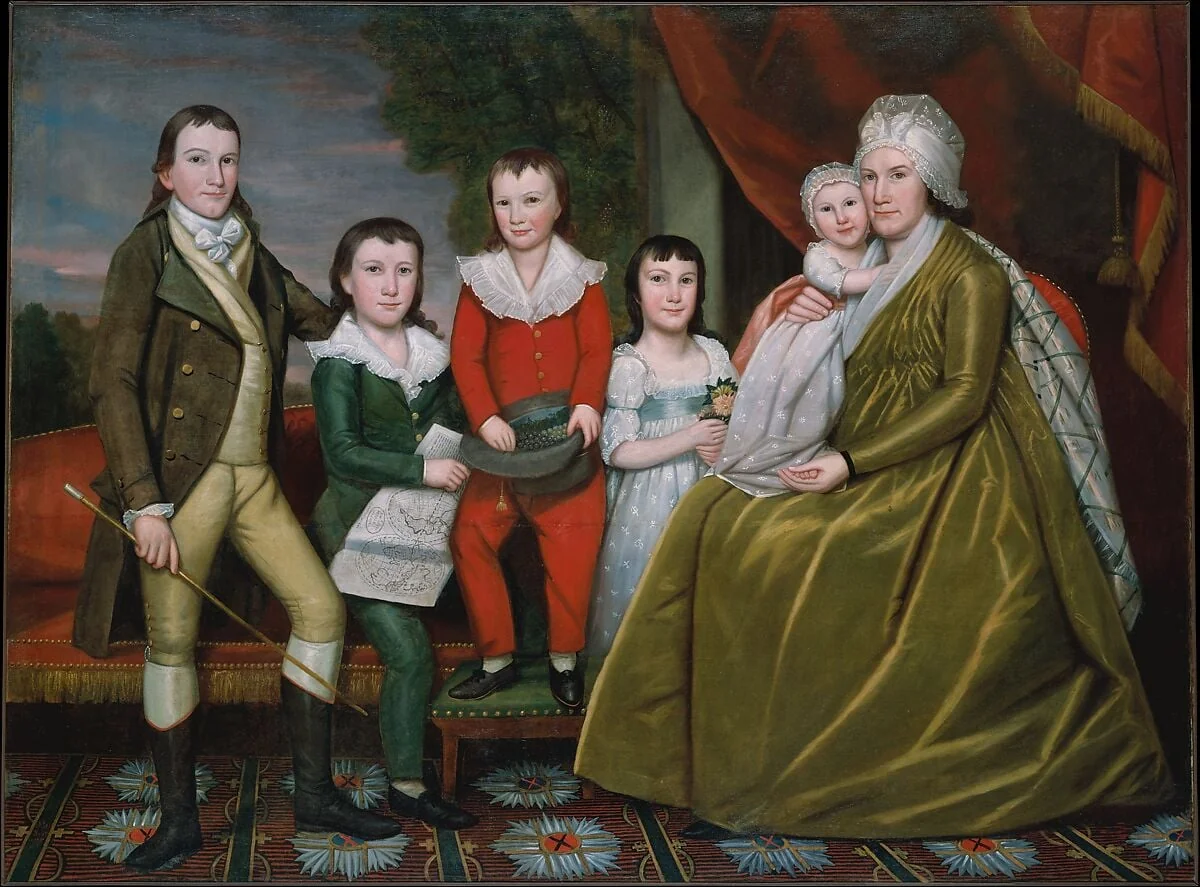
His ambition peaked in a group portrait. In 1798, traveling through New England, Earl painted in Vermont Mrs. Noah Smith and Her Children, which the Metropolitan calls the most ambitious work of his career. It is large and full of life. Mrs. Smith sits at the center in a pale satin gown that Earl renders with obvious relish, the cloth catching light along every fold, her children gathered close, the youngest held near her lap. Earl arranges the children in a descending rhythm around her, each one turned slightly toward the mother so the group reads as a single body with one center of gravity. Behind the family a curtain pulls back to disclose a landscape, the New England view standing in for the country estate that an English portrait of this scale would have given a peer.
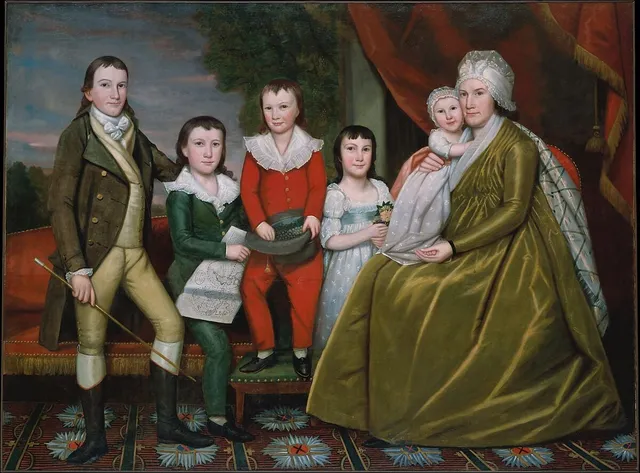
The format has a name. The informal group portrait of a family at ease in a domestic or garden setting was an eighteenth-century English fashion known as the conversation piece, usually small in scale and meant to show people relaxed among their own. Earl takes that intimate type and inflates it to the dimensions of state portraiture. He treats a Vermont merchant's family with the compositional seriousness a London painter reserved for the aristocracy. The mother is enthroned by paint. The children are arranged with the care of a dynastic group. You can see the same instinct in his Lady Williams and Child, where mother and child are given the gravity of a monument. The claim is the one running through the Boardman portrait, now told through a household instead of a shop: the republic's families deserve the visual language of importance, and Earl will supply it.
The debtor's window
There is an irony at the center of all this painted prosperity, and Earl lived it. In September 1786 he was jailed in New York City for unpaid debts. Even inside the prison he kept working, drawing portraits of his visitors and of members of the Society for the Relief of Distressed Debtors who took up his cause, and he was released in January 1788. The man who painted Connecticut's solvent merchants standing proud in their shops was himself insolvent, sketching his way out of a debtors' cell. He died in Bolton, Connecticut, in 1801, at the age of fifty.
That fact sharpens the work rather than undercutting it. Earl knew precisely what the account books in his portraits meant, because his own had ruined him. The prosperity he painted was not naive. It was the thing he could see clearly and could not hold for himself. His sitters wanted permanence: the ledger balanced, the family secure, the town prospering outside the window. He gave it to them with a conviction sharpened by his own want of it. The pictures are documents of what financial standing looked like to a man who had lost his, and they carry no trace of envy. If anything, the steadiness of the painting reads as respect for a thing he understood from the wrong side of the ledger.
What the argument left
The other faces follow the same logic. In Marinus Willett Earl gives a Revolutionary officer the bearing of command without inventing a battlefield his sitter never won. The posture does the work, the steady look does the rest, and the painter declines the easy theater of smoke and cannon. In Esther Boardman a young woman sits in the open air above a New England valley, her dress crisp against the green distance, the landscape behind her doing the work of a dowry while her composure stays entirely her own. Earl paints her hands and the fall of her skirt with the same even attention he gives the hills, refusing to let the setting upstage the sitter or pretend the country is a borrowed Italian park. It is Connecticut, and she belongs to it.
Daniel Boardman, now in the National Gallery of Art, poses its sitter full length against the same kind of Connecticut country, a young man whose easy confidence the land behind him is meant to explain. Fields and a far roll of hills open behind him, the visible proof of a settled country, and Earl lets the figure stand a little forward of that view, so the man reads first and the land second. The order is deliberate: this is a portrait that means to say the sitter owns his place rather than merely stands in front of it. In each one the setting is local and the standing is earned.
Works discussed in this article
Earl did not work in a vacuum. The painting trade ran in the family, and his brother James Earl worked the same portrait market in his own key. Together they belong to the first set of painters who took the imported English manner and made it answer to American sitters. What Earl settled is a question the next generation would not have to ask. He proved that the grand format could carry a merchant as convincingly as a marquess, that a shopkeeper's counting room could be as dignified a setting as a drawing room, and that an account book in a sitter's hand read as a credential rather than a confession of trade.
His limitation was also his signature. He could not, or would not, dissolve the visible world into flattering air. He counted the bolts of cloth, ruled the ledger lines, and kept the light frank and even across every face. A century of American portraiture would loosen that grip and chase the European softness again. Earl's pictures stay stubbornly legible, and that legibility is the argument he won: in his rooms you can still read exactly what these people owned and meant to keep.
Sources & further reading
- Ralph Earl — Wikipedia
- Ralph Earl, Union List of Artist Names — Getty Research Institute
- Elijah Boardman — The Metropolitan Museum of Art
- Mrs. Noah Smith and Her Children — The Metropolitan Museum of Art
- Conversation piece — Tate
- Daniel Boardman — National Gallery of Art
- The Earle family: Ralph Earle and his descendants — Internet Archive