Piero di Cosimo, the Florentine painter, has spent five centuries trapped inside an anecdote. Giorgio Vasari, writing a generation after the man was dead, fixed him as the studio recluse who feared fire so badly that he refused to cook, surviving instead on hard-boiled eggs he prepared fifty at a time while he boiled glue for his panels. The story is delicious, and it has done real damage. It turned a serious painter into a curiosity, a footnote tucked between his more celebrated contemporaries. My argument runs the other way. Strip away the legend and Piero stands out as the most patient observer of the natural world that Florence produced in his lifetime, a painter who trusted what the eye actually reports over the ideal proportions his peers chased. The eccentric biography has functioned as a kind of frame, and the frame has kept people from looking hard at what is inside it.
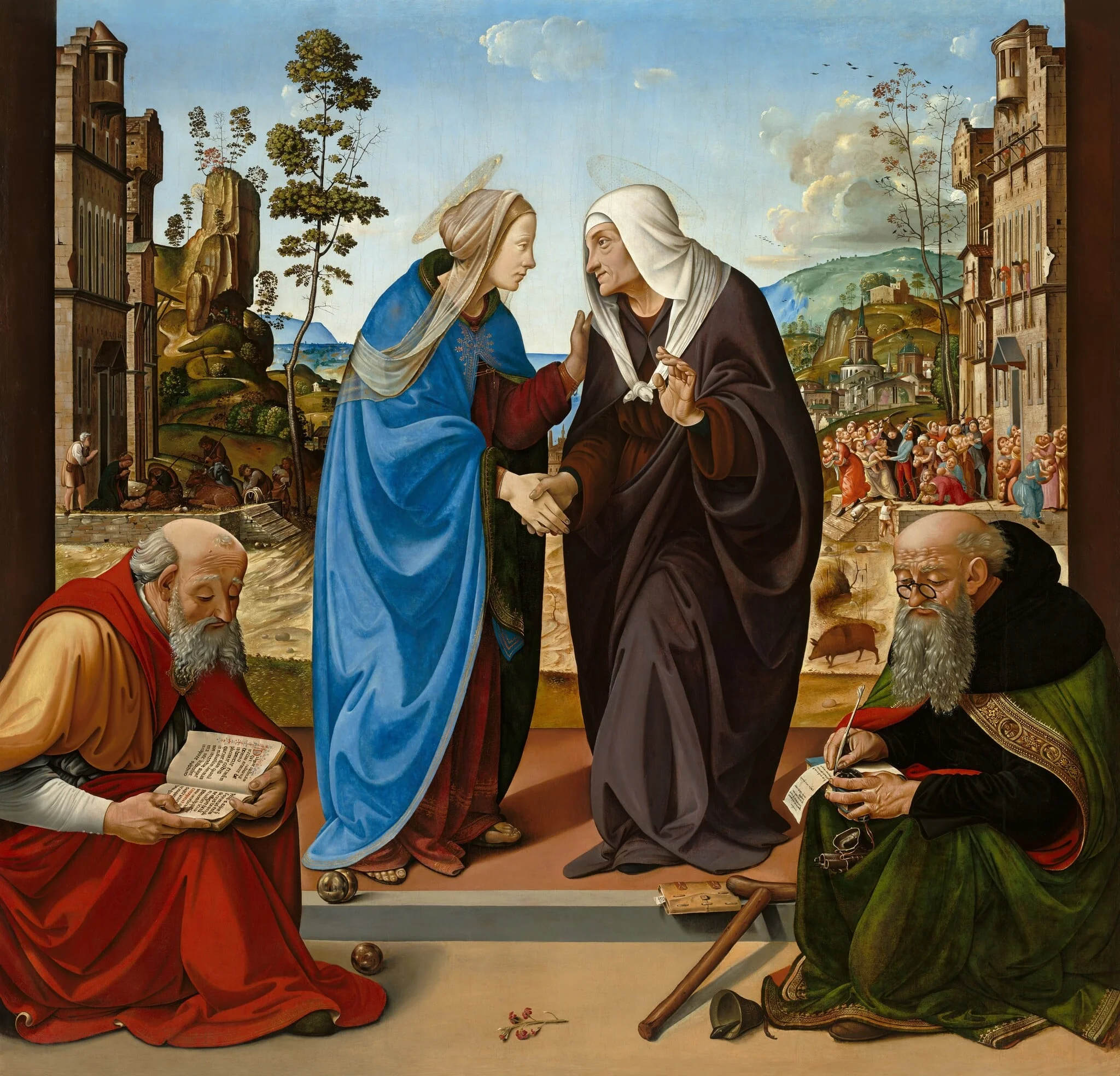
The case is best made not by survey but by looking, and one panel carries the whole method. The Visitation with Saint Nicholas and Saint Anthony Abbot, painted around 1490 and now in Washington, dissolves the supposed eccentric the longer you stand in front of it. What remains is a craftsman assembling a sacred story out of observed particulars: the weight of an old man bent over a book, the cold clarity of distant air, the specific hard gold of a metal sphere. This essay reads Piero through that single work and then tests the reading against the rest of his output, the violent hunts and the comic mythologies, the quiet altar Madonnas. The thread that ties them together is attention, paid more honestly than anyone around him paid it. Once you start counting the things Piero bothered to notice, the recluse of the eggs simply evaporates.
The man behind the eggs
He was born in Florence in 1462 and died there in 1522, most likely of plague, according to the surviving biographical record. The name we use is not quite his own. He was Piero di Lorenzo; the addition of di Cosimo attached itself because he trained in the workshop of Cosimo Rosselli and took the master's first name as his marker. Under Rosselli he was no junior hand. He went to Rome in the early 1480s and worked on the Sistine Chapel wall frescoes, and several modern eyes have picked out passages there, the landscape above all, that read more like the pupil than the teacher. The pupil who could make a stretch of hills breathe was already present in that Roman commission, and the habit never left him. Wherever a contract gave him an inch of open ground, he filled it with weather and distance rather than with the stock architecture his training would have suggested.
Vasari's portrait of the older Piero is the source of nearly everything popular memory keeps. The fear of fire, the refusal to prune his garden, the fifty eggs boiled alongside the glue, the rage at crying children and coughing men. Read as biography it is unreliable, set down decades later by a man with a taste for the picturesque. Read as criticism it is revealing in a different way. Vasari could not file Piero under any of his tidy categories of artistic progress, so he filed him under temperament instead. The wildness he reported was, I suspect, the wildness of a painter who would not smooth nature down into a formula, and who therefore looked, to a theorist of ideal beauty, like a man slightly out of his mind. A painter who counts bristles and tracks the exact colour of failing light is not mad. He is simply working from a different premise about what a picture is for.
Close-looking: the Visitation
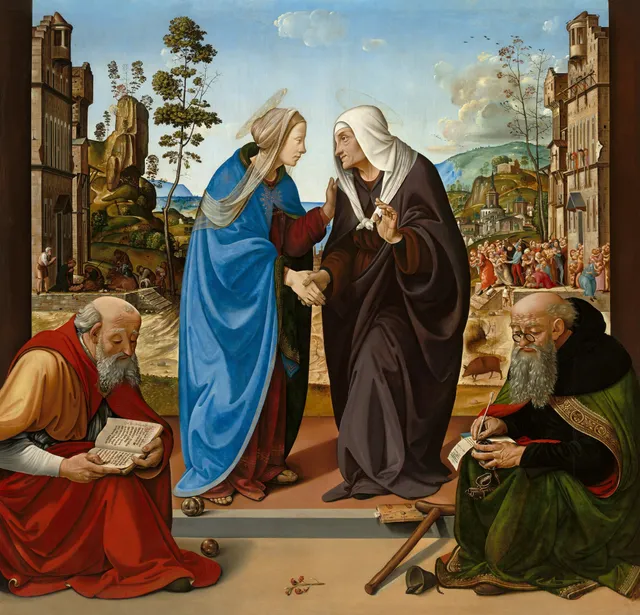
Stand in front of the Visitation and the eye finds two women meeting at the center of the panel. Mary, younger, leans in; Elizabeth, older and stooped, reaches toward her, and their hands and gazes lock in the instant of recognition the Gospel describes. Piero gives the meeting almost no theatrical flourish. The drama lives in the bend of Elizabeth's spine and in the gentleness with which the two faces approach. Behind and around them the panel opens into air rather than architecture, and that single choice tells you where his interest lay. A more conventional painter would have built a portico to frame the holy women. Piero gives them sky.
To either side sit the two title saints, and they do something quietly strange. Neither looks at the miracle beside him. Saint Nicholas, on the left, is sunk into a book, three gold spheres set on the ground near him, the metal catching light with a hardness that the flesh tones never have. Saint Anthony Abbot, on the right, reads as well, his tau staff and bell beside him, his pig settled at his feet with the dumb patience of an animal painted from life. Piero has staged a meeting of the holy and then ringed it with figures absorbed in private reading, as though devotion were an interior, almost scholarly act rather than a public event. The composition argues a position: faith is something you sink into alone. Look at how the four bodies are spaced and you see a painter who refuses to crowd them into a single rhetorical gesture. Each is given room to be its own self-contained study.
The landscape is where the panel declares itself outright. The ground falls away behind the figures into a luminous distance of pale hills and thin water, the light cool and even, closer to the Netherlandish painting Florentine collectors prized than to the warm Tuscan formula. Two tiny narrative scenes sit in that depth, the Nativity and the slaughter of the Innocents, painted at a scale that forces you to lean toward the glass. Piero learned the trick of folding whole stories into the far ground from imported panels, and he uses it not for ornament but for time. The foreground holds one charged moment; the distance holds the future that moment sets in motion. The eye that rendered those far hills is the same eye that counted the bristles on Anthony's pig, and refusing to separate the two scales is the whole of his originality. He treats a creased forehead and a band of distant haze with the same seriousness, and the panel is held together by that even pressure of looking.
The naturalist among the myths
Turn to A Hunting Scene and the same eye is at work on far stranger material. The panel at the Metropolitan Museum of Art shows the world before civilization, men and satyrs clubbing animals in a forest that is burning at its edge. It belongs to a series on the early life of humankind, most likely made for the wainscoting of a Florentine palace. The violence is frank. A bear rears, a lion twists, a man swings a heavy branch, and the bodies tangle without the balletic spacing a more classicizing painter would impose. Piero is reconstructing prehistory the way a naturalist might, asking what it actually looked like when people lived as animals among animals, and answering with smoke, muscle, and panic. The fire at the treeline is not decoration. It is the engine of the story, the force that drives every beast in the picture toward the figures who will learn to master it.
That documentary impulse runs through all his mythologies. The Discovery of Honey by Bacchus, held by the Worcester Art Museum, according to the J. Paul Getty Museum, turns a comic origin myth into a crowded field study of revelers banging pans to settle a swarm of bees. The gag is genuine, the laughter built into the jostling crowd, but so is the entomology: Piero has actually watched how a swarm behaves and where it will settle. His Allegory works the opposite register, compressing a riddle into a single mounted figure and a still, watchful animal. Across these panels the constant is a curiosity about the non-human: the way fur sits over muscle, the way a creature holds its head when it is alert. He paints beasts the way other men painted saints, with reverence for the particular, and he never lets the joke or the riddle flatten the animal into a symbol.
Seen together rather than as scattered oddities, these panels reveal a painter returning again and again to the threshold between the human and the wild. Artifact World Gallery holds twenty-two works under his name, drawn from fourteen separate institutions and ranging across roughly 1490 to 1520, which is a wide spread for an artist whose surviving output is modest and frequently disputed. Set that against the largest gathering scholars have ever managed: the 2015 National Gallery of Art retrospective, the first monographic show of Piero mounted in the United States, reunited forty-four of his paintings. To hold roughly half that count across our own archive is a reminder of how thinly the corpus is spread, and how much of the looking still has to be done one panel at a time, in one collection after another, with no single room ever holding the whole man.
The devotional panels
The altarpieces and devotional panels are where critics have most often underrated him, treating them as the conventional bread-and-butter that funded the eccentric mythologies. Look closely and the same temperament surfaces. In the Nativity with the Infant Saint John, the kneeling figures gather around the child with a tenderness that never tips into sweetness, and the landscape behind keeps that cool, particular light. The Young Saint John the Baptist gives the boy a gravity well beyond his years, the face built in soft transitions of shadow that show how much Piero had absorbed of the new modeling without surrendering his own clean edges. The hands and the wrapped fur are observed, not generalized. He has looked at how a child's wrist actually folds, and he paints that, not a formula for a wrist.
The Virgin and Child with the Young Saint John the Baptist, Saint Cecilia, and Angels is more ambitious still, a grouping that balances the calm geometry of the new century against Piero's stubborn love of incident. The angels are individuated, not interchangeable; Cecilia's presence pulls music into the scene without a single instrument needing to sound. The composition arranges itself with the quiet symmetry his younger contemporaries were perfecting, yet every face inside it keeps its own pulse. These are not the works of a man who could only paint monsters and burning forests. They are the works of a man who painted everything in front of him with the same unblinking attention, and who saw no reason to make a saint's face less specific than a satyr's.
Works discussed in this article
Between two centuries
The first scholar to take Piero seriously at book length was the German art historian Fritz Knapp, whose 1899 monograph framed him precisely as a master of transition between the Florentine Quattrocento and the Cinquecento, a study you can still read on the Internet Archive. The label fits. Piero was trained in fifteenth-century workshop habits and lived long enough to watch a younger generation remake what a painting could be. He took in the new mood, the softer modeling and the calmer arrangement of bodies, without letting it erase the sharp particularity that was his signature. He is the rare painter who modernized without converting, keeping the inquisitive Quattrocento eye while the air around him turned toward grander, smoother ideals.
Set him beside the painters who came just after and the distance reads clearly. Fra Bartolomeo pursued a grave, balanced monumentality; Andrea del Sarto brought an almost faultless tonal harmony to the Florentine altarpiece; Pontormo, youngest of them, would soon stretch color and pose into the nervous energy later called Mannerism. Piero shares their century but not their program. Where they idealized, he observed. His teacher Cosimo Rosselli handed him the grammar of the Quattrocento workshop, and what Piero added to it was an appetite for the specific that none of his colleagues quite matched. The younger men resolved a face into a type. Piero kept the face.
His portraits make the rehabilitation easier. The pendant double portrait of the architect Giuliano da Sangallo and his musician father Francesco Giamberti, made in the early 1480s and now in the Rijksmuseum, sets a quill and a compass against a sheet of musical notation, two trades recorded with the dry precision of a man who liked to get the tools right. That same honesty, turned on faces, makes his sitters feel met rather than flattered. They carry the particular weather of a real person, the lines and the set of the jaw that no formula would invent. When the 2015 reassembly in Washington let viewers test the whole arc at once, from the prehistoric hunts to these sober portraits, the verdict was a quiet upward revision of a reputation Vasari had pinned in place.
The next time the legend of the fifty eggs comes up, set it aside and find a Piero panel instead. Put your face close to the glass. Look at how the light dies in the far hills, how an animal waits at a saint's feet without a hint of allegorical stiffness, how a story you thought you knew has been rebuilt out of things the painter plainly went and observed. The eccentric was never the point. The looking was, and it still rewards anyone willing to do the same in front of the work.
Sources & further reading
- Piero di Cosimo — Wikipedia
- A Hunting Scene (object 437283) — The Metropolitan Museum of Art
- The Discovery of Honey by Bacchus — The J. Paul Getty Museum
- Piero di Cosimo: The Poetry of Painting in Renaissance Florence (2015) — National Gallery of Art
- Piero di Cosimo: ein Übergangsmeister vom Florentiner Quattrocento zum Cinquecento — Fritz Knapp (1899), Internet Archive