The works gathered under architectural painting all answer one awkward question. A building is a heavy thing that stands in real space and refuses to move. A painting is a thin sheet with no depth at all. How do you carry the first onto the second without lying about it, and once you accept that some lie is unavoidable, which lie do you choose? Every picture in this corner of the collection is a decision about that. The cathedral that bends toward the light, the drawer that pretends to be a real drawer, the Roman wall that opens onto a city no one ever walked through: each one is a different verdict on the same problem.
My claim is plain. Architectural painting is not a quiet annex of landscape but the room where painters argued, in paint, about what a flat surface is allowed to do. The genre keeps asking the same question and keeps coming back with incompatible answers: record the building, measure it, invent it, expand the room with it, deny it, or let it dissolve. Artifact World Gallery holds 2,309 architectural works, made by 1,048 hands across 63 venues, the earliest dated near 1210 and the latest from 2023. Eight centuries, and the argument never settles. That refusal to settle is the genre's actual subject, and it is why a wall fresco from a buried Roman villa and a banknote-strewn drawer by an American card sharp belong on the same shelf.
A question the academies tried to rank
When the seventeenth-century academies sorted painting into a hierarchy, they named five kinds: history, portrait, landscape, genre scenes of everyday life, and still life, in descending order of seriousness, as the Tate glossary still records the scheme. Buildings had no rank of their own. A painted street or church interior was filed under landscape, which sat near the bottom, above only still life. The ranking was a snobbery about subject, not about skill, and it got the difficulty exactly backward. Of all the genres, architecture was the one you could not fake. A face can be flattered, a tree can be approximate, but a colonnade with one column out of true announces the error to anyone who has stood in a real room.
The machinery for getting it right had a name and a literature. Leonardo's notebooks, gathered into the treatise on painting, open a whole section on linear perspective, the construction of vanishing points and receding lines that lets a painter build a believable floor under a believable wall. This was the engineering behind the art. A vedutista setting up a square, or a Dutch painter laying out a nave, began with geometry before pigment, plotting where the orthogonals would meet so the stone would seem to stand. The question of how to put a building on a flat sheet was, first, a question of arithmetic. What makes the genre interesting is everything painters did once they had the arithmetic and decided whether to obey it.
Answer one: record it
The most literal answer is the view, the veduta, defined as a highly detailed and usually large-scale picture of a cityscape or vista, a form that began in Flanders with painters such as Paul Bril in the sixteenth century before Venice became the home of the vedutisti by the middle of the eighteenth, according to the survey of the veduta. The promise of the view is fidelity: this is the place, this is where the light fell, this is the cornice you would touch if you were there. Giovanni Paolo Panini, the great Roman view-painter, drew the line between two kinds of work in his own studio, what the National Gallery of Art describes as accurate views of actual places set against imaginary combinations of particular buildings. The recording instinct and the inventing instinct lived in the same hand.
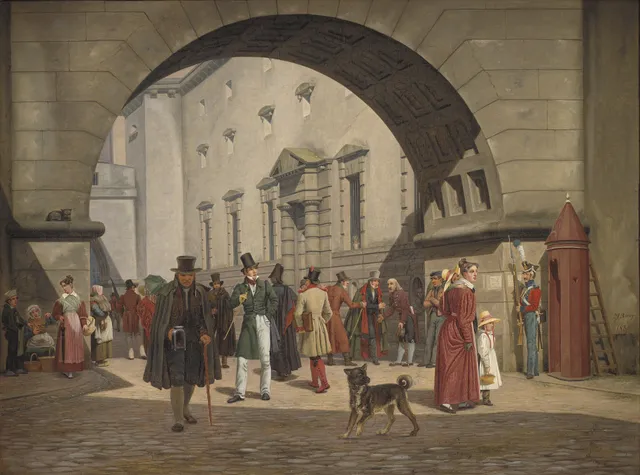
The recording instinct travelled north and turned sober. In Copenhagen, Christoffer Wilhelm Eckersberg, who is represented here by eighteen works, drilled perspective into a generation of Danish students until the discipline became a habit of seeing. His pupil Martinus Rørbye carried that training into the streets. Look at The Prison of Copenhagen. Rørbye sets the long masonry front close to frontal, so the wall fills the picture and the rhythm of windows and stone courses does the work that drama usually does elsewhere. A few figures cluster at the base, small enough to measure the building against, and the northern light rakes the masonry sideways, catching every joint and sill. There is no story being told. The painting is content to be a faithful report on a particular building under a particular sky, and its restraint is the argument: record the thing well and the thing is enough.
Answer two: measure it
Recording shades into something more rigorous when the painter stops at the door of a building and decides to make its portrait. The Dutch master Pieter Saenredam is the pivot. Before him, as the Rijksmuseum puts it, painters mostly invented fantasy churches; Saenredam always relied on existing buildings, studied on the spot, drawn on site, and only then reworked in the studio. He stood inside real Dutch churches with a measuring eye, scaled the whitewashed piers, and let the architecture itself be the whole event. The Met preserves one of his ground plans of the church of Saint John in 's-Hertogenbosch, a working drawing in which the building is reduced to measured line before any paint touches it. This is the genre at its most exacting: architecture treated as a sitter who must be likened exactly, with light and dust as the only incident allowed.
The measured answer has a cost. Drain a picture of figures and anecdote and you are betting everything on proportion and tone. A Saenredam interior succeeds or fails on whether a far pier reads as far, whether the vault carries its own weight in your eye. When it works, the emptiness becomes the content. You feel the cool air of a real building rather than a painter's idea of one. The measured church is the opposite of theatre, and that is its discipline.
Answer three: invent it
Against the measured church stands its mirror image, the capriccio, the architectural fantasy that places buildings, archaeological ruins, and other elements together in fictional and often fantastical combinations. Here the painter keeps the geometry of perspective and throws away the obligation to truth. Antonio Canaletto, better known for his exact Venetian views, also made these inventions; the Cleveland Museum of Art's drawing of a palace with a courtyard by the lagoon is catalogued as a capriccio, an artistic fantasy of architecture and landscape. Panini's imaginary views did the same on canvas, assembling monuments that never shared a horizon. The capriccio is a confession in plain sight. It says the building in a painting was always a construction, so why not build one that pleases the eye more than any real street could. Saenredam asks the wall to be true. The capriccio asks it only to be convincing.
The Flemish habit of stuffing a panel with invented grandeur ran deep. Jan Brueghel the elder, who appears once in this collection, built palatial settings as stages for allegory, piling up porticoes and vistas that exist only to frame an idea. The lesson the capriccio teaches the rest of the genre is that the line between recording and inventing is thinner than the academies pretended. Every view selects, crops, and idealises. The fantasy simply admits what the honest view tries to hide.
Answer four: expand the room
The oldest answer in the collection is also the boldest, and it predates the codified geometry by fifteen centuries. The wall painting from Room L of the Villa of P. Fannius Synistor at Boscoreale was made to fool a real wall into disappearing. The Roman painter covered the plaster with a fictive colonnade: slender painted columns carry a painted entablature, and between them the surface opens onto receding porticoes and a small round temple set deep in an impossible distance. Masks and garlands hang at the edges of the illusion. The whole device exists to make a cramped room in a country house feel like a terrace looking out over an architecture grander than anything the owner owned. The Romans had no fully systematic linear perspective, so the lines do not all converge on a single point, and the deep view shimmers slightly out of true. That near-miss is the charm. You watch a culture reaching for depth by instinct, building a city on a wall to push the wall back.
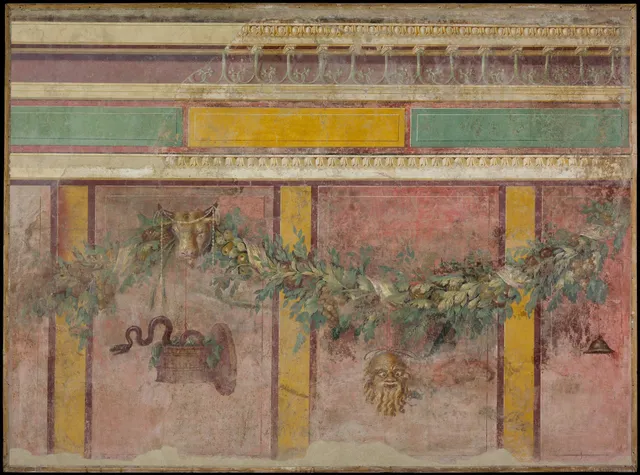
Set the Boscoreale wall beside Saenredam's church and the genre's range snaps into focus. Both are about architecture and both want depth, but one measures a building that exists and the other paints a building to abolish the building it is painted on. The same craft, perspective, serves two opposite ends: to tell the truth about a place, and to make a place vanish.
Answer five: deny it
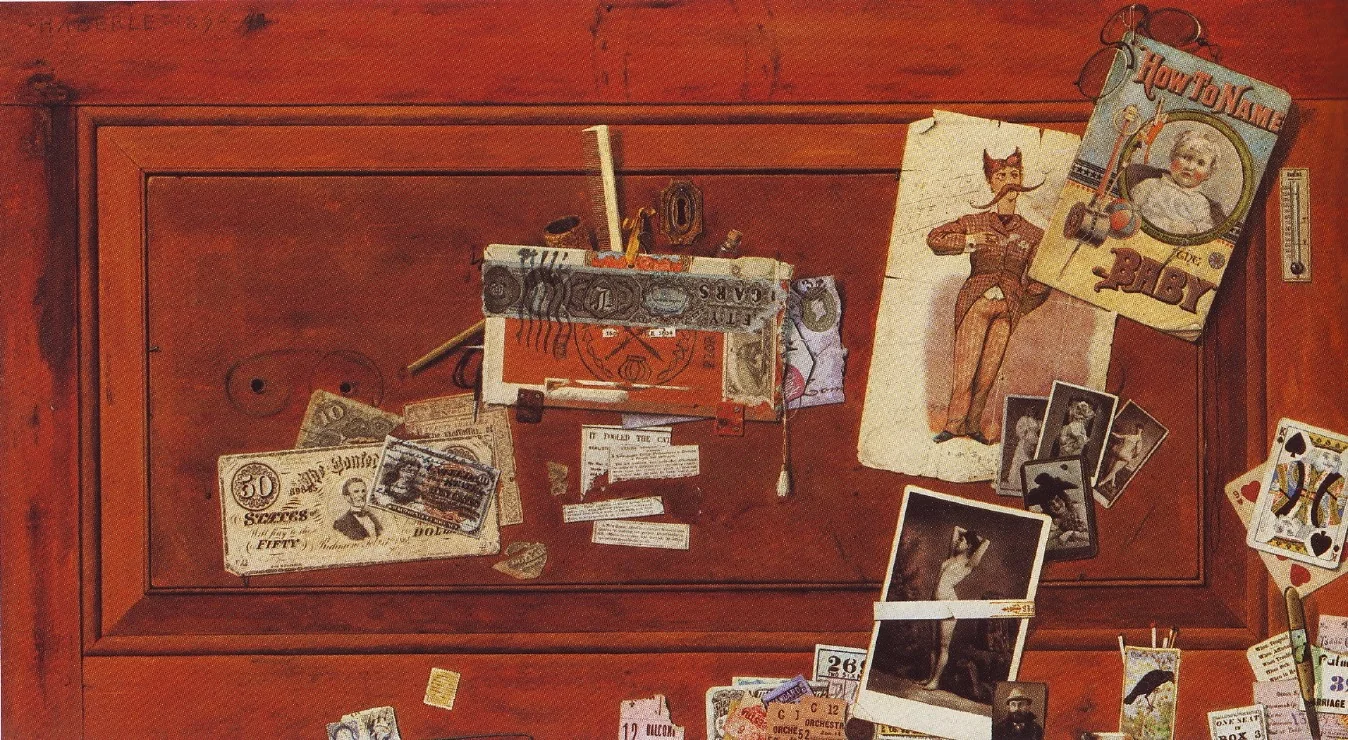
The most cunning answer turns the whole question inside out. Instead of using a flat surface to conjure deep architecture, the trompe-l'oeil painter uses deep skill to insist the surface is exactly as flat and shallow as it really is. John Haberle, an American working at the end of the nineteenth century, is the sharpest practitioner here. His A Bachelor's Drawer is architecture reduced to a single built plane, the front of a wooden drawer, set parallel to the picture surface so that the painting and the object share one shallow depth.
Look at what is on it. Paper currency lies pasted and pinned across the wood, the engraving on each note rendered so closely you lean in to check it. A comb is wedged under a tack. Photographs, ticket stubs, a folded news clipping, spent matches, and playing cards crowd the boards, each casting its own small painted shadow against the grain. Haberle paints the wood, the nail heads, the curling edges of paper, the faint warp where damp has lifted a corner. Nothing recedes. The drama is entirely in the quarter inch between the front of the drawer and the things tacked to it. The joke, and it is a real joke with a grin in it, is that the hardest illusion in painting is not the deepest space but the shallowest. A wall that opens onto a temple is easy to want. A flat board that genuinely looks flat, and yet alive with objects you could pick off it, is harder, and Haberle does it to show he can.
He returns to the same idea in Imitation, a tighter arrangement of banknotes and scraps whose title is the whole argument printed on the wall. The trompe-l'oeil tradition treats the picture surface as a piece of architecture in its own right, a wall or a door, and then refuses to pierce it. After centuries of painters working to make the flat sheet open like a window, Haberle shuts the window and paints the shutter so well you reach for the latch.
Answer six: dissolve it
If Haberle denies depth to flatter the surface, Claude Monet dissolves the building to chase the light. Rouen Cathedral: The Portal (Sunlight) takes the most measurable subject imaginable, a Gothic west front whose every finial a mason could plot, and lets it half-melt. The stone becomes a crust of dragged and stippled pigment, ochre and rose and chalky blue, thick enough that the paint surface stands in for the carved one. The great portal reads less as an arch than as a pocket of shadow eaten at its edges by sun. Monet has stopped measuring the cathedral and started measuring the hour. The building is no longer a fact to be reported. It is a screen the light plays across, and the subject of the painting is the playing, not the stone.
This is the genre arriving at its own dissolution and refusing to apologise. Eight centuries after a Roman painter built a fictive temple to deepen a wall, and three after Saenredam measured his piers, Monet treats architecture as weather. The portal at the right hour goes the colour of a struck match. The same Gothic front, painted again at dusk or in fog, would be a different painting entirely, because the building was never really the point. The light was.
A different question entirely
Every answer so far assumes a European premise: that depth means convergence, that the way to honour a room is to make parallel lines meet at a vanishing point. The collection holds a tradition that never accepted the premise. Tosa Mitsunori, working in the Japanese yamato-e manner, painted interiors in the albums of scenes from The Tale of Genji using conventions that solve the flat-surface problem by other means. Roofs are simply lifted off, the blown-off-roof device that lets us look down into a palace as though the ceiling had been removed. Floors and screens recede along steady diagonals that never converge, a parallel oblique that keeps the far edge of a mat the same width as the near one. There is no single vanishing point because the painting does not want one. Space is built from stacked planes and tilted grounds, and the eye reads rank, season, and intimacy from how the architecture frames each figure.
Place the Genji album next to Monet's cathedral and the genre's one question turns out to have been two questions all along. The European tradition asks how to make a flat surface behave like a window onto deep space. The yamato-e painter asks how to arrange a building on the surface so a viewer understands the human drama inside it, and decides that converging lines would only get in the way. Neither is wrong. They are answering different needs with the same raw material, walls and roofs and floors laid onto a flat ground.
Why the argument matters
Stack these answers and a pattern surfaces. The view records, the measured church verifies, the capriccio invents, the Roman wall expands, the trompe-l'oeil denies, the cathedral dissolves, and the Genji album sidesteps the whole geometry. They cannot all be right, because they want incompatible things from the same square of flat surface. That is exactly why the genre repays close looking. A landscape can drift into mood and a portrait into flattery, but a building forces the painter to take a position on the most basic fact of the medium, that it is flat and pretending not to be. Every architectural painting is caught in the act of choosing how to pretend.
This is also where the genre earns its keep against its low academic rank. Filed under landscape, near the bottom, architecture was in fact the discipline that taught painting how to construct space at all. The perspective box that holds a Saenredam nave is the same box that holds a history painting's grand hall. Painters learned the rules on buildings because buildings punished error, then carried the skill into every more prestigious genre above. The annex turns out to have been the workshop.
Works discussed in this article
Walk the collection in order of these answers and you watch a single problem refuse to die. The Roman painter builds a temple on plaster to make a small room large. Saenredam measures a real nave until it needs no story. Canaletto invents a palace that pleases the eye more than any quay could. Haberle nails a comb to a painted board and dares you to lift it. Monet lets a thousand-year cathedral go soft as butter in the eight o'clock sun. None of them solved the question, because the question has no solution, only choices. The next architectural painting you stand in front of is making one too. Find the wall in it, then watch what the painter decided to do with the fact that the wall is flat.
Sources & further reading
- Genre painting and the hierarchy of genres — Tate
- Veduta — Wikipedia
- Giovanni Paolo Panini — National Gallery of Art
- Pieter Saenredam and the painting of real buildings — Rijksmuseum
- Capriccio (art) — Wikipedia
- Capriccio: A Palace with a Courtyard by the Lagoon — Internet Archive (Cleveland Museum of Art)
- Leonardo da Vinci, A Treatise on Painting (section on Linear Perspective) — Internet Archive
- Pieter Jansz. Saenredam, Groundplan of the Church of Saint John in 's-Hertogenbosch — The Metropolitan Museum of Art