Artwork
Imitation
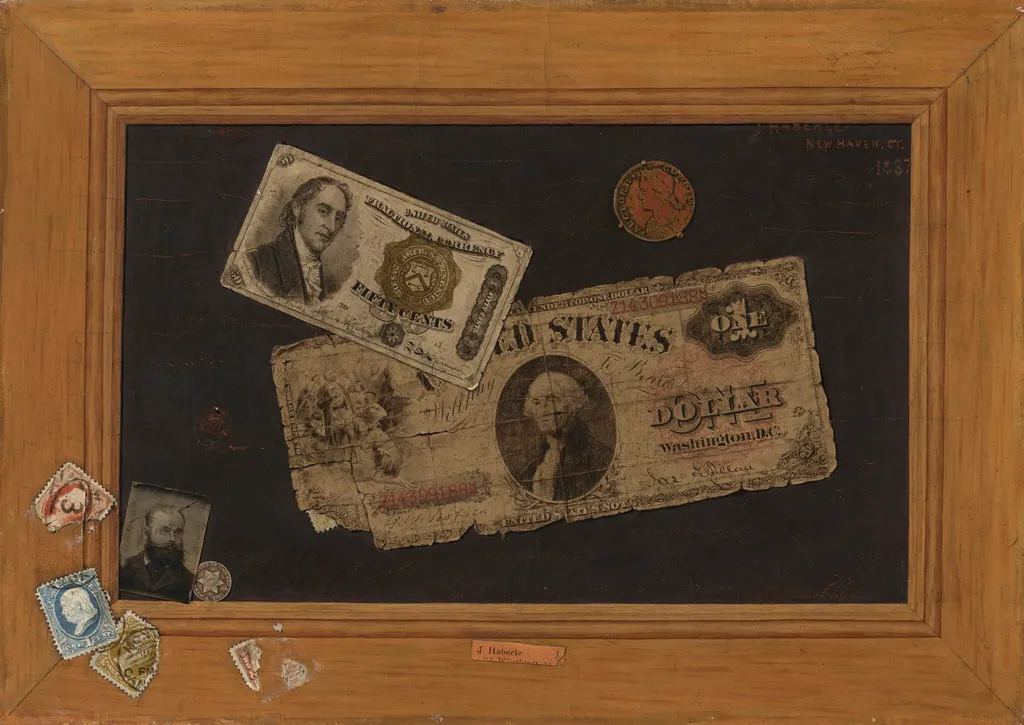
Imitation is an oil painting by the American Impressionist artist John Haberle. It dates from 1887 and is held in the collection of the National Gallery of Art.
- Inscription
- Inscribed:upper right: J. HABERLE / NEW HAVEN, CT. / 1887; lower center: J Haberle
About this work
A small tintype of the artist tucked into the painted frame underscores the joke: this is art passing as legal tender.
In 1887, John Haberle submitted his first currency painting to the National Academy of Design in New York, well aware that fellow artist William Harnett had been arrested the year before for depicting paper money too convincingly. The work, titled "Imitation," fooled viewers with microscopic brushstrokes rendering worn bills and stamps so precisely that Harnett himself declared he had never seen such reproduction anywhere. A small tintype of the artist tucked into the painted frame underscores the joke: this is art passing as legal tender.
Subject & Meaning
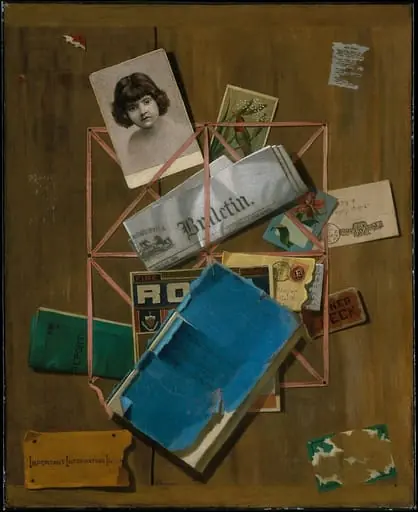
The painting depicts a group of objects arranged to mimic a casual desktop scatter: a United States one-dollar bill, fractional currency, a coin, a postage stamp, a small photograph, and a picture frame. Executed in the trompe-l'œil (fool-the-eye) tradition, the still life creates an illusion of three-dimensional reality, blurring the boundary between painted surface and actual objects. The title "Imitation" explicitly signals the work's central theme, the act of copying and the deceptive power of pictorial representation.
By rendering ostensibly valuable items (currency, stamps) in hyper-realistic detail, Haberle questions notions of authenticity, worth, and the authority of the original. The inclusion of a photograph further layers the commentary on mechanical versus handcrafted reproduction.
Technique & Style
Executed in oil on canvas, Imitation exemplifies Haberle’s mastery of trompe-l’œil still life. The medium allows for precise, illusionistic rendering, while the support provides a stable ground for the meticulous handling required to simulate the texture of paper currency, postage stamps, and a photograph. Haberle’s technique relies on fine brushwork and careful modulation of light and shadow to create convincing depth and surface qualities.
The composition, a tightly cropped arrangement of a one-dollar bill, fractional notes, a coin, and stamps, exhibits a formal order typical of American trompe-l’œil. The painting’s small scale (25.4 × 35.6 cm) enhances the intimate, deceptive effect, underscoring the artist’s skill in mimicking printed materials and metallic sheen. No significant condition issues are noted in the sources.
History & Provenance
John Haberle painted Imitation in 1887, and it was first exhibited that year at the National Academy of Design, where Thomas B. Clarke of New York purchased it directly. Clarke included the painting in his celebrated collection until its sale in February 1899 at Chickering Hall and American Art Galleries, New York. H. Staples Potter of Boston acquired the still life at that auction.
The work subsequently passed by inheritance to Potter’s niece, Sibyl McKenzie Snyder of Kansas City, Missouri, and then to her son, Kenneth W. Snyder. Later it descended to Mr. and Mrs. Peter L. Chapman. After a sale at Sotheby’s, New York, on 28 May 1987, the painting was handled by Berry-Hill Galleries, Inc., before being purchased by the National Gallery of Art on 30 October 1998.
The painting is held at the National Gallery of Art in Washington, D.C., having been acquired in 1998. Its first recorded exhibition was at the National Academy of Design in 1887, where it was purchased by Thomas B. Clarke. No further exhibition history is documented in the provided sources.
Overview
John Haberle created "Imitation," an oil on canvas painting, in 1887 during a period when American trompe l'oeil art was highly developed. This small work, measuring only ten by fourteen inches, immediately captivated viewers with its convincing illusion of currency and other objects. It exemplifies the artist's skill in rendering everyday items with such precision that they appear to be real objects affixed to the canvas, challenging the viewer's perception of reality and artifice.
Context
"Imitation" emerged at a time when the United States Secret Service actively monitored depictions of currency, creating a risky environment for artists exploring this subject. Haberle, who had prior training as an engraver and bookplate designer before studying at the National Academy of Design, was aware of these risks. He submitted the painting for exhibition in 1887, despite the recent arrest of fellow artist William Harnett for his own convincing money paintings, highlighting Haberle's bold artistic stance.
Own this work as a print
Artist & collection
Artist
John Haberle (1856–1933) was an American painter in the trompe-l'œil (literally, "fool the eye") style.

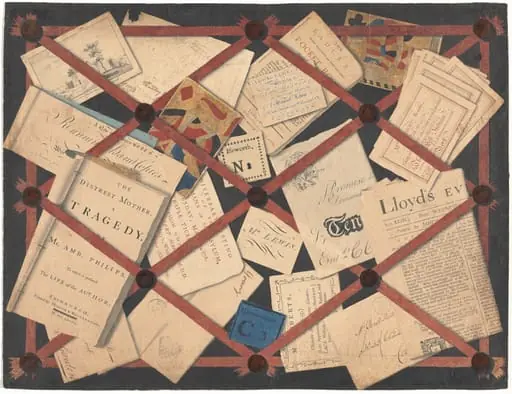
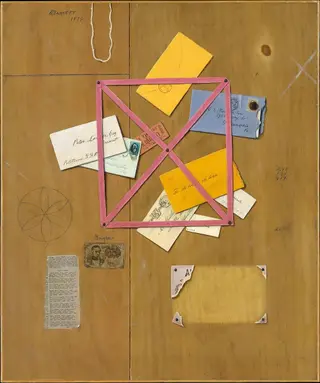
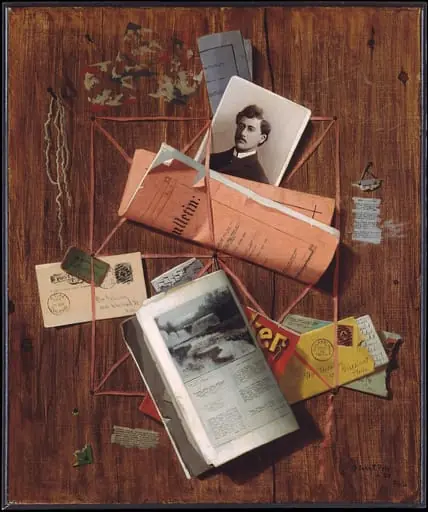
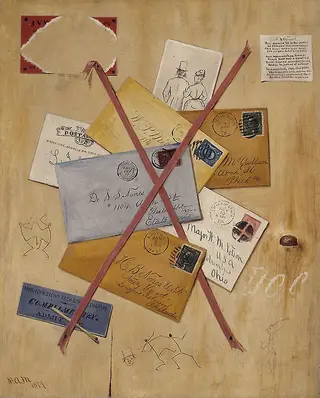
 Compared in the How to Look at a Painting course