Artwork
A Bachelor's Drawer
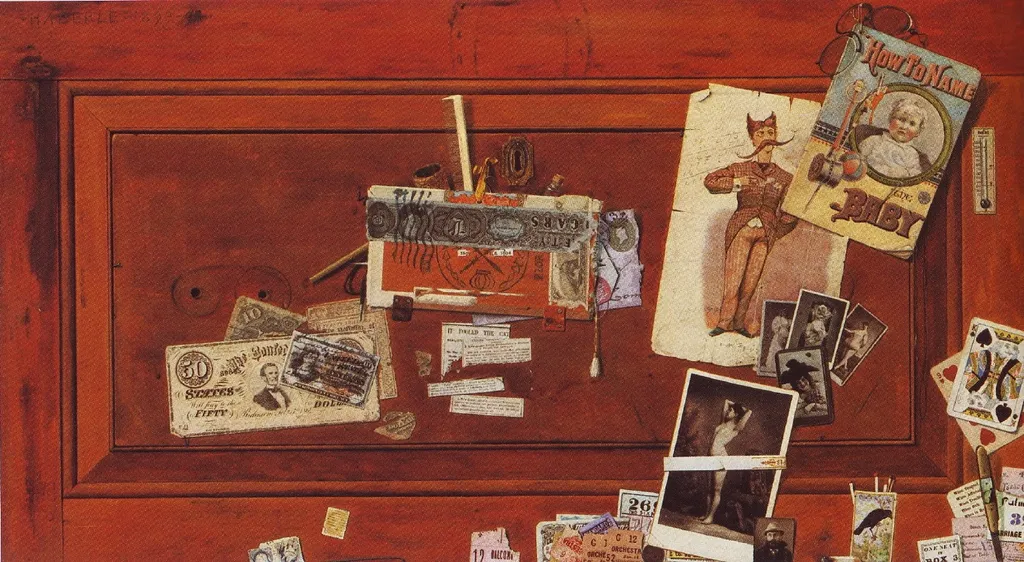
A Bachelor's Drawer is an oil painting by the American Impressionist artist John Haberle. It dates from 1896 and is held in the collection of the Metropolitan Museum of Art.
About this work
Theater stubs, playing cards, and "girlie" photographs spill across a simulated drawer front in John Haberle's trompe-l'oeil still life of 1896. Held at the Metropolitan Museum of Art, it hides a pamphlet titled "How To Name the Baby" and a cartoon of a dyspeptic infant, quiet jokes about a bachelor giving in to marriage. A faux tintype self-portrait at the bottom edge serves as his signature.
Overview
John Haberle's "A Bachelor's Drawer," an oil painting created between 1890 and 1894, stands as a notable example of American trompe-l'oeil still life.
John Haberle's "A Bachelor's Drawer," an oil painting created between 1890 and 1894, stands as a notable example of American trompe-l'oeil still life. Measuring twenty by thirty-six inches, it is among the artist's largest canvases and represents one of his final humorous works in this genre. The painting meticulously portrays a collection of personal effects, rendered with hyperrealistic detail to create an illusion of depth and reality, while subtly incorporating autobiographical elements related to Haberle's personal life.
Subject & Meaning
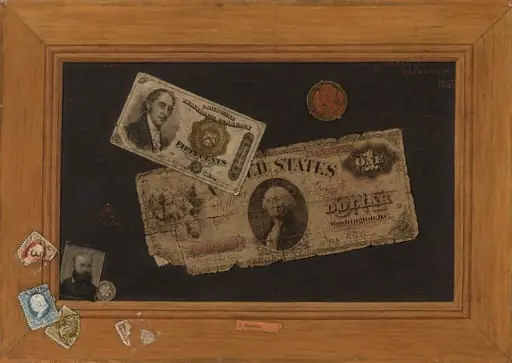
The composition features an array of objects scattered across a simulated drawer front, including fractional currency, postage stamps, theater tickets, playing cards, and various photographs. These items collectively evoke the private world of a single man. However, the inclusion of a pamphlet titled "How To Name the Baby" and a cartoon of a fussy infant humorously signals the end of this independent lifestyle, reflecting Haberle's own transition into marriage and fatherhood during the painting's creation.
Technique & Style
Haberle employed a trompe-l'oeil technique, meticulously rendering each object with microscopic precision to create the illusion that the viewer is observing an open drawer. This hyperrealistic approach, a hallmark of his style, aimed to deceive the eye through its detailed observation and exactitude in depicting textures and forms. The artist's background, including training at the National Academy of Design and work as a preparator, likely contributed to his precise execution.
History & Provenance
John Haberle dedicated four years to "A Bachelor's Drawer," from 1890 to 1894. This period coincided with significant personal milestones, as he courted and married Sarah Emack in 1892, and their daughter Vera was born in 1894, the year the painting was completed. After remaining in Haberle's personal collection for nearly five decades, the artwork was acquired by the Metropolitan Museum of Art in 1970, entering its permanent collection through the Henry R. Luce Fund.
Context
The painting's hyperrealistic depiction of paper currency carried a specific contemporary resonance. Haberle had previously received warnings from the Secret Service regarding his currency paintings, which were deemed to closely resemble actual money and thus skirt counterfeiting laws. In a subtle act of defiance, the artist incorporated a newspaper clipping within the composition that directly references these legal concerns, adding a layer of meta-commentary to his work.
Artist & collection
Artist
John Haberle (1856–1933) was an American painter in the trompe-l'œil (literally, "fool the eye") style.